
Australian Shepherd
Aussie, Little Blue Dog
The Australian Shepherd, or Aussie, is a medium-sized herding dog with a big brain and an even bigger need to work. These are clever, biddable dogs that bond hard to their people and want to be involved in everything you do. Energy levels are high and the breed needs proper daily exercise plus mental work, whether that is a real job on stock, dog sports, or structured training. Bored Aussies invent their own jobs, and that usually means herding the kids, nipping heels, or barking at anything that moves. They suit active owners who train and run their dog often. They are a poor fit for sedentary households, full-time apartment life with no outlet, or owners who want a dog that switches off. The double coat sheds and needs a brush a few times a week, more when it blows out twice a year.
Size
Medium
Lifespan
12-15 years
Group
Group 5 - Working Dogs
Height
Male: 52-58 cm (20-23 inches), Female: 46-53 cm (18-21 inches)
Weight
Male: 25-29 kg (55-64 lbs), Female: 18-25 kg (40-55 lbs)
Origin
United States
Compatibility & care
How this breed fits into life with you
Scores are out of 5. Tap the help icon next to any trait to see what it really means.
Personality
How they think and behave
With family
Who they get along with
Care needs
What they ask of you
Origin & history
Despite the name, the Australian Shepherd was developed in the western United States, mostly through the 1800s and into the early twentieth century. Stockmen on ranches in California and the western states wanted a tough, biddable herding dog, and the breed came together from various collie and shepherd type dogs, including dogs that arrived with Basque shepherds (some by way of Australia, which is likely where the name stuck). The breed earned its keep working cattle and sheep over rough country and long days. It became closely tied to American ranch culture and the rodeo circuit, where Aussies were popular in trick and arena work. Recognition by the major kennel clubs came relatively late, in the second half of the twentieth century. Today the Aussie works as a herding dog and competes at a high level in obedience, agility and herding trials, while also being a common active family dog.
Temperament
Aussies are devoted, sensitive and very switched-on dogs. With their own family they are affectionate and want close involvement, and they generally do well with children they are raised with, though the herding instinct can show up as chasing or nipping at running kids and needs managing early. They are typically reserved or aloof with strangers rather than outgoing, and good early socialisation keeps that from tipping into shyness or suspicion. With other dogs and pets they are usually fine when raised together, but the strong chase drive means cats and small animals need care. Trainability is excellent; these are some of the most responsive dogs around and they love learning, which also means they pick up bad habits just as fast. They are alert watchdogs that bark to announce things. The core need is a job and a partnership; without consistent training, exercise and a role, an Aussie becomes anxious, noisy and destructive.
Appearance
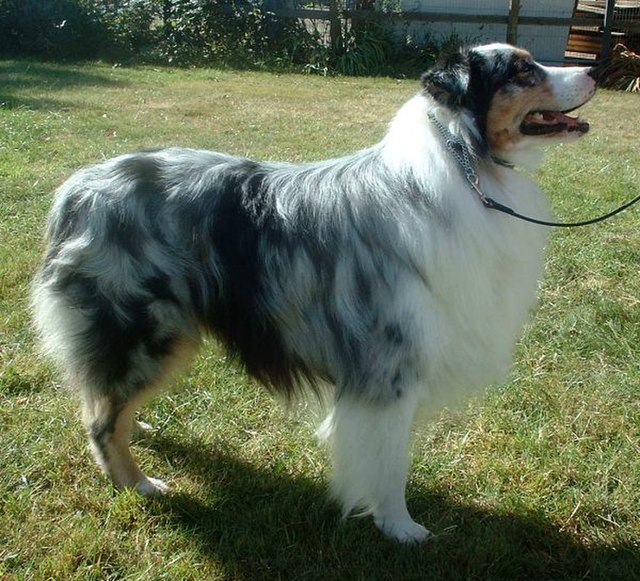
A medium-sized, athletic dog with a slightly longer than tall outline and a balanced, muscular build. Males stand roughly 51 to 58 cm at the shoulder and females about 46 to 53 cm, with weight usually in the 18 to 32 kg range. The coat is a medium-length double coat, straight to wavy, with feathering on the legs and a fuller mane. Four colours are standard: black, red (liver), blue merle and red merle, all with or without white and tan (copper) markings. Eyes can be brown, amber, blue, or any mix, and split or marbled eyes are common. The tail is naturally short in some dogs and was traditionally docked, though docking is restricted or banned in much of Australia.
Suitability
This is a house-and-yard dog for an active, hands-on owner, ideally someone who trains, walks and engages the dog every day or competes in a dog sport. They can cope with smaller homes if the exercise and mental work are genuinely there, but a quiet flat with a busy absent owner is the wrong home. Aussies are not an easy first dog; their drive, sensitivity and brains overwhelm many novices, though a committed first-timer who does the homework can manage one. They do not love being left alone for long stretches and can become destructive or vocal when under-stimulated. In the Australian climate the dense coat means they feel the heat, so exercise in the cool of the morning or evening through summer and always provide shade and water.
Health
Most Australian Shepherds live around 12 to 15 years. The breed has several well-documented predispositions. Hip and elbow dysplasia occur, so breeding dogs should be hip and elbow scored. Eye disease is a real concern, including collie eye anomaly, progressive retinal atrophy and cataracts, and a reputable breeder will have annual eye exams and relevant DNA tests done. The breed also carries the MDR1 (multidrug sensitivity) gene mutation at high frequency, which causes dangerous reactions to several common drugs, so DNA testing for MDR1 matters and the result should be shared with your vet. Merle to merle breeding produces double merle pups with a high risk of deafness and blindness and should never be done. Epilepsy is also seen in some lines. Buy from a breeder who hip and elbow scores, eye tests, and DNA tests for MDR1 and the eye conditions relevant to the breed.
Find your Australian Shepherd
Browse trusted Australian Shepherd breeders across Australia and read genuine reviews from real owners, or take the quiz to be sure of the fit.