
Akita
Great Japanese Dog, Japanese Akita, American Akita
The Akita is a large, powerful spitz-type breed from Japan, built for strength and known for its dignified, quietly confident character. It is intensely loyal and affectionate with its own family but naturally aloof with strangers and often assertive toward unfamiliar dogs, with strong guarding and prey instincts. It is not a demonstrative, crowd-pleasing dog. It is independent, strong-willed and can be dominant, so it needs an experienced owner who can provide calm leadership, thorough early socialisation and consistent, reward-based training. Exercise needs are moderate but real, with daily walks and secure space. This is a thinking, watchful dog rather than a tireless runner. The dense double coat sheds heavily, with two major moults a year, and needs regular brushing. It suits committed, experienced owners wanting a devoted guardian, and is a poor choice for first-time owners, households with constant strangers, or homes with other same-sex dogs.
Size
Large to Giant
Lifespan
10-14 years
Group
Group 6 - Utility
Height
Male: 66-71 cm (26-28 inches), Female: 61-66 cm (24-26 inches)
Weight
Male: 34-54 kg (75-119 lbs), Female: 34-50 kg (75-110 lbs)
Origin
Japan
Compatibility & care
How this breed fits into life with you
Scores are out of 5. Tap the help icon next to any trait to see what it really means.
Personality
How they think and behave
With family
Who they get along with
Care needs
What they ask of you
Origin & history
The Akita originates from the mountainous Akita Prefecture in northern Japan, where its ancestors were used for centuries to hunt large game including wild boar, deer and bear, and as fighting and guard dogs. The modern breed was refined from the 19th century onward and was declared a Japanese natural monument in 1931, with the loyal dog Hachiko cementing its national status. The breed nearly vanished during the World Wars through food shortages and culling for pelts, and was rebuilt afterwards. Crossings during that era led to a divergence that produced two types now usually treated as separate breeds: the Japanese Akita (Akita Inu), which retained the lean spitz look, and the larger, heavier American Akita, which accepts a wider colour range including black masks. American servicemen, and famously Helen Keller, helped introduce the breed to the West. The ANKC recognises both the Japanese and American Akita as distinct breeds in the Utility Group.
Temperament
The Akita is calm, dignified and deeply bonded to its family, often choosing one or two favourite people and showing a quiet, watchful affection rather than exuberance. It is a natural guardian, reserved and suspicious of strangers, and its protectiveness combined with its size makes early and ongoing socialisation essential. It generally does not tolerate other dogs well, particularly those of the same sex, and its strong prey drive means caution around cats and small animals unless raised with them from puppyhood. It is intelligent but independent and was bred to make its own decisions, so it can appear stubborn and is not a dog that lives to obey. Training must be consistent, fair and reward-based, never harsh, as Akitas resent rough handling. It is typically quiet, clean and undemanding indoors, but its guarding instinct, dominance and intensity mean it needs an owner who commands respect calmly and supervises interactions with visitors and children.
Appearance
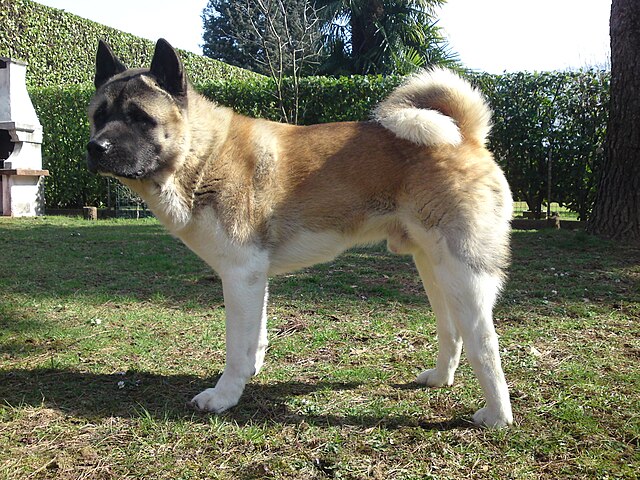
A large, heavy-boned, well-muscled dog with a broad bear-like head, small deep-set triangular eyes, firmly erect ears and a thick tail curled over the back. Males stand roughly 64 to 70 cm and females about 58 to 64 cm, with weights commonly from around 30 kg in smaller females to 50 kg or more in large American-type males. The double coat has a soft dense undercoat and a harsh, straight, stand-off outer coat of medium length. The Japanese type is restricted to red, brindle and white, all with the pale urajiro shading on the cheeks, chest and legs. The American type additionally allows pinto and a range of colours with or without a black mask. The overall impression is one of substance, balance and alert dignity.
Suitability
The Akita needs a house with a securely fenced yard rather than an apartment, and an experienced, confident owner who can provide structure, socialisation and supervision. It is not a suitable first dog. It is best in an adult household or one with older, dog-savvy children, and often does better as the only dog given its intolerance of same-sex companions. It is relatively independent and can cope with reasonable periods alone if well exercised, but boredom or under-stimulation can fuel destructiveness in such a powerful dog. The heavy double coat makes Akitas sensitive to heat, so in the Australian climate they need shade, fresh water and exercise restricted to the cooler parts of the day in summer, and the seasonal moults demand committed brushing year-round.
Health
Akitas typically live around 10 to 13 years. As a deep-chested giant they are at risk of gastric dilatation-volvulus (bloat), a sudden life-threatening emergency. Hip and elbow dysplasia occur and warrant screening. The breed is notably predisposed to immune-mediated conditions, including uveodermatologic (Vogt-Koyanagi-Harada-like) syndrome, pemphigus, sebaceous adenitis and immune-mediated thyroid disease, and hypothyroidism is common. Eye disorders such as progressive retinal atrophy occur, and some lines are sensitive to certain anaesthetics and vaccine reactions. Buy from breeders who hip and elbow score, conduct eye testing and thyroid screening, are transparent about any autoimmune or bloat history in their lines, and feed and manage to reduce bloat risk. Knowing the signs of bloat and having an emergency plan is essential for any Akita owner.
Find your Akita
Browse trusted Akita breeders across Australia and read genuine reviews from real owners, or take the quiz to be sure of the fit.