
Boxer
German Boxer, Deutscher Boxer
The Boxer is a medium to large, muscular dog with a square head, short muzzle and a famously playful, almost clownish personality that lasts well into adulthood. Boxers are deeply attached to their families, patient and gentle with children, and they tend to stay puppyish and bouncy for years. All that energy comes with a need for real daily exercise and company, and a Boxer left alone and under-stimulated will find its own entertainment, usually destructively. They are intelligent and trainable but high-spirited and a touch stubborn, so they do best with owners who enjoy an active, sociable dog rather than a calm one. Grooming is easy, just a quick weekly brush of the short coat. One thing to know going in: the short muzzle means Boxers feel the heat badly, which matters a great deal in the Australian climate.
Size
Large
Lifespan
10-12 years
Group
Group 6 - Utility
Height
Male: 56-63 cm (22-25 inches), Female: 53-61 cm (21-24 inches)
Weight
Boxer Male: 27-32 kg (60-70 lbs), Female: 24-29 kg (55-65 lbs)
Origin
Germany
Compatibility & care
How this breed fits into life with you
Scores are out of 5. Tap the help icon next to any trait to see what it really means.
Personality
How they think and behave
With family
Who they get along with
Care needs
What they ask of you
Origin & history
The Boxer was developed in Germany in the late 1800s, bred down from the now-extinct Bullenbeisser, a powerful hunting dog used to grip large game, crossed with an English Bulldog type. Early Boxers worked as hunting helpers, cattle dogs and guard dogs, and the strong jaw and undershot bite are leftovers from a job that needed a dog to hold on hard. The breed was refined and a standard written around the turn of the twentieth century, and Boxers went on to serve widely as military and police dogs, messengers and, later, guide dogs and therapy dogs. They became hugely popular family pets across Europe, North America and Australia through the twentieth century, valued as much for their character as their looks. The name most likely comes from the way they paw and spar with their front legs when they play.
Temperament
Boxers are exuberant, affectionate and endlessly playful, and they take being part of the family seriously. With children they are usually wonderful, tolerant and gentle, though their bounce means small kids should be supervised so nobody gets bowled over. They are alert and naturally protective, which makes them good watchdogs, but with proper socialisation they are friendly rather than aggressive towards people. With other dogs they can be a mixed bag and some, especially entire males, can be pushy with strange dogs of the same sex, so early socialisation is key. They are clever but have a stubborn, mischievous streak, and they get bored with repetitive drilling, so keep training upbeat, short and reward-based. A Boxer needs daily exercise, mental stimulation and plenty of company to be the happy, well-mannered dog the breed can be.
Appearance
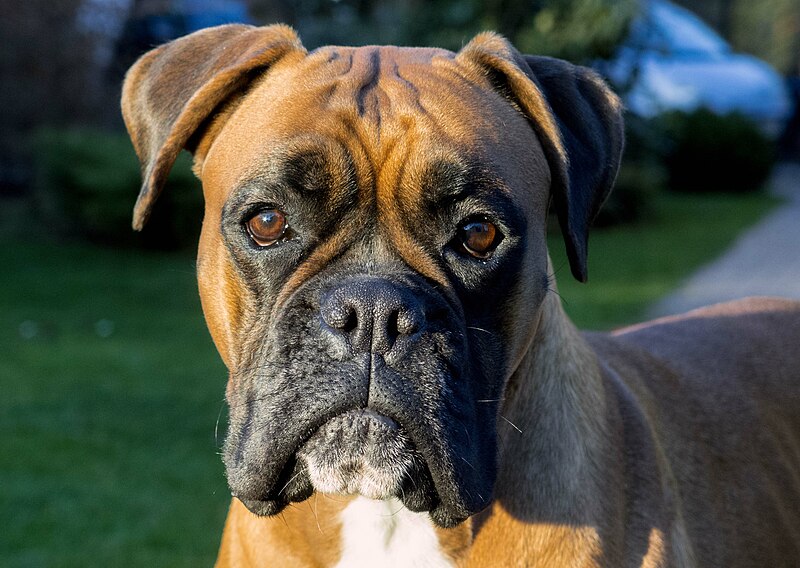
The Boxer is a medium to large, athletic, square-built dog. Males stand roughly 57 to 63 cm at the shoulder and females about 53 to 59 cm, with weight commonly between 25 and 32 kg. The body is well-muscled with a deep chest and a clean, powerful outline. The head is the breed's signature: broad and short with an undershot jaw, a blunt muzzle and a slightly wrinkled brow. The coat is short, smooth and tight to the body, easy to keep clean. Colours are fawn or brindle, both often with white markings, and there are also white Boxers, which need sun protection as they burn easily.
Suitability
Boxers suit active owners with a house and a securely fenced yard, and they fit families well thanks to their patience with children. They are not ideal for apartment living, for sedentary owners, or for anyone away from home all day, as they crave company and can develop separation problems and destructive habits when left alone too long. A first-time owner can manage a Boxer if they are ready for an energetic, strong, sometimes stubborn dog. The short muzzle is the big climate caveat: Boxers tolerate heat poorly and are at real risk of heatstroke, so in Australian conditions exercise them in the cool of the morning or evening, keep them indoors with cooling on hot days, and always have shade and water available.
Health
A well-bred Boxer typically lives around 10 to 12 years. The breed carries some serious, well-documented predispositions, so health testing of the parents is not optional. Boxers have a notably high rate of cancers, particularly mast cell tumours and lymphoma, so check your dog over regularly for any lumps. They are also strongly associated with a heart-muscle disease called arrhythmogenic right ventricular cardiomyopathy (sometimes called Boxer cardiomyopathy) as well as aortic and subaortic stenosis, both of which can cause sudden collapse. Hip dysplasia, hypothyroidism and a condition called degenerative myelopathy also occur. As a short-faced breed they are prone to brachycephalic airway problems and overheat easily. Buy from a breeder who does cardiac screening (including Holter monitoring), hip scoring and the relevant DNA tests, and who can talk honestly about cancer in their lines.
Find your Boxer
Browse trusted Boxer breeders across Australia and read genuine reviews from real owners, or take the quiz to be sure of the fit.