
Bernese Mountain Dog
Berner Sennenhund, Bernese Cattle Dog, Berner
The Bernese Mountain Dog is a large Swiss working breed with a striking tri-colour coat and a famously gentle, good-natured temperament. Bred to work alongside farmers, the Berner is calm, affectionate and people-oriented, happiest when it is part of family life rather than left outside on its own. Exercise needs are moderate, daily walks and the chance to potter about a yard keep one content, and they are not a high-drive dog despite their size. They suit families with the space for a big dog and the time to include them, and they are generally good with children. They are a poor choice for anyone after a low-shedding pet or a guard dog, as that heavy double coat sheds heavily and the breed is far too friendly to be much of a deterrent. Be prepared for regular brushing and, sadly, a shorter life than most breeds.
Size
Large to Giant
Lifespan
7-10 years
Group
Group 6 - Utility
Height
Male: 23-30 cm (9-12 inches), Female: 23-28 cm (9-11 inches)
Weight
Male: 38-50 kg (84-110 lbs), Female: 36-48 kg (79-106 lbs)
Origin
Switzerland
Compatibility & care
How this breed fits into life with you
Scores are out of 5. Tap the help icon next to any trait to see what it really means.
Personality
How they think and behave
With family
Who they get along with
Care needs
What they ask of you
Origin & history
The Bernese Mountain Dog comes from the canton of Bern in Switzerland, one of four related Swiss mountain dog breeds known collectively as the Sennenhund. For generations these dogs were all-purpose farm dogs in the Swiss countryside, droving cattle, guarding the property and pulling carts loaded with milk and produce to market. By the late 1800s numbers had dropped as their traditional work faded, and the breed was revived in the early 1900s through the efforts of Swiss fanciers, with the cynologist Albert Heim playing a key part in promoting and standardising it. The name comes from Bern and from Dürrbach, an area where many of the dogs were found. The breed reached the wider world through the twentieth century and is now a popular companion in Australia, valued far more for its temperament than for any working role.
Temperament
The Berner's temperament is its great strength. With family it is affectionate, calm and devoted, often gently leaning into the people it loves and content simply to be near them. It is typically excellent with children, patient and tolerant, though its sheer size means small kids should be supervised so nobody gets knocked over. Most are friendly or politely reserved with strangers rather than suspicious, and while they will bark to announce a visitor, they are too soft-natured to be genuine guard dogs. They usually get on well with other dogs and pets, especially when raised together. They are sensitive, eager to please and very trainable with kind, reward-based methods, but they wilt under harsh handling. The big behavioural need is inclusion, this is a dog that does not cope well with being shut away or left alone for long.
Appearance
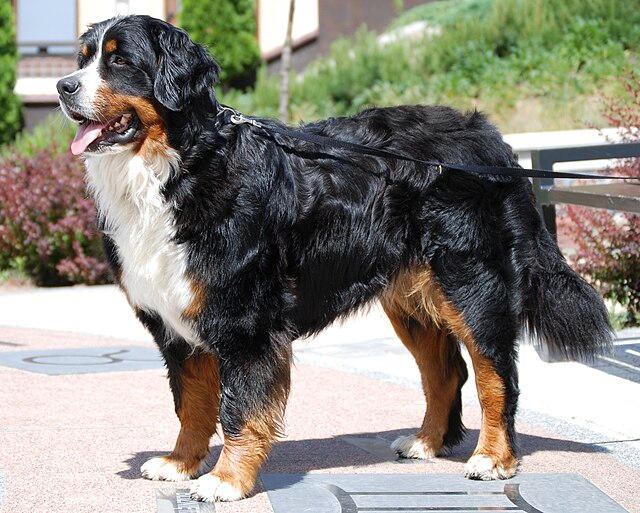
A large, sturdy, well-balanced dog. Males stand about 64 to 70 cm at the shoulder and females 58 to 66 cm, with weight commonly 40 to 50 kg, males being heavier. The coat is thick, moderately long and slightly wavy, with the breed's signature tri-colour pattern: a jet black base, rich rust markings over the eyes, on the cheeks, chest and legs, and clean white on the muzzle, chest, feet and tail tip. The head is broad with a gentle expression, the eyes dark and almond-shaped, and the ears medium, triangular and dropped. The whole impression is one of strength softened by an open, friendly face.
Suitability
Best suited to a house with a decent yard and a family that is around often and wants the dog as part of daily life. They are gentle and trainable enough to suit a first-time owner who has done their homework on the breed's grooming and health realities. They are not built for apartment living given their size and shedding, and they do not tolerate long stretches of isolation, becoming unhappy and sometimes destructive when lonely. The thick double coat is made for Swiss winters, which makes heat a genuine welfare issue in much of Australia. Keep them indoors with cooling on hot days, exercise only in the cool of the morning or evening through summer, and always provide shade and fresh water. Expect to brush a few times a week and to vacuum often.
Health
This is the hard part of owning the breed. Bernese Mountain Dogs are sadly short-lived, with an average of only around 7 to 9 years, and they carry a high rate of cancer, particularly histiocytic sarcoma, which is one of the leading causes of death in the breed. They are also prone to hip and elbow dysplasia, and as a deep-chested giant they are at real risk of bloat (gastric torsion), a sudden emergency that needs immediate veterinary surgery. Some lines carry the inherited kidney disease and progressive retinal atrophy. None of this is reason to avoid the breed, but it is reason to choose carefully. Buy only from a breeder who hip and elbow scores, eye tests, and is honest about the ages and causes of death in their lines, since longevity and cancer history matter enormously here. Pet insurance is well worth considering.
Find your Bernese Mountain Dog
Browse trusted Bernese Mountain Dog breeders across Australia and read genuine reviews from real owners, or take the quiz to be sure of the fit.