
Border Collie
Scotch Sheep Dog, Sheepdog
The Border Collie is a medium-sized herding breed from the Anglo-Scottish border, widely regarded as the most intelligent and trainable of all dogs. It was bred to work sheep all day using its hypnotic crouching stare and rapid, responsive movement, and that working drive defines it as a pet: it needs substantial daily exercise plus real mental work, and becomes anxious, obsessive or destructive without it. It is affectionate and intensely bonded to its handler, eager to learn and quick to excel at obedience, agility and other dog sports. It is sensitive, can be reserved with strangers, and its instinct to chase and gather may show as nipping at heels, children, bikes or cars. The coat is moderate and needs regular brushing. It suits active, committed owners and working or sport homes; it is a poor fit for sedentary households, long hours alone, or owners wanting an easygoing low-maintenance companion.
Size
Medium
Lifespan
12-15 years
Group
Group 5 - Working Dogs
Height
Male: 33-41 cm (13-16 inches), Female: 28-36 cm (11-14 inches)
Weight
Male: 14-20 kg (30-44 lbs), Female: 12-19 kg (26-41 lbs)
Origin
United Kingdom
Compatibility & care
How this breed fits into life with you
Scores are out of 5. Tap the help icon next to any trait to see what it really means.
Personality
How they think and behave
With family
Who they get along with
Care needs
What they ask of you
Origin & history
The Border Collie was developed in the hill country along the border between Scotland and England, where shepherds bred dogs purely for working ability rather than looks. The breed traces strongly to a dog named Old Hemp, born in 1893, whose calm, powerful herding style influenced most modern lines, and the name reflects both the border region and the old word collie for a sheepdog. Selection has always prioritised the distinctive working method of gathering stock with an intense crouching eye and controlled movement under a handler's whistle and voice commands. Border Collies remain the dominant working sheepdog worldwide and are central to sheepdog trials. In Australia they are widely used on farms and stations and excel in dog sports, and the breed is recognised by the ANKC in the Working Dog Group. A working registry exists alongside the conformation standard, and many breeders still prioritise herding instinct.
Temperament
The Border Collie is brilliant, sensitive and intensely work-oriented, forming a close, focused bond with its handler and thriving on having a job to do. It is affectionate with its family and usually good with children it is raised with, though its strong herding instinct can lead it to circle, stare at and nip at running children, cyclists or cars, which needs early management. It is often reserved or watchful with strangers and can be a quiet alert barker rather than a guard dog. Highly responsive to training, it learns fast and excels in obedience, agility, flyball and herding, but that same intelligence means it is easily bored and can develop compulsive behaviours, noise phobias or anxiety if under-stimulated. It generally gets on with other dogs and pets when socialised, though it may try to herd them too. This is a dog that needs its mind engaged daily, not just its body, and responds poorly to harsh handling.
Appearance
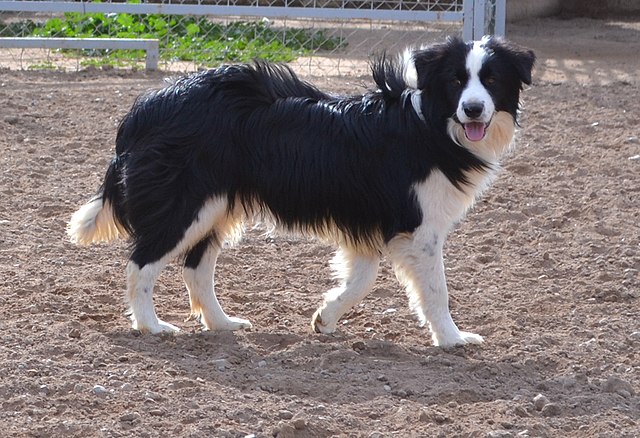
A medium-sized, athletic and well-balanced dog built for stamina and agility rather than bulk, standing roughly 46 to 56 cm at the shoulder, with males larger than females, and weighing about 14 to 22 kg. There are two coat types, a moderately long rough coat with feathering and a shorter smooth coat, both double and weather-resistant. Black and white is the classic and most familiar pattern, but the breed comes in many colours including red and white, tricolour, chocolate, blue, lilac and merle, often with white on the face, chest, legs and tail tip. The expression is keen and intelligent, the eyes oval and often brown though merles may have blue eyes, and the ears may be erect, semi-erect or dropped. The overall look is alert, agile and ready to move.
Suitability
The Border Collie needs an active home with space, ideally a house with a secure yard, and an owner committed to substantial daily exercise plus training, scentwork, sport or farm work to occupy its mind. It is not suited to apartment life unless exceptionally well exercised and stimulated, and it is a demanding choice for a first-time owner who underestimates its drive. It bonds tightly and does not cope well with long hours alone, where boredom can turn into barking, escaping or obsessive behaviour. It is well adapted to most of the Australian climate and works readily outdoors, but the double coat means it needs shade and water and should be worked in the cooler parts of the day during summer heat. Matched with the right energetic, engaged owner it is outstanding; mismatched with a quiet household it is one of the breeds most likely to develop problems.
Health
Border Collies are generally healthy and typically live around 12 to 15 years. Hip dysplasia is the main orthopaedic concern, and elbow dysplasia occurs, so joint screening matters. Several inherited conditions are well documented and DNA-testable: Collie eye anomaly, progressive retinal atrophy, neuronal ceroid lipofuscinosis (CL) and trapped neutrophil syndrome (TNS), the last two being serious and best avoided through carrier testing. Idiopathic epilepsy also occurs in the breed. Many Border Collies carry the MDR1 (ABCB1) gene mutation that causes sensitivity to certain common medications, including some worming and anaesthetic drugs, so DNA testing for MDR1 is strongly advised and should be shared with your vet. Buy from breeders who hip and elbow score, perform eye testing, and provide DNA results for CEA, CL, TNS and MDR1 at minimum.
Find your Border Collie
Browse trusted Border Collie breeders across Australia and read genuine reviews from real owners, or take the quiz to be sure of the fit.