
Bloodhound
St. Hubert Hound, Chien St. Hubert, Sleuth Hound
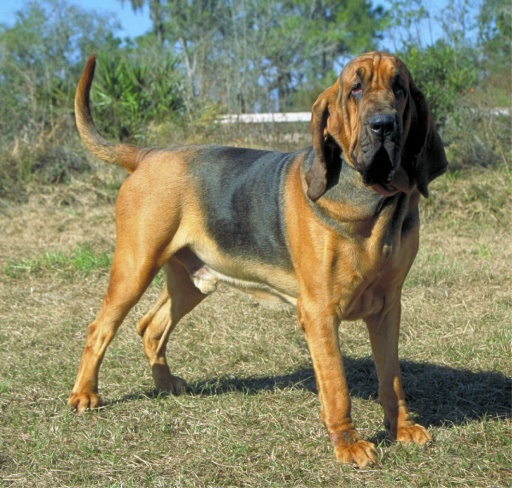
The Bloodhound is a large scent hound with arguably the finest nose in the dog world, famous for trailing people and game over astonishing distances. Behind that wrinkled, soulful face is a gentle, affectionate and rather laid-back dog that is also stubborn, independent and ruled by its nose. They need a good deal of exercise and a secure environment, because once a Bloodhound locks onto a scent it becomes effectively deaf to everything else. They suit patient, experienced owners with space and a sense of humour, especially anyone interested in tracking. They are not for the houseproud or for apartment dwellers, given the drool, the shedding, the size and the baying. The short coat is easy enough, but the loose skin and long ears need regular cleaning, and prospective owners should go in knowing the breed has a sadly short lifespan.
Size
Large to Giant
Lifespan
10-12 years
Group
Group 4 - Hounds
Height
Male: 56-69 cm (22-27 inches), Female: 53-64 cm (21-25 inches)
Weight
Male: 41-50 kg (90-110 lbs), Female: 36-45 kg (80-100 lbs)
Origin
United Kingdom / Belgium
Compatibility & care
How this breed fits into life with you
Scores are out of 5. Tap the help icon next to any trait to see what it really means.
Personality
How they think and behave
With family
Who they get along with
Care needs
What they ask of you
Origin & history
The Bloodhound's roots reach back to medieval Europe, with the breed most often traced to the monastery of Saint-Hubert in Belgium, where monks bred careful records of their scent hounds from around the eighth century. These Saint-Hubert hounds spread through France and into Britain, where they were refined into the dog we know today, prized by the nobility for tracking deer and, later, for trailing people. The name is generally thought to refer to its breeding as a hound of pure or noble blood rather than to anything gruesome. Its tracking ability is so reliable that a Bloodhound's trail has long been accepted as evidence in courts. The breed remains the gold standard for search and rescue and police trailing work around the world, including in Australia, though as a pet it is relatively uncommon here.
Temperament
For all its size, the Bloodhound is a gentle, affectionate and patient dog at heart. With family it is loving and tolerant and generally very good with children, putting up with a lot, though its size means it can knock small kids over without meaning to. It is typically friendly or placidly indifferent towards strangers, so despite the imposing looks it makes a poor guard dog, offering little beyond a deep bark. It is sociable with other dogs, reflecting its pack heritage, but its overwhelming prey and scent drive means small animals can be a problem. The real challenge is training: Bloodhounds are independent and famously stubborn, and a scent will override almost any command, so off-lead recall is never truly reliable. They need patient, good-humoured, reward-based training and firm but kind consistency. Above all they need an outlet for that nose and secure containment.
Appearance
A large, powerful, substantial hound standing about 58 to 69 cm at the shoulder and weighing roughly 36 to 50 kg, with males larger than females. The coat is short, dense and fairly weatherproof, coming in black and tan, liver and tan, or red. The breed is defined by its abundant loose skin, which falls into deep wrinkles about the head and forms pendulous folds around the throat, and by its very long, low-set ears that drag the ground scent up towards the nose. The eyes are deep-set with drooping lower lids that give the famous sad, dignified expression, and the whole head is long and narrow. Heavy flews mean the breed drools considerably.
Suitability
A house with a large, securely fenced yard and a patient, experienced owner is what this breed needs, ideally one drawn to tracking or trailing work that lets the dog use its gift. It is not suited to apartments, to the fastidious, or to first-time owners who may underestimate the stubbornness, the drool, the noise and the sheer determination of a Bloodhound on a scent. They can tolerate moderate time alone but want company and may bay or become destructive if bored or lonely. The short coat handles Australian conditions reasonably, but the heavy build and dark colouring mean they should be exercised in the cool of the day in summer with constant access to shade and water. A tall, secure fence and a strong lead are essential, as a Bloodhound will simply follow its nose.
Health
This is a breed to enter with eyes open, as Bloodhounds are sadly one of the shorter-lived dogs, often only around 8 to 10 years. As a giant, deep-chested breed the most serious risk is bloat and gastric torsion, a sudden, life-threatening emergency that is a leading cause of death in the breed, so feeding measured meals and avoiding hard exercise after eating is vital. They are prone to hip and elbow dysplasia. The loose facial skin and drooping eyelids predispose them to eye conditions such as ectropion and entropion and to skin-fold infections, while the long ears need regular cleaning to prevent chronic ear trouble. Choose a breeder who hip and elbow scores their dogs and is honest about longevity and bloat history in their lines, and learn the signs of bloat before you bring one home. Insurance is well worth considering.
Find your Bloodhound
Browse trusted Bloodhound breeders across Australia and read genuine reviews from real owners, or take the quiz to be sure of the fit.