
Cane Corso
Cane Corz, Italian Mastiff, Cane Di Macellaio
The Cane Corso is a large, athletic Italian guardian, more agile and driven than the mastiff types it is related to. It is intelligent, intensely loyal and strongly protective, bonding hard to its family and naturally suspicious of outsiders. With its own people it can be affectionate and even goofy, but this is a dominant, powerful working breed that needs an owner who understands and enjoys that. It is good with children in its family when raised properly, though its size and drive call for supervision. Exercise needs are high for a big dog, both physical work and mental challenge, and a bored or under-led Corso can become a serious problem. It is firmly a breed for experienced owners. The short coat is low-maintenance, but the protective temperament means socialisation and training are non-negotiable.
Size
Large
Lifespan
10-11 years
Group
Group 6 - Utility
Height
Male: 64-68 cm (25-27 inches), Female: 60-64 cm (23-25 inches)
Weight
Male: 45-50 kg (99-110 lbs), Female: 40-45 kg (88-99 lbs)
Origin
Italy
Compatibility & care
How this breed fits into life with you
Scores are out of 5. Tap the help icon next to any trait to see what it really means.
Personality
How they think and behave
With family
Who they get along with
Care needs
What they ask of you
Origin & history
The Cane Corso comes from southern Italy and descends from old Roman war and farm dogs of the molosser type. For centuries it was an all-purpose rural worker, guarding farms and livestock, droving cattle and pigs, and hunting large game such as wild boar. The name comes from Latin roots meaning roughly guardian or bodyguard dog. As Italian farming changed through the twentieth century the breed nearly disappeared, and a group of enthusiasts revived it from the 1970s onward, with formal Italian recognition following in the 1990s. It is now well established internationally and is steadily becoming more common in Australia. It is worth knowing that the cropped ears often seen in overseas photographs are illegal in Australia, where Corsos are kept with their natural, drop ears.
Temperament
The Cane Corso is loyal, confident and assertive, with a strong, deeply ingrained guarding instinct. It is devoted to its family and is usually steady and affectionate with the children of the household, while being naturally aloof and watchful with strangers. A sound Corso is stable and discerning, not nervous or indiscriminately aggressive, but reaching that takes deliberate, ongoing socialisation from puppyhood. Many are dog-reactive, and same-sex aggression is common, so careful introductions and management around other dogs are important. The breed is highly intelligent and trainable and genuinely wants a job, but it will test boundaries and needs an owner who leads calmly and consistently rather than through force. Without enough exercise, structure and mental work, this is a dog that can become destructive, pushy or dangerously over-protective.
Appearance
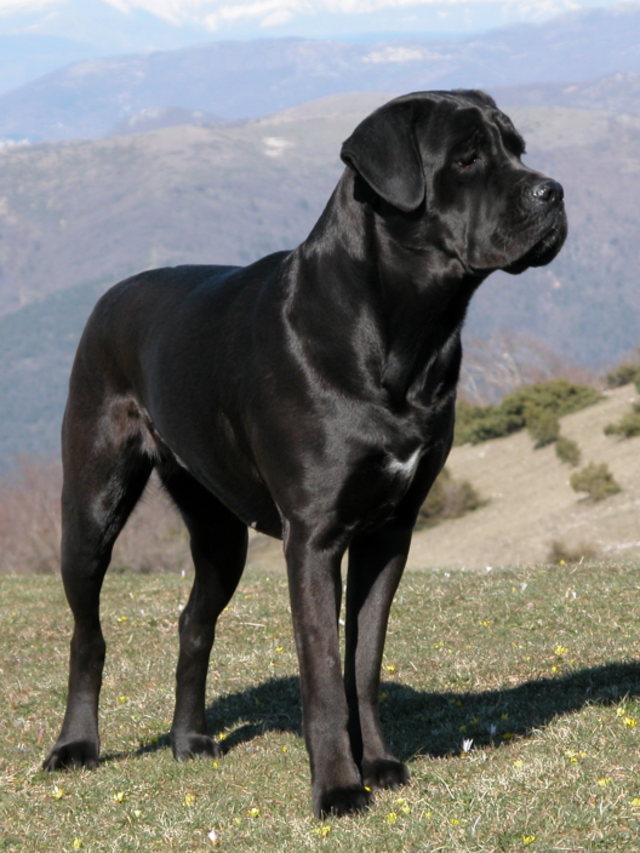
A large, powerfully muscled dog built for agility as well as strength. Males stand about 62 to 70cm at the shoulder and weigh roughly 45 to 50kg, with females smaller. The head is large and broad with a deep, square muzzle and obvious stop, and in Australia the medium-sized ears are left natural and hang down. The body is slightly longer than it is tall, lean and athletic rather than bulky. The coat is short, dense and stiff with a light undercoat, and appears in black, various greys (often called blue), fawn, red and brindle, frequently with a black or grey mask. A small white patch on the chest is common.
Suitability
This breed needs a house with a high, secure fence and an owner who has real experience with large, strong, dominant dogs. It is absolutely not a first-time dog, and it is a poor match for a busy household with no time for training, or for anyone wanting an easygoing pet. It can tolerate being left for moderate periods once mature and well exercised, but a young, under-stimulated Corso left alone too long will find trouble. It thrives where it has a confident handler, daily physical and mental work, and clear rules. In the Australian heat the short coat helps a little, but a dog this size still needs shade, water and cooler-hour exercise through summer, and care to prevent overheating.
Health
Lifespan is usually around 9 to 12 years. Hip and elbow dysplasia are the main orthopaedic concerns, so breeding dogs should be hip and elbow scored. The breed is prone to eyelid faults, particularly entropion, ectropion and cherry eye, and eye examination of breeding stock is sensible. As a large, deep-chested dog the Cane Corso is at risk of bloat, the sudden twisting of the stomach that is a surgical emergency, so owners should know the signs. Some lines carry heart disease, and a DNA test is available for a form of degenerative myelopathy, a progressive spinal condition, so ask whether parents have been tested. Demodectic mange can also occur in young dogs. Buy from a breeder who hip and elbow scores, screens eyes and hearts, and DNA tests for degenerative myelopathy.
Find your Cane Corso
Browse trusted Cane Corso breeders across Australia and read genuine reviews from real owners, or take the quiz to be sure of the fit.