
English Springer Spaniel
Springer Spaniel
The English Springer Spaniel is a medium-sized gundog bred to flush and retrieve game, and it has kept all the bounce, drive and people-loving warmth that job demands. These are cheerful, affectionate, busy dogs with a tail that rarely stops, and they thrive on being involved in whatever the family is doing. They are clever and very trainable, which is why they show up everywhere from the shooting field to detection work to dog sport. The catch is the energy: a Springer needs real daily exercise and something for its mind, and an under-exercised one can become restless, mouthy and prone to barking. They suit active owners and families who will walk, train and play with them properly, and they do not suit a quiet, stay-at-home lifestyle. The medium-length coat with its feathering needs regular brushing and a bit of tidying to stay free of knots and grass seeds.
Size
Medium
Lifespan
10-14 years
Group
Group 3 - Gundogs
Height
Male: 48-56 cm (19-21 inches), Female: 46-51 cm (18-20 inches)
Weight
Male: 23-25 kg (50-55 lbs), Female: 18-23 kg (40-50 lbs)
Origin
United Kingdom
Compatibility & care
How this breed fits into life with you
Scores are out of 5. Tap the help icon next to any trait to see what it really means.
Personality
How they think and behave
With family
Who they get along with
Care needs
What they ask of you
Origin & history
The Springer is an old English gundog, with spaniels of its type recorded in Britain for centuries. The name comes from the dog's original job of springing or flushing game birds from cover so they could be netted or, later, shot over. For a long time springing and cocking spaniels appeared in the same litters, distinguished mainly by size and work, and the English Springer Spaniel and the Cocker were only formally separated as distinct breeds in the early twentieth century. From there the breed split into two fairly different lines: a lighter, intensely driven field type bred for work, and a heavier, more heavily coated show type. Both remain popular. The Springer is a common and well-liked breed in Australia, kept both as a working gundog and as an active family dog.
Temperament
Springers are sociable, soft-natured and devoted, forming strong attachments and genuinely wanting to be with their people. They are usually excellent with children, taking the noise and bustle of family life in their stride, and they tend to be friendly rather than suspicious with strangers, which makes them poor guard dogs but delightful companions. Most get on well with other dogs and can live happily with other pets, though the flushing instinct means birds and small animals may be chased. They are intelligent, eager and quick to learn with reward-based training, but that same sensitivity means harsh handling backfires badly. The defining need is activity and engagement: a Springer that gets enough exercise, training and company is a joy, while one left bored and under-stimulated can become anxious, noisy and hard to settle.
Appearance
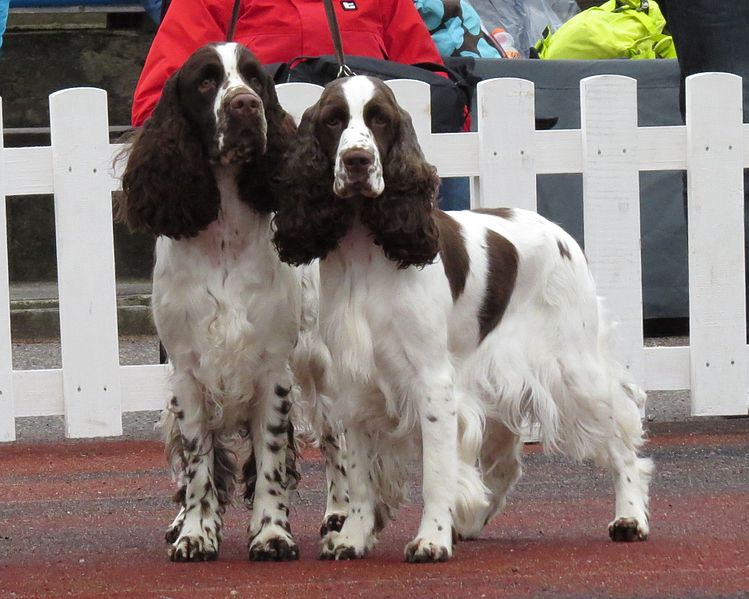
A compact, medium-sized gundog, the English Springer stands roughly 48 to 51 cm at the shoulder, with bitches a touch smaller, and weighs about 18 to 25 kg. The build is sturdy and balanced, made for a long day's work in the field. The coat is medium in length, flat or slightly wavy, weather-resistant, and carries feathering on the ears, chest, legs and belly. Classic colours are liver and white or black and white, often with tan markings, and ticking through the white is common. The ears are long and set fairly low, framing a kind, gentle expression. Working-bred dogs tend to be lighter and shorter-coated than the showier bench type.
Suitability
This breed is best suited to active people or families with a house and yard who enjoy getting out and about, whether that is long walks, gundog work, jogging or dog sport. They can manage suburban life provided the exercise is genuinely there, but they are not a low-effort dog and not ideal for someone seeking a placid stay-at-home companion. They are reasonably first-owner friendly given their willingness to please, as long as the new owner commits to the exercise and training. They are people-oriented and dislike being left alone for long stretches. For the Australian climate the moderate coat copes reasonably well, but watch for grass seeds in the feathering and ears after walks, and exercise in the cooler hours on hot days.
Health
English Springer Spaniels are generally robust and often live around twelve to fourteen years, but there are well-documented conditions to test for. Hip dysplasia occurs, and several inherited eye disorders are recognised, including progressive retinal atrophy and retinal dysplasia. The breed also has specific DNA-testable conditions, notably phosphofructokinase (PFK) deficiency, a metabolic muscle disorder, and fucosidosis, a serious inherited neurological disease. Ear infections are common given the long, heavy ears, so routine ear care is part of life with a Springer. Some show lines have also been linked to a form of sudden aggression sometimes called rage syndrome, though it is uncommon. Buy from breeders who hip score, eye test annually, and DNA test for PFK deficiency and fucosidosis. Keeping ears clean and dry and the dog at a sensible weight rounds out good preventative care.
Find your English Springer Spaniel
Browse trusted English Springer Spaniel breeders across Australia and read genuine reviews from real owners, or take the quiz to be sure of the fit.