
German Shepherd
Alsatian (UK), Alsatian wolf dog (UK), Berger Allemand
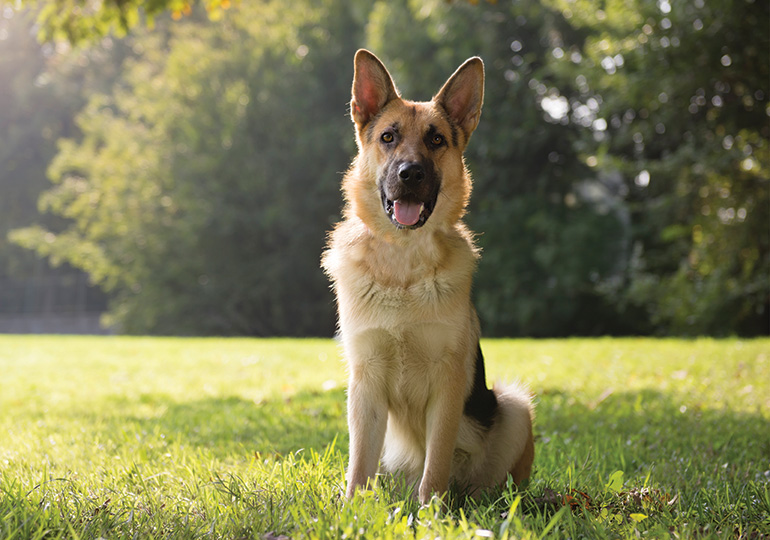
The German Shepherd Dog is a large, athletic working breed prized for intelligence, trainability and loyalty. Confident and alert, it bonds closely with its family and is naturally watchful, which makes it a capable guardian as well as a versatile worker in police, military, search-and-rescue and assistance roles. This is a high-energy, high-drive dog that needs substantial daily exercise plus real mental work. Without a job to do it can become bored, anxious or destructive and may develop nuisance behaviours. It suits active owners who enjoy training and have time to commit, and is a poor fit for people wanting a low-maintenance pet, those out all day, or first-time owners unprepared for its needs. The double coat sheds heavily, with very heavy seasonal moults, so regular brushing is essential. Few breeds match its combination of nose, stamina and willingness to learn.
Size
Large
Lifespan
10-13 years
Group
Group 5 - Working Dogs
Height
Male: 60-65 cm (24-26 inches), Female: 55-60 cm (22-24 inches)
Weight
Male: 30-40 kg (66-88 lbs), Female: 22-32 kg (49-71 lbs)
Origin
Germany
Compatibility & care
How this breed fits into life with you
Scores are out of 5. Tap the help icon next to any trait to see what it really means.
Personality
How they think and behave
With family
Who they get along with
Care needs
What they ask of you
Origin & history
The German Shepherd Dog was developed in Germany from the late 1890s, led by cavalry officer Max von Stephanitz, who set out to standardise the best regional herding and farm dogs into a single capable working breed. The first registered dog, Horand von Grafrath, founded the studbook in 1899. Bred initially to herd and guard flocks, the dog's intelligence and biddability quickly saw it adopted for police and military duties, a role that expanded enormously during the First World War. International popularity followed, helped by early film fame, and the breed went on to excel as guide, detection and search-and-rescue dogs. It is recognised by the ANKC and is consistently one of Australia's most popular and most widely worked breeds. Long-standing import restrictions on German Shepherds in Australia have since been lifted.
Temperament
German Shepherds are loyal, confident and strongly bonded to their families, typically affectionate at home and good with children they are raised with, though their size means supervision around small kids is wise. They are naturally aloof or reserved with strangers and alert to their surroundings, which gives them genuine watchdog and protective instincts. Sound temperament and thorough early socialisation are essential to prevent nervousness or over-reactivity. With other dogs and pets they can be sociable when well socialised, though some show same-sex dog tension or strong prey drive. They are exceptionally trainable, quick to learn and eager to work with their handler, but that same drive means they need a clear, consistent owner. Key behavioural needs are daily physical exercise, structured mental work or training, and a real sense of purpose. A bored, under-stimulated German Shepherd is prone to anxiety, barking and destructiveness.
Appearance
A large, well-muscled dog, the German Shepherd generally stands about 55 to 65 cm at the shoulder and weighs roughly 22 to 40 kg, with males notably larger than females. The body is longer than it is tall, with a characteristic sloping topline in show-type dogs, while working lines tend to be straighter-backed. The head is noble with a strong muzzle, almond eyes and large erect ears. The coat is a dense double coat, most often medium-length, though a long-coated variety also occurs. The classic colour is black-and-tan or black-and-red with a saddle pattern, but sable, solid black and bi-colour are also seen. The bushy tail hangs in a slight curve at rest.
Suitability
This breed is best suited to a house with a secure yard and to active, committed owners who enjoy training, exercise and giving a dog a job. It is generally not recommended for first-time owners, very busy households, or apartment living unless the owner is exceptionally dedicated to its exercise and enrichment. German Shepherds can tolerate moderate time alone if well exercised and mentally satisfied, but they are people-oriented and not suited to being left isolated for long days. In the Australian climate the dense double coat means heat must be managed: provide shade and water, exercise in the cooler parts of the day, and expect heavy shedding that calls for regular brushing. With the right owner they are outstanding companions and working partners.
Health
Typical lifespan is around 9 to 13 years. The breed's best-known predispositions are hip and elbow dysplasia, which can lead to pain and arthritis, and degenerative myelopathy, a progressive spinal-cord disease causing gradual hind-limb paralysis. German Shepherds are also prone to gastric dilatation-volvulus (bloat), a life-threatening emergency in deep-chested dogs, as well as exocrine pancreatic insufficiency, certain autoimmune and skin conditions, and haemophilia in some lines. Buy from breeders who hip and elbow score their breeding stock under the ANKC and AVA schemes, DNA test for degenerative myelopathy, and are open about temperament and longevity in their lines. Feeding to keep the dog lean, sensible exercise during growth, and splitting meals to reduce bloat risk all support long-term health, alongside routine veterinary care.
Find your German Shepherd
Browse trusted German Shepherd breeders across Australia and read genuine reviews from real owners, or take the quiz to be sure of the fit.