
German Shorthaired Pointer
GSP, DK, Kurzhaar, Deutscher Kurzhaariger Vorstehhund, Deutsch Kurzhaar
The German Shorthaired Pointer is a medium-to-large, athletic gundog built for stamina and all-day work in the field. It is intelligent, affectionate and intensely energetic, a breed that points, tracks and retrieves on land and in water. With its family it is friendly and people-focused, but it is emphatically not a low-maintenance dog: it needs vigorous daily exercise, ideally running and off-lead work, plus mental stimulation, or it becomes restless, vocal and destructive. It suits active, outdoorsy owners, runners, hunters and dog-sport enthusiasts, and is a poor choice for sedentary households, full-time-away owners, or homes with small pets given its strong prey drive. The short, dense coat is very easy to maintain, needing only a quick weekly brush, though it does shed. A standout trait is sheer versatility: few gundogs do as many jobs as well.
Size
Medium to Large
Lifespan
12-14 years
Group
Group 3 - Gundogs
Height
Male: 59-64 cm (23-25 inches), Female: 53-58 cm (21-23 inches)
Weight
Male: 25-32 kg (55-70 lbs), Female: 20-27 kg (45-60 lbs)
Origin
Germany
Compatibility & care
How this breed fits into life with you
Scores are out of 5. Tap the help icon next to any trait to see what it really means.
Personality
How they think and behave
With family
Who they get along with
Care needs
What they ask of you
Origin & history
The German Shorthaired Pointer was developed in Germany through the 19th century, taking firmer shape in the latter decades as breeders worked towards an all-purpose hunting dog. The foundation drew on older Spanish and German pointing dogs, with scenthound and, later, English Pointer influence to sharpen nose, style and speed. The aim was a single versatile gundog that could find and point game, work to the gun, track wounded animals and retrieve from land and water, rather than a specialist. The result was a fast, biddable hunter with an excellent nose and a love of water. The breed spread internationally in the 20th century and is recognised by the ANKC. In Australia it is popular both as a working and field dog and as an active family companion.
Temperament
German Shorthaired Pointers are friendly, enthusiastic and deeply attached to their people, usually excellent with children and sociable with strangers, which makes them better companions than guard dogs, though they will bark to alert. They generally get on well with other dogs, but a strong, hardwired prey drive means cats, rabbits, poultry and other small pets can be at risk unless the dog is raised with them and carefully managed. Trainability is high: they are clever, willing and quick to learn, and excel in field work, agility, obedience and tracking. They are not an independent breed and crave human company, often becoming anxious or badly behaved if regularly left alone or under-exercised. Their defining behavioural need is an outlet for boundless energy, so daily hard exercise and a thinking job are non-negotiable for a settled, well-mannered dog.
Appearance
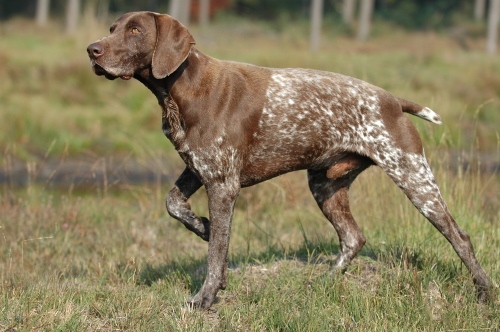
A clean-lined, muscular dog of medium to large size, the German Shorthaired Pointer generally stands about 53 to 64 cm at the shoulder and weighs roughly 20 to 32 kg, with males larger than females. The build is square to slightly longer than tall, athletic and built for endurance rather than bulk. The coat is short, flat and dense, harsh to the touch and water-resistant. Colour is liver, or liver and white in patterns ranging from solid patches to heavy ticking and roan, sometimes almost wholly ticked. The head is clean with a broad muzzle, brown eyes and moderately long drop ears set high. The tail is traditionally docked where law permits, otherwise carried as a natural tail.
Suitability
This is a breed for an active home with space, ideally a house with a secure yard and owners who run, hike, hunt or compete in dog sports. It is not suited to apartment living unless exercise is exceptional, nor to relaxed or frequently absent owners, and the prey drive makes it a risky match for households with small pets. Committed first-time owners can manage one if they fully grasp the exercise commitment. It does not cope well with long hours alone and is happiest with company and activity. In the Australian climate the short coat offers little protection from sun, so provide shade and water, exercise in the cooler parts of the day, and make use of swimming, which most of these dogs love.
Health
Typical lifespan is around 12 to 14 years. As a generally hardy breed it has fewer inherited problems than many, but well-documented predispositions include hip dysplasia and gastric dilatation-volvulus (bloat), a life-threatening emergency in this deep-chested dog. Some lines carry von Willebrand disease, an inherited bleeding disorder, and the breed is prone to certain cancers as it ages, including mast cell tumours, so any persistent lump should be checked. The drop ears mean ear infections are common if not kept clean and dry, especially in dogs that swim. Buy from breeders who hip score their breeding stock under the ANKC and AVA schemes, eye test, and DNA test for von Willebrand disease where it is present in the line. Keep the dog lean, split daily meals to lower bloat risk, and keep on top of ear care.
Find your German Shorthaired Pointer
Browse trusted German Shorthaired Pointer breeders across Australia and read genuine reviews from real owners, or take the quiz to be sure of the fit.