
Gordon Setter
Gordon Castle Setters
The Gordon Setter is the largest and heaviest of the setters, a handsome black-and-tan gundog with real substance and stamina. Bred to find and point game birds over big, rough country, it is loyal, affectionate and notably devoted to its own people, often more reserved and one-family in its attachments than the easygoing English or Irish Setter. This is an energetic sporting dog that needs a good hour or more of vigorous daily exercise plus mental work, and it grows bored and mischievous without it. It suits active owners with time and space, and is a poor fit for sedentary homes, apartments or owners out all day. The long, silky coat with its feathering needs regular brushing to prevent mats, and the breed is slow to mature, staying boisterous and puppyish for a couple of years. Its loyalty and dignified good looks are what win people over.
Size
Large
Lifespan
10-12 years
Group
Group 3 - Gundogs
Height
Male: 61-69 cm (24-27 inches), Female: 58-66 cm (23-26 inches)
Weight
Male: 25-36 kg (55-80 lbs), Female: 20-32 kg (45-70 lbs)
Origin
United Kingdom
Compatibility & care
How this breed fits into life with you
Scores are out of 5. Tap the help icon next to any trait to see what it really means.
Personality
How they think and behave
With family
Who they get along with
Care needs
What they ask of you
Origin & history
The Gordon Setter developed in Scotland, taking its modern form by the early 19th century and named for the Dukes of Gordon, whose kennels at Gordon Castle did much to popularise and fix the black-and-tan setter. Setters of this colour existed in Scotland well before then, but it was the ducal kennels in the early 1800s that brought the type to prominence. The breed was built to find, point and work birds, especially grouse, over wide and difficult highland terrain, favouring endurance and a methodical, reliable style over flashy speed. It made its way to North America and beyond through the 19th century. The Gordon Setter is recognised by the ANKC and, while uncommon, is kept in Australia both as a working and field dog and as a striking companion.
Temperament
Gordon Setters are loyal, affectionate and strongly attached to their families, often bonding intensely with one or two people and thriving on being included in everything. They are usually good with children they are raised with, given their size and exuberance warrant supervision around small kids. With strangers they tend to be more reserved and watchful than other setters, which gives them a fair watchdog instinct, though they are not guard dogs. They are generally sociable with other dogs, and a moderate prey drive means small pets are safest if the dog is raised with them. Intelligent and capable, they are trainable but carry an independent, sometimes stubborn streak and mature slowly, so they need patient, consistent, reward-based training and plenty of early socialisation. Their core needs are ample daily exercise, mental challenge and close human company, without which they become restless and destructive.
Appearance
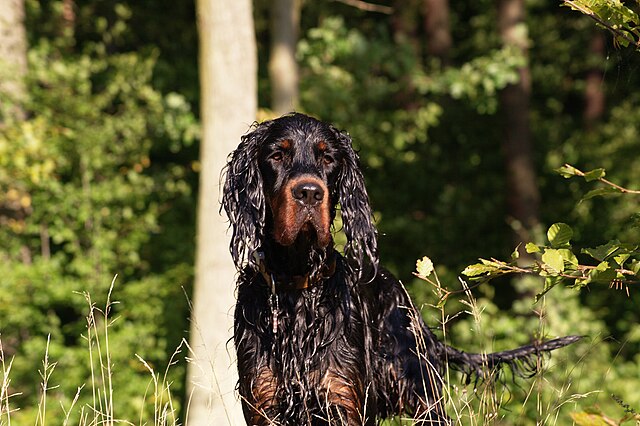
A large, well-balanced sporting dog, the Gordon Setter generally stands about 58 to 69 cm at the shoulder and weighs roughly 20 to 36 kg, with males clearly larger and more substantial than females. The build is sturdy and muscular, deep through the chest, with more bone than the other setters. The coat is moderately long, straight or slightly wavy, soft and shining, with feathering on the ears, chest, belly, legs and tail. Colour is a deep coal black with clearly defined chestnut or mahogany tan markings on the muzzle, over the eyes, on the chest, legs and under the tail. The head is fairly heavy with a kind expression, dark brown eyes and long, low-set pendant ears, and the tail is carried roughly level with the back.
Suitability
The Gordon Setter suits an active household with space, ideally a house with a secure yard and owners who walk, run, hunt or compete and will involve the dog closely in daily life. It is not an apartment breed, nor one for relaxed or frequently absent owners, and its slow maturity and strong-willed streak make it better for owners willing to put in steady training, though a committed first-timer can manage one. It forms deep attachments and does not cope well with long hours alone, tending towards separation distress. In the Australian climate the long, dense coat means heat must be managed with shade, fresh water and exercise in the cooler parts of the day, and the feathered coat needs regular brushing to stay free of mats and burrs.
Health
Typical lifespan is around 10 to 12 years. Well-documented predispositions include hip and elbow dysplasia and gastric dilatation-volvulus (bloat), a life-threatening emergency in this deep-chested breed. The breed carries an inherited form of progressive retinal atrophy (rcd4 late-onset PRA) for which a DNA test is available, as well as other inherited eye conditions, and hypothyroidism is also seen. A breed-specific neurological disease, sometimes called Gordon Setter cerebellar ataxia (DUNGS), exists in some lines and can now be DNA tested. Buy from breeders who hip and elbow score under the ANKC and AVA schemes, eye test their breeding stock, and DNA test for the PRA and ataxia mutations where relevant. Keeping the dog lean, splitting daily meals to lower bloat risk, and routine veterinary care all support a long, sound life.
Find your Gordon Setter
Browse trusted Gordon Setter breeders across Australia and read genuine reviews from real owners, or take the quiz to be sure of the fit.