
Irish Setter
Red Setter, Irish Red Setter
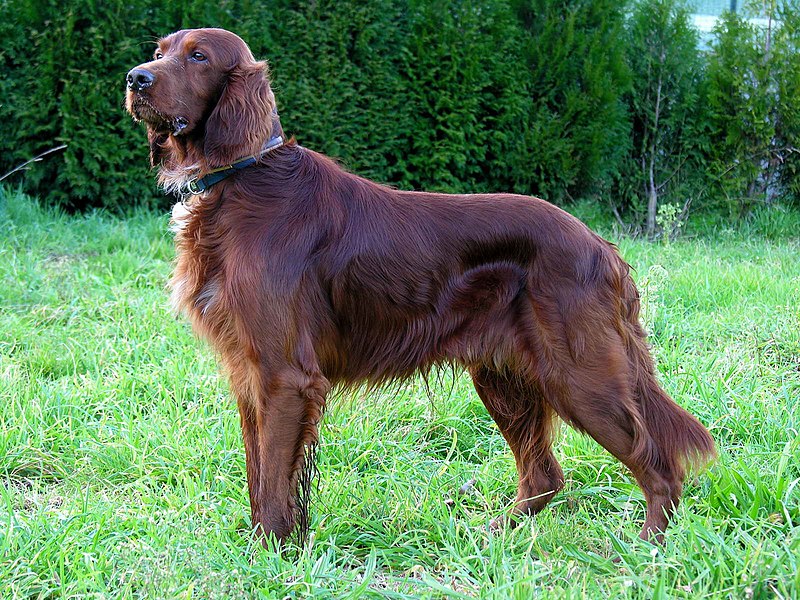
The Irish Setter is a tall, glamorous gundog with a deep red coat and a sense of humour to match. Bred to range across open country after game birds, it carries serious stamina and needs a good hour or more of proper exercise daily, ideally including a run off lead in a safe space. Mentally it stays young for years, which charms some owners and exhausts others, so it is not the dog for a quiet household or a first-timer wanting something settled. It thrives with active families who enjoy training and the outdoors. Setters are affectionate, soft-natured and useless as guard dogs, greeting strangers like long-lost friends. The feathered coat needs brushing two or three times a week and trimming around the ears and feet to keep it tidy and free of knots.
Size
Large
Lifespan
12-14 years
Group
Group 3 - Gundogs
Height
Male: 66-71 cm (26-28 inches), Female: 61-66 cm (24-26 inches)
Weight
Male: 27-32 kg (60-70 lbs), Female: 23-27 kg (50-60 lbs)
Origin
Ireland
Compatibility & care
How this breed fits into life with you
Scores are out of 5. Tap the help icon next to any trait to see what it really means.
Personality
How they think and behave
With family
Who they get along with
Care needs
What they ask of you
Origin & history
The Irish Setter was developed in Ireland over the 1700s and 1800s as a bird dog, used to range across open ground, find game birds by scent and freeze on point so the hunter could move in. Early Irish setters were often red and white, and the solid red dog that we know today was refined later in the 19th century, becoming fashionable partly for its striking looks. The breed was among the early registrations when formal stud books began, and it spread quickly through Britain, North America and beyond. A split gradually opened between the heavily coated show type and the lighter, harder-running field type still used for hunting. In Australia the Irish Setter has long been a familiar show and companion breed, recognised by the ANKC, though it is less often worked here than in its homeland.
Temperament
Irish Setters are friendly, exuberant and deeply attached to their families, and they tend to stay playful and adolescent in outlook for several years, longer than most breeds. They are typically excellent with children, happy in the noise and bustle of family life, though a boisterous young Setter can knock over a toddler simply through enthusiasm. They are sociable with other dogs and, with early exposure, usually fine with cats and other pets, although the bird-finding instinct means some interest in smaller animals. With strangers they are welcoming rather than wary, which makes them friendly faces but unreliable guards. They are intelligent and eager to please, yet easily distracted, so training needs to be upbeat, consistent and patient. The core need is plenty of exercise and company, a bored, under-exercised Setter becomes destructive and noisy.
Appearance
This is a substantial, racy gundog. Males generally stand about 58 to 67 cm at the shoulder with females a little smaller, and weight sits roughly in the 25 to 32 kg range depending on type and sex. The build is athletic and balanced, longer in leg and lighter in frame than many gundogs, built for galloping. The coat is the signature, moderately long, flat and silky, with generous feathering on the ears, chest, legs, underline and tail. Colour is a rich chestnut or mahogany red, sometimes with small white marks on the chest or toes. The head is long and lean, the eyes dark and kind, and the long ears hang low and close to the head.
Suitability
This breed wants a house with a decent securely fenced yard and, more importantly, an owner committed to real daily exercise and ongoing training. It suits active people and families who enjoy the outdoors and want a dog to come running, walking or to a dog sport. It is not a good match for apartment life, for a sedentary household, or for an owner away long hours, as Setters fret and act up when left alone too much. First-time owners can manage one if they go in clear-eyed about the energy and the slow road to maturity. In the Australian heat the long red coat means exercising in the cool of the morning or evening through summer, with shade and water always on hand, and care taken on hot pavement.
Health
Irish Setters usually live around 12 to 14 years. The breed has a few well-documented predispositions. Hip dysplasia occurs and breeding dogs should be hip-scored. Eye disease is a real concern, including progressive retinal atrophy, which has a DNA test in this breed, so insist on parents being tested. Two further inherited conditions have DNA tests available, canine leucocyte adhesion deficiency (CLAD) and gluten-sensitive enteropathy, and reputable breeders screen for both. Like many deep-chested dogs, the Irish Setter is at risk of gastric dilatation-volvulus (bloat), a sudden, life-threatening twisting of the stomach, so feed measured meals and avoid hard exercise right after eating. Buy from a breeder who hip-scores, eye-tests and uses the available DNA panels, and ask to see the certificates rather than taking their word for it.
Find your Irish Setter
Browse trusted Irish Setter breeders across Australia and read genuine reviews from real owners, or take the quiz to be sure of the fit.