
Jack Russell Terrier
Russell Terrier, JRT, Jack
The Jack Russell Terrier is a small, hard, high-energy working terrier with a personality far bigger than its body. Bred to bolt foxes, it is bold, clever and absolutely relentless, with a strong prey drive and a love of digging, chasing and barking. Properly exercised and given a job it is a brilliant, funny, devoted companion; left bored it will dig up the garden, bark the street down and find its own trouble. These dogs need a lot of physical exercise and mental work, and they are emphatically not a low-maintenance lap dog despite the size. The coat, whether smooth, broken or rough, is easy to care for. This breed suits an active, experienced-minded owner who finds terrier cheek entertaining, and it is a poor match for a quiet home or one with small pets.
Size
Small
Lifespan
13-16 years
Group
Group 2 - Terriers
Height
Male: 25-30 cm (10-12 inches), Female: 25-30 cm (10-12 inches)
Weight
Male: 6-8 kg (13-17 lbs), Female: 6-8 kg (13-17 lbs)
Origin
United Kingdom
Compatibility & care
How this breed fits into life with you
Scores are out of 5. Tap the help icon next to any trait to see what it really means.
Personality
How they think and behave
With family
Who they get along with
Care needs
What they ask of you
Origin & history
The breed traces to early 19th century England and to the Reverend John Russell, a parson and keen fox hunter who bred a line of working terriers to run with hounds and bolt foxes from their dens without harming them. The emphasis was always on function: a small, brave, tireless dog with the drive to go to ground. The type spread among hunting people and, much later, became hugely popular as a pet and a fixture on film and television. In Australia the closely related Jack Russell is enormously common, and notably the Australian-developed Tenterfield Terrier shares this working-terrier heritage. The pedigree Jack Russell is recognised with a defined standard, while many family pets are of the same working stock without papers.
Temperament
This is a confident, busy, intelligent dog that thrives on activity and attention. With its own family it is affectionate, playful and deeply loyal, though its energy and bossiness suit a home with older, active children better than one with toddlers. It is usually alert and outspoken with strangers, making a noisy and effective little watchdog. The sticking point is other animals: the breed can be scrappy and pushy with other dogs, particularly same-sex, and the powerful prey drive makes it a serious risk around cats, rabbits, guinea pigs and chickens unless raised together and even then with care. Jacks are highly trainable but strong-willed and easily bored, so training must be firm, consistent and interesting, with plenty of outlets for digging and chasing. Under-exercised, this breed becomes loud, destructive and frustrated very quickly.
Appearance
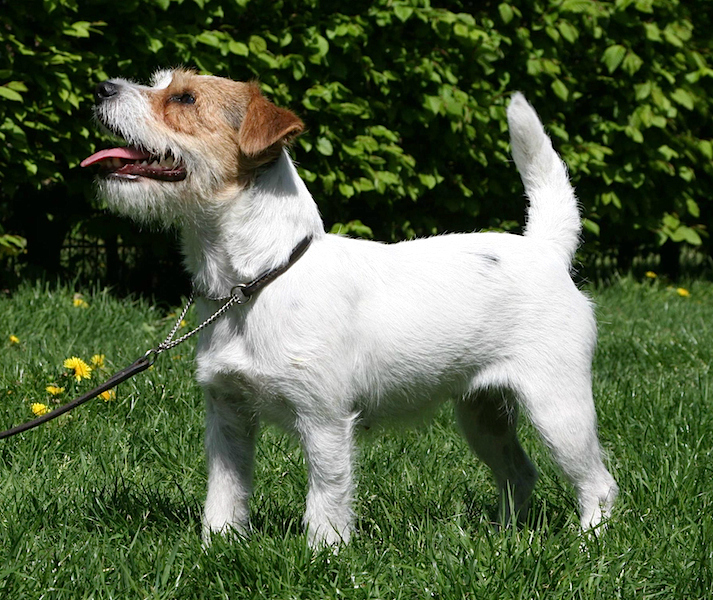
This is a small, sturdy, balanced terrier built for going to ground, standing roughly 25 to 30 cm at the shoulder and weighing in the region of 5 to 8 kg. The body is slightly longer than tall, lean and athletic rather than stocky. The coat comes in three types, smooth, broken and rough, all harsh and weatherproof, and is predominantly white with markings in black, tan or both, often around the head and at the tail. The head is wedge-shaped with dark almond eyes and small V-shaped button ears that fold forward. The tail is set high and carried up when the dog is on the move, and the whole impression is one of alertness and readiness for action.
Suitability
A house with a well-fenced yard suits this breed best, and the fencing needs to be solid because Jacks are champion diggers and escape artists. They can manage in an apartment only with an owner truly committed to heavy daily exercise and mental work, as the energy has to go somewhere. The ideal owner is active, has a sense of humour about terrier antics, and ideally has handled a strong-willed dog before. They tolerate normal time alone if properly exercised but become destructive and noisy if under-stimulated or lonely. Their prey drive makes them a poor choice for homes with small pets. The short coat handles the Australian climate well, needing only the usual shade, water and sensible avoidance of midday heat in summer.
Health
Jack Russells are a tough, long-lived breed, commonly reaching 13 to 16 years. They are generally healthy but a few inherited conditions are well recognised. Patellar luxation (slipping kneecaps) and Legg-Calve-Perthes disease both affect the hindlimbs and a careful breeder screens for them. Several hereditary eye conditions occur, including primary lens luxation, for which a DNA test exists, along with cataract, so annual eye testing of breeding dogs is worthwhile. Deafness turns up in some heavily white-marked lines, and ataxia and other neurological conditions appear in particular families. Look for a breeder who eye tests, checks patellas, and DNA tests for primary lens luxation, and who can speak to deafness and joint health in their dogs.
Find your Jack Russell Terrier
Browse trusted Jack Russell Terrier breeders across Australia and read genuine reviews from real owners, or take the quiz to be sure of the fit.