
Japanese Chin
Chin, Japanese Spaniel
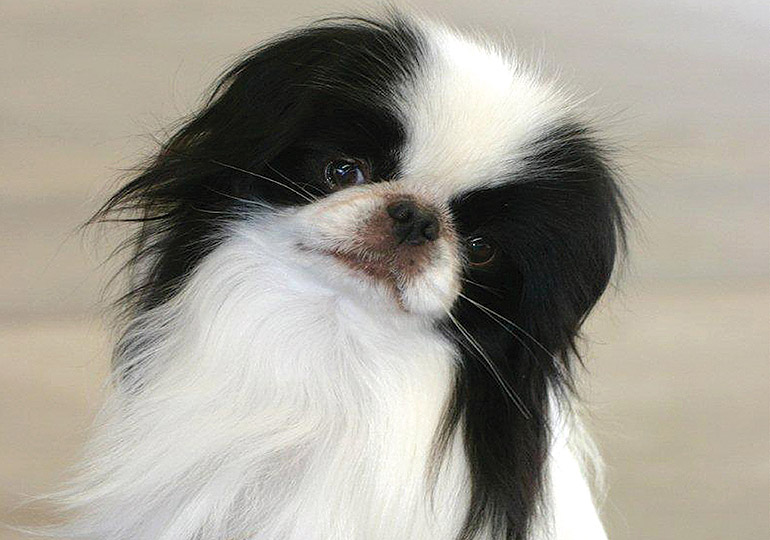
The Japanese Chin is a small, elegant toy dog with a flat face, big dark eyes and a flowing silky coat, bred for centuries purely as a companion to nobility. It is a quiet, refined little dog, affectionate and devoted to its people, often described as almost cat-like in its grace and its habit of perching on the backs of furniture. The Chin is gentle and well-mannered rather than rowdy, with modest exercise needs met by short walks and indoor play, which makes it well suited to quieter homes. The long coat looks demanding but is surprisingly easy to keep with regular brushing. As a flat-faced breed it can struggle with heat and breathing, a point that matters a great deal in the Australian climate. It suits someone wanting a calm, charming indoor companion.
Size
Smallest
Lifespan
10-12 years
Group
Group 1 - Toys
Height
Male: 20-25 cm (8-10 inches), Female: 20-25 cm (8-10 inches)
Weight
Male: 3-5 kg (6-11 lbs), Female: 3-5 kg (6-11 lbs)
Origin
Japan
Compatibility & care
How this breed fits into life with you
Scores are out of 5. Tap the help icon next to any trait to see what it really means.
Personality
How they think and behave
With family
Who they get along with
Care needs
What they ask of you
Origin & history
Despite the name, the breed's roots are usually traced to China and the Asian mainland, from where small flat-faced lap dogs were given as gifts to the Japanese court, probably more than a thousand years ago. In Japan the Chin was refined and kept as a treasured companion of the aristocracy, bred for beauty and charm rather than any work. The breed reached the West in the 19th century, partly through trade and diplomatic gifts after Japan opened to foreign contact, and became fashionable in Europe and America. In Australia it is an uncommon but long-established toy breed, kept almost entirely as a house companion and shown by a small group of enthusiasts. Its whole history is one of companionship, which shows clearly in its temperament today.
Temperament
The Chin is a gentle, affectionate and notably sensitive companion that forms a close, almost devoted bond with its owner and is happiest in their company. It is usually good with considerate children and with other pets, and being small and non-confrontational it tends to live peacefully alongside other dogs and cats. With strangers it is often reserved or dignified rather than effusive, warming up in its own time, and it may give a quiet alert at the door but is no real watchdog. The breed is intelligent and has a quirky, playful, sometimes comical side, but it is also proud and a little independent, so it responds to gentle, positive training and not at all to harsh handling, which simply upsets it. Its key needs are companionship and calm; it dislikes being left alone for long and thrives in a settled, affectionate household.
Appearance
This is a small, square, well-balanced toy dog, typically standing around 20 to 27 cm at the shoulder and weighing roughly 2 to 5 kg. The head is broad with a short, flat face, a clearly defined stop and a small upturned muzzle, set with large, wide-set dark eyes that often show a little white in the inner corner, giving the breed its characteristic look of surprise. The coat is long, straight and silky, single rather than heavy, with a profuse mane, feathered ears, and a plumed tail carried over the back. Colours are white with patches of black, or white with red or sable, and a symmetrical facial pattern is prized. The overall impression is dainty and aristocratic.
Suitability
This breed is well suited to apartment living and to quieter, more relaxed owners, including older people, since its exercise needs are light and it is naturally clean and undemanding. It strongly prefers company and does not do well left alone for long stretches, so it fits a household where someone is around much of the day. It is reasonably first-timer friendly for a gentle owner, with the main caution being its delicacy and its flat-faced health needs rather than any difficulty in temperament. The most important point for Australian owners is heat: as a brachycephalic breed the Chin overheats dangerously easily, so it must be kept cool in summer, exercised only in the cool of the day, given constant shade and water, and never left in a hot car or room.
Health
Japanese Chin generally live a good while, often around 12 to 14 years. As a flat-faced (brachycephalic) breed the main welfare issue is breathing: many cope reasonably but they can suffer from brachycephalic airway problems and they overheat easily, so heat management is a genuine health matter rather than a minor concern. The prominent eyes are vulnerable to injury, ulcers and conditions such as dry eye and cataract, so eye testing of breeding stock is sensible. Patellar luxation (slipping kneecaps) is common in the breed and worth screening. Heart murmurs and some neurological conditions also occur in certain lines. Choose a breeder who pays attention to breathing and nostril openness, eye tests, checks patellas, and does not breed for an extreme, over-flattened face that makes the airway problems worse.
Find your Japanese Chin
Browse trusted Japanese Chin breeders across Australia and read genuine reviews from real owners, or take the quiz to be sure of the fit.