
Koolie
Australian Koolie, German Koolie, German Coolie
The Koolie is an Australian herding breed developed on farms and stations for working stock, and it remains first and foremost a working dog. It is intensely intelligent, athletic and driven, with the stamina and biddability to work cattle and sheep all day. That makes it a brilliant partner for an active owner and a difficult pet for a sedentary one. Koolies bond closely with their people, are quick to learn and excel at herding, agility and other dog sports. They are generally good with children and other dogs when well socialised, but the strong herding instinct can show as chasing or nipping at heels. They need a lot of physical exercise and, just as importantly, mental work. Coats vary from short to medium and need only modest grooming. A bored or under-stimulated Koolie will find its own job, usually one you would rather it did not, so this breed needs an owner who can keep it busy.
Size
Medium to Large
Lifespan
16-18 years
Group
Not ANKC Recognised
Height
Male: 40-60 cm (16-24 inches), Female: 40-55 cm (16-22 inches)
Weight
Male: 16-20 kg (35-45 lbs), Female: 14-18 kg (30-40 lbs)
Origin
Australia
Compatibility & care
How this breed fits into life with you
Scores are out of 5. Tap the help icon next to any trait to see what it really means.
Personality
How they think and behave
With family
Who they get along with
Care needs
What they ask of you
Origin & history
The Koolie is one of Australia's working dog breeds, developed by colonial-era stockmen from British herding dogs brought out in the nineteenth century and bred purely for the ability to work sheep and cattle across big, demanding country. Unlike the Kelpie or the Australian Cattle Dog, the Koolie was never bred to a single fixed appearance, which is why the breed still varies so much in size, coat and colour: function always came before looks. For generations Koolies were a station and farm dog known mostly to the people who worked them, passed along working bloodlines rather than show pedigrees. In more recent decades the breed has become better organised, with the Koolie Club of Australia and others recording dogs and promoting the breed, and it has built a following in dog sports and as an active companion. The Koolie is not recognised as a standardised pedigree breed by the ANKC in the way the Kelpie is, reflecting its working, type-varied origins.
Temperament
The Koolie is intelligent, energetic and intensely focused, a dog that genuinely wants to work and to please. It bonds strongly with its owner and is usually devoted, sensitive and very responsive to training, picking up new tasks fast and thriving on having a role. With family it is affectionate and loyal, and well-socialised Koolies are generally good with children and tolerant of other dogs and household pets. The herding instinct is the trait to manage: many will try to gather and control movement, which can mean circling, chasing or nipping at the heels of running children, pets or bikes if it is not redirected into proper outlets. They are alert and will let you know when something is up, though they are not guard dogs. The breed's biggest behavioural need is simply enough to do; a Koolie without sufficient exercise and mental challenge becomes restless, anxious and inventive in unwanted ways. Early socialisation and consistent, reward-based training bring out the best in them.
Appearance
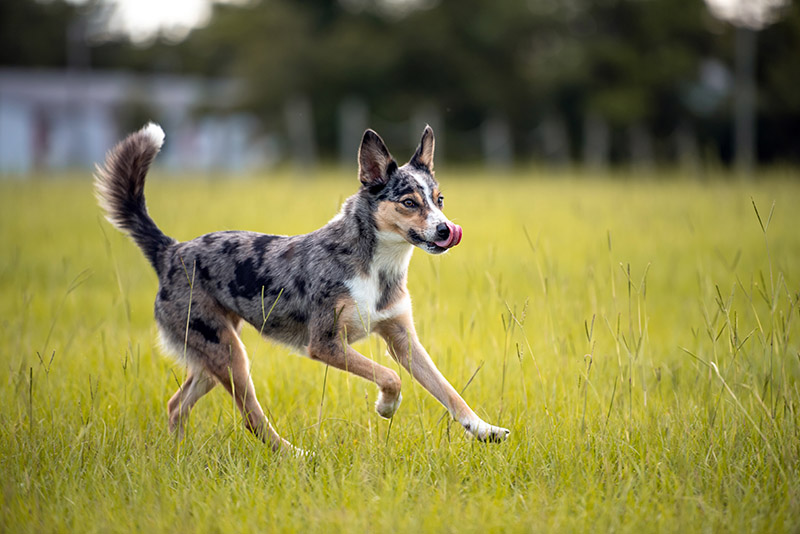
There is no single Koolie look, which is part of the breed's character. Most are medium-sized and athletic, commonly standing around 40 to 60cm at the shoulder and weighing roughly 15 to 25kg, built for speed, agility and endurance rather than bulk. The coat may be short, medium or occasionally longer, and is generally easy to care for. Colour is highly variable: solid black or red, black and tan, and especially merle, where a marbled pattern overlays the base colour, are all common, often with white markings. Eyes can be brown, blue or one of each, particularly in merle dogs. The overall impression is of a lean, alert, quick working dog rather than a fixed show type.
Suitability
Koolies suit active owners and working homes, ideally a house with a securely fenced yard or a rural property, and they fit naturally with people involved in farming, dog sports or an outdoor, energetic lifestyle. They are a poor match for apartments, for owners who are out all day, or for anyone who wants a low-energy dog, and they are best for owners who can commit to daily exercise and training rather than absolute beginners after an easy pet. They do not enjoy being left alone with nothing to do and can become destructive when bored. Being a home-grown Australian breed, the Koolie generally handles the local climate well, but like any active dog it needs shade, plenty of water and exercise scheduled for the cooler parts of the day in summer. Give a Koolie a job and it will repay you many times over.
Health
Koolies are generally a healthy, hardy working breed, and many are active well into their teens, with lifespans often quoted around 12 to 18 years. The most important health issue is tied to the merle coat that is so common in the breed. Breeding two merle dogs together produces a high risk of "double merle" puppies that are often deaf, blind, or both, so a responsible Koolie breeder never mates merle to merle and can explain the coat colours of both parents. Congenital deafness can occur in merle lines even outside double-merle matings, and BAER hearing testing is a useful check. Eye abnormalities are also worth screening for, and as a herding breed some Koolies carry the MDR1 gene that affects sensitivity to certain medications, for which a simple DNA test exists. Hip dysplasia is seen as in most active breeds. A good breeder will test or screen appropriately and be open about the parents' colours and health.
Find your Koolie
Browse trusted Koolie breeders across Australia and read genuine reviews from real owners, or take the quiz to be sure of the fit.