
Miniature American Shepherd
North American Shepherd, Mini American, MAS, Ameri
The Miniature American Shepherd, still widely called the Mini Aussie, is a small herding dog packed with the brains and drive of a full-sized Australian Shepherd. Standing knee-high or thereabouts, it is athletic, quick to learn and happiest with a job to do. This is not a low-maintenance lap dog. Expect a dog that wants daily exercise, training games, scent work or a dog sport, and one that can get nippy, vocal or destructive when bored. They bond hard to their people and can be reserved with strangers. They suit active owners, agility and obedience enthusiasts, and rural or suburban families who will actually engage their minds. They are a poor match for someone after a calm, sleep-all-day companion or anyone out of the house long hours. The medium-length double coat sheds and needs a thorough brush once or twice a week, more when it blows.
Size
Small to Medium
Lifespan
13-15 years
Group
Group 5 - Working Dogs
Height
Male: 36–46 cm (14–18 inches), Female: 33–43 cm (13–17 inches)
Weight
Male: 9-16 kg (20-35 lbs), Female: 8-14 kg (18-30 lbs)
Origin
United States
Compatibility & care
How this breed fits into life with you
Scores are out of 5. Tap the help icon next to any trait to see what it really means.
Personality
How they think and behave
With family
Who they get along with
Care needs
What they ask of you
Origin & history
This is a young breed, developed in the United States from the 1960s onwards by crossing and selecting smaller Australian Shepherds, themselves an American creation despite the name. Early breeders on the California show and rodeo circuit wanted a compact dog with all the herding ability and trainability of the Aussie in a more portable size. They were known for years as Miniature or North American Shepherds before the American Kennel Club recognised the breed in 2015 under the Miniature American Shepherd name to separate it cleanly from the standard Aussie. The working roots show: these dogs were bred to move stock and travel light, and many still herd, compete in agility and obedience, and work as active companions. In Australia the breed is gaining a following among dog-sport people, and the ANKC recognises it within the working dog group.
Temperament
Bright, biddable and intensely loyal, the Mini Aussie wants to be with its family and involved in whatever is happening. With children it is usually devoted and playful, though the herding instinct can show as chasing or heel-nipping, so supervise and redirect young pups. They tend to be aloof or watchful with strangers rather than instantly friendly, and they make alert little watchdogs that will bark to announce visitors. With other dogs and household pets they generally do well when raised together, but the urge to herd cats or livestock can be strong. Trainability is a highlight: they pick things up fast and thrive on reward-based training, but that same cleverness means they invent their own jobs if you do not provide one. They are not especially independent and dislike being left alone for long stretches. Give them daily physical exercise, mental work and clear, consistent guidance.
Appearance
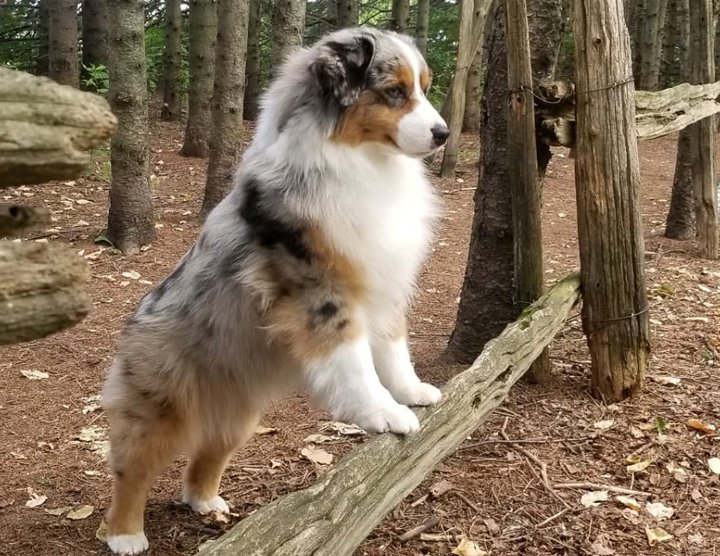
A small, well-balanced herding dog, slightly longer than tall. Males stand roughly 36 to 46 cm at the shoulder and females a touch less, with weight usually in the 9 to 18 kg range depending on size and substance. The coat is a medium-length weather-resistant double coat with feathering on the legs and a fuller ruff. Common colours are black, blue merle, red and red merle, each with or without white and copper points. Eyes can be brown, blue, amber or any combination, and split or marbled eyes are common in merles. Ears are set high and break forward. The tail is naturally short in some lines or docked where still permitted, though docking is restricted in much of Australia.
Suitability
This breed suits an active household far more than a quiet one. A house with a securely fenced yard is ideal, though they can live in a smaller home if the owner is committed to daily exercise and training. They are reasonably first-timer friendly for someone willing to put the work in, but a totally hands-off owner will struggle. They do not cope well with being left alone all day and can develop barking or destructive habits, so they fit people who are home often or can take the dog along. The double coat gives decent protection in cool weather, and they handle the Australian heat acceptably if you walk them in the cooler parts of the day and provide shade and water. Merles should have their eyes and hearing checked and need sun protection on any pink skin.
Health
Most Miniature American Shepherds live around 12 to 15 years. The breed shares several conditions with the Australian Shepherd. Hip dysplasia and elbow dysplasia occur, so look for parents with hip and elbow scores. Inherited eye disease is a real concern, including progressive retinal atrophy, cataracts, collie eye anomaly and persistent pupillary membranes, so breeding dogs should have current eye certificates and relevant DNA testing. The MDR1 (now ABCB1) gene mutation is common in this breed and affects sensitivity to certain worming and anaesthetic drugs, so a DNA test for MDR1 is genuinely important and should be discussed with your vet. Buy from a breeder who DNA-tests for PRA and MDR1, screens hips and elbows, and has annual eye examinations done by a veterinary ophthalmologist. Ask to see the certificates rather than taking a verbal assurance.
Find your Miniature American Shepherd
Browse trusted Miniature American Shepherd breeders across Australia and read genuine reviews from real owners, or take the quiz to be sure of the fit.