
Mastiff
English Mastiff, Old English Mastiff
The Mastiff, often called the English Mastiff, is one of the largest dogs in the world, a giant, heavy-boned breed with a deep history as a guardian. For all its imposing bulk it is typically calm, steady and gentle, devoted to its family and naturally protective without being aggressive. This is a quiet, dignified dog that wants to be near its people rather than off doing its own thing. Exercise needs are surprisingly moderate, steady daily walks suit it better than hard running, and as a giant breed its joints should not be over-exercised while young. It needs serious space, and the size, the drool and the cost of feeding and vet care mean it does not suit small homes or anyone underestimating what a giant breed involves. The short coat is easy to groom but sheds. First-time owners should go in with their eyes open.
Size
Giant
Lifespan
10-12 years
Group
Group 6 - Utility
Height
Male: 76 cm (30 inches), Female: 70 cm (27.5 inches)
Weight
Male: 72-104 kg (160-230 lbs), Female: 54-77 kg (120-170 lbs)
Origin
United Kingdom
Compatibility & care
How this breed fits into life with you
Scores are out of 5. Tap the help icon next to any trait to see what it really means.
Personality
How they think and behave
With family
Who they get along with
Care needs
What they ask of you
Origin & history
The Mastiff is an ancient guardian and war dog, and large mastiff-type dogs were recorded in Britain in Roman times, valued by the Romans who reportedly sent some back to fight in the arena. Through the Middle Ages and beyond, these big dogs were kept in England to guard estates, hold large game at bay and protect homes and livestock, bred above all for size, strength and a steady protective nature. The modern English Mastiff was shaped in nineteenth century England into the giant, dignified breed seen today. The breed came close to disappearing after the two World Wars, when feeding such large dogs was impossible for many, and was rebuilt from a small number of survivors with help from North American stock. It remains a well-known if not especially common breed in Australia.
Temperament
The Mastiff is famously gentle, calm and good-natured, the classic gentle giant, placid and patient at home and strongly attached to its family. It is loyal and naturally protective, an effective deterrent simply by its presence, yet a well-bred Mastiff is steady and not aggressive, more likely to stand its ground quietly than to react. It is usually good with children and very tolerant, though its size means it can easily knock over a toddler, so supervision is sensible. With strangers it tends to be reserved and watchful rather than friendly, and early socialisation is important to keep that wariness balanced. It can be dog-selective, particularly between same-sex adults. It is intelligent but has an independent, sometimes stubborn streak, so it needs calm, consistent, reward-based training from puppyhood, while the dog is still small enough to manage easily.
Appearance
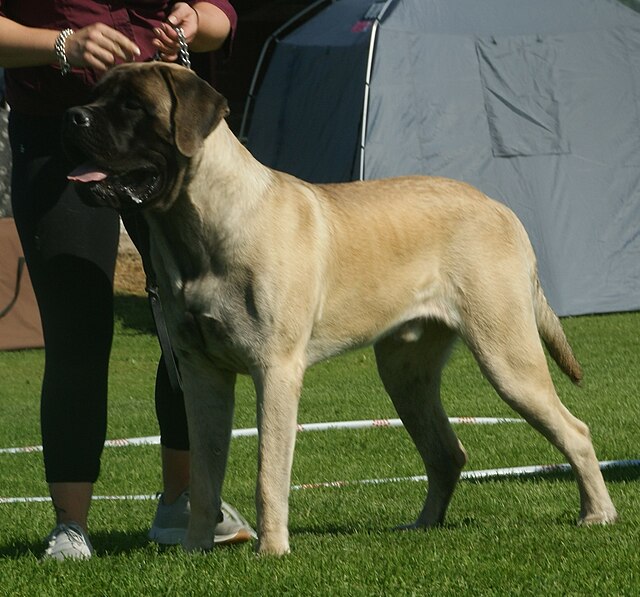
One of the heaviest of all breeds. Males stand from about 76 cm at the shoulder and commonly weigh 70 to 100 kg or more, with females large but somewhat lighter. The build is massive and rectangular, deep through the body with heavy bone and powerful muscle. The coat is short, dense and close, in fawn, apricot or brindle, and the breed is marked by a dark mask over the muzzle and around the eyes. The head is huge and broad with a short muzzle, a wrinkled brow, dark eyes and small drop ears, giving the serious, watchful expression typical of the breed. Some drool and loose flews go with the territory.
Suitability
A Mastiff needs a house with plenty of room and suits owners who have the space, the budget and ideally some experience with large or giant breeds. It is not a dog for apartments or small yards, and the feeding, veterinary and general costs of a giant breed are substantial. It is not very active and is happy indoors with its family, but it must have early training and socialisation while still a manageable size. It is deeply attached to its people and does not do well left alone for long stretches. On climate, the heavy build, short muzzle and dark mask mean real heat sensitivity, so an Australian Mastiff needs constant shade, plenty of water, a cool place to rest and exercise kept to the cooler parts of the day, as these dogs overheat easily.
Health
Like most giant breeds the Mastiff is not long-lived, with a typical span of only around 7 to 10 years, something to weigh up before taking one on. As a deep-chested giant the most urgent risk is bloat and gastric torsion, a sudden emergency where the stomach distends and twists, so owners must know the signs and respond immediately. Hip and elbow dysplasia, where the joints develop abnormally and lead to arthritis, are common in the breed and the parents should be hip and elbow scored. Heart disease, including dilated cardiomyopathy, occurs and warrants cardiac screening in breeding stock. Several eye conditions are also seen. Giant dogs are sensitive to anaesthetic dosing too. Choose a breeder who scores hips and elbows, has the parents heart and eye tested, and breeds for soundness and health rather than extreme size.
Find your Mastiff
Browse trusted Mastiff breeders across Australia and read genuine reviews from real owners, or take the quiz to be sure of the fit.