
Miniature Pinscher
Min Pin, King Of The Toys, Reh Pinscher, Zwergpinsc
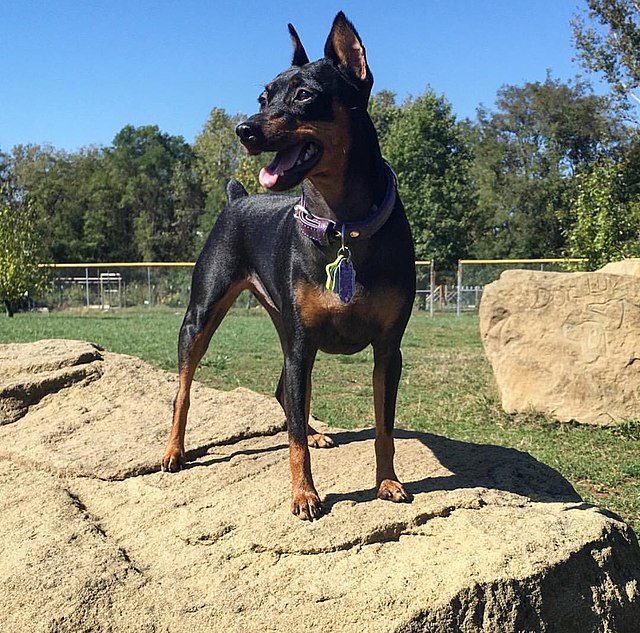
The Miniature Pinscher is a tiny, fine-boned toy dog with an outsized personality and a distinctive high-stepping, prancing gait. Often nicknamed the King of Toys, it is fearless, busy and self-assured, with a real terrier-like spark despite being a toy breed. They are alert and quick to sound off, which makes them effective little watchdogs but also means they can be yappy without training. Energetic and curious, they need daily walks and play and enjoy having things to investigate. They bond closely with their people and can be bossy. They suit owners who find a confident, lively small dog endearing and who will set consistent rules. They are less ideal for homes with very young children, given their small, delicate frame, or for anyone wanting a placid lap-warmer. The sleek short coat needs almost no grooming beyond a quick wipe-over.
Size
Smallest
Lifespan
12-15 years
Group
Group 1 - Toys
Height
Male: 25-30 cm (10-12 inches), Female: 25-30 cm (10-12 inches)
Weight
Male: 3.5-4.5 kg (8-10 lbs), Female: 3.5-4.5 kg (8-10 lbs)
Origin
Germany
Compatibility & care
How this breed fits into life with you
Scores are out of 5. Tap the help icon next to any trait to see what it really means.
Personality
How they think and behave
With family
Who they get along with
Care needs
What they ask of you
Origin & history
Despite a passing resemblance to a small Dobermann, the Miniature Pinscher is the older breed and is not a scaled-down Dobermann at all. It comes from Germany, where it was known as the Reh Pinscher and developed over a long period as a stable and farm ratter, prized for nerve and speed in dealing with vermin. Its ancestry is generally thought to include the German Pinscher along with Dachshund and small Italian Greyhound influence, which helps explain the elegant outline and springy movement. The breed became popular in Germany and Scandinavia in the late 1800s and early 1900s, and after the World Wars it spread to Britain, the United States and elsewhere. The flashy hackney-like gait became a signature trait. In Australia the ANKC recognises the Miniature Pinscher within the toy group, where it remains a small but devoted following.
Temperament
Bold, busy and full of confidence, the Min Pin behaves like a big dog in a small body. With its family it is affectionate, playful and very attached, often picking a favourite person and shadowing them. It is naturally wary of strangers and quick to bark, which makes it a keen watchdog but also means early socialisation is needed to keep that alertness from tipping into nervous yapping. With children it can be a delightful companion for sensible older kids, but it is too small and too quick to take offence to suit rough toddlers. Around other dogs it is fearless to the point of recklessness and will happily challenge much larger animals, so supervision matters, and its strong prey drive means small pets like rodents are not safe with it. It is intelligent and trainable but also independent and a touch stubborn, so consistent, reward-based training and firm, kind boundaries get the best results. Without enough exercise and mental work it can become demanding, vocal and prone to escaping.
Appearance
A small, sleek, square-built toy dog that looks compact and well-muscled rather than dainty. Height is about 25 to 30 cm at the shoulder, with weight usually around 4 to 5 kg. The coat is short, hard, smooth and glossy and lies close to the body. The classic colours are clear red and stag red, plus black or chocolate with sharp rust-red markings on the face, chest and legs. The head is wedge-shaped with bright, dark eyes and high-set ears that may be naturally erect or, in some countries historically, cropped, though cropping is illegal in Australia. The hallmark is the gait: a bold, high lift of the front feet that gives the breed its showy, prancing action.
Suitability
The Miniature Pinscher adapts well to apartment or house living thanks to its size, but it is busier and more vocal than many toy breeds, so it needs daily walks, play and training rather than just a cushion. It is a fair choice for a first-time owner who is ready to be consistent and to socialise it well, since an unchecked Min Pin can become bossy and noisy. It dislikes being left alone for long periods and does better with company or a companion. A secure yard or fencing is important because these little dogs are agile, curious escape artists. On climate, the short single coat offers little protection, so they feel the cold and need a coat in a Melbourne or Tasmanian winter, and while they handle warm Australian weather better than heavy-coated breeds, they still need shade, water and sensible care on hot days.
Health
Miniature Pinschers are long-lived for a purebred, often reaching 12 to 16 years. The most common orthopaedic problem is patellar luxation, a slipping kneecap that can cause skipping lameness, and breeding dogs should have their knees checked. Legg-Calve-Perthes disease, where the hip joint degenerates in young dogs, also occurs in the breed. On the eye side, progressive retinal atrophy is the key inherited concern, and a DNA test is available for the relevant form, so ask whether the parents are tested or clear by parentage. Lens luxation can also be seen. Their fine build and tiny mouths make dental disease common, so regular tooth care matters. Buy from a breeder who checks patellas, DNA-tests or eye-tests for PRA, and is honest about hip and knee history in the line. Because they are small and bold, they also need protecting from injury and from getting cold in winter.
Find your Miniature Pinscher
Browse trusted Miniature Pinscher breeders across Australia and read genuine reviews from real owners, or take the quiz to be sure of the fit.