
Manchester Terrier
Black and Tan Manchester, Black and Tan Terrier, English Toy Terrier
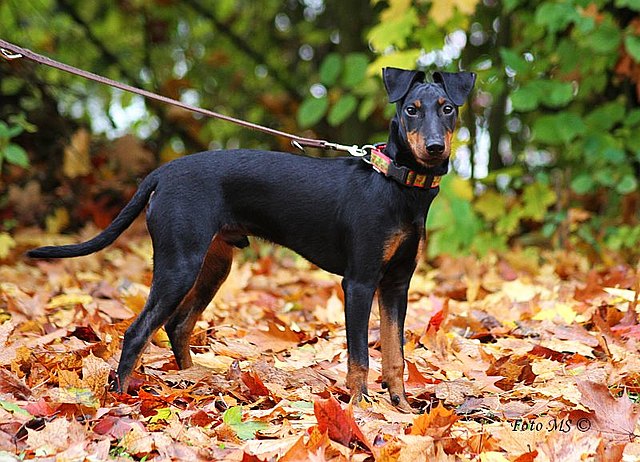
The Manchester Terrier is a sleek, black and tan terrier with an elegant outline and a sharp, busy mind. Bred as a ratter, it keeps that quick, game terrier character, alert and lively, but it is also genuinely affectionate and devoted to its own people. There are two sizes internationally, a standard and a toy, the toy variety known in some countries as the English Toy Terrier. These are energetic dogs that need daily exercise and something to occupy them, and they do well at obedience and agility. They suit an active owner who enjoys a clever, interactive dog and will not appreciate being left idle, as a bored Manchester can find its own mischief. Grooming is about as easy as it gets, a short, glossy coat that needs only an occasional brush. The prey drive is real, so small pets and off-lead reliability need thought.
Size
Smallest, Small
Lifespan
14-16 years
Group
Group 2 - Terriers
Height
Toy: 25-30 cm (10-12 inches), Standard: 39-40 cm (15-16 inches)
Weight
Male: 5.5-10 kg (12-22 lbs), Female: 4.5-8 kg (10-18 lbs)
Origin
United Kingdom
Compatibility & care
How this breed fits into life with you
Scores are out of 5. Tap the help icon next to any trait to see what it really means.
Personality
How they think and behave
With family
Who they get along with
Care needs
What they ask of you
Origin & history
The Manchester Terrier was developed in nineteenth century England, in and around the city it is named for, by crossing the old Black and Tan Terrier with the Whippet to create a fast, agile dog that could kill rats. This was a working dog of the industrial north, used in rat-catching and the rat pits that were a grim popular pastime of the era, as well as coursing rabbits. It was once simply called the Black and Tan Terrier before the modern name settled. The breed split into two sizes, and the smaller toy form was refined separately, becoming the English Toy Terrier in Britain. Numbers fell over the twentieth century and the Manchester is now an uncommon breed, including in Australia, kept going by a small group of enthusiasts.
Temperament
This is a bright, spirited terrier that bonds firmly with its family and is genuinely affectionate at home, often attaching strongly to one person. They are loyal and observant, which makes them keen little watchdogs quick to sound the alarm, though they are not aggressive. With children they are usually good, especially older ones, and they are playful and full of character. Around other dogs they are generally fine, but the terrier prey drive means cats and small pets such as rabbits or rodents can be a problem, true to their ratting roots. They are clever and trainable and enjoy having their minds worked, yet they have an independent terrier streak and respond far better to reward-based methods than to heavy-handedness. The main behavioural needs are daily exercise, mental stimulation and a securely fenced yard.
Appearance
A compact, clean-lined terrier. The standard size stands roughly 38 to 41 cm and weighs about 5 to 10 kg, while the toy variety is smaller at around 25 to 30 cm and 3 to 4 kg. The build is sleek and muscular with a slightly arched back and a deep, narrow chest. The coat is short, dense and glossy, always black and tan, with sharply defined rich mahogany markings in a set pattern over the eyes, on the muzzle, chest and legs. The head is long and wedge-shaped with small, dark, almond-shaped eyes. The standard variety may have button or naturally erect ears, while the toy always carries large, erect candle-flame ears. The tail tapers and is carried low.
Suitability
A Manchester Terrier adapts well to apartment or house living as long as it gets proper daily exercise and something to think about, and it suits an active owner who wants an engaged, interactive companion. They can work for a switched-on first-time owner who is ready to channel terrier energy and manage the prey drive, particularly around small pets. They form strong attachments and would rather not be left alone all day, though with enough exercise and stimulation they cope with normal working hours better than many companion breeds. On climate, the short single coat gives little insulation, so they feel the cold and appreciate a coat in winter, while in the Australian heat the usual sense applies, shade, fresh water and exercise in the cooler parts of the day.
Health
Manchester Terriers are generally robust and often live around 13 to 16 years. A few inherited conditions are well established and worth testing for. Von Willebrand disease, a blood-clotting disorder, occurs in the breed and has a reliable DNA test. There is also a specific inherited heart condition, juvenile dilated cardiomyopathy, recognised in young Manchester Terriers, and a DNA test is now available for it. Patellar luxation and a couple of eye conditions are seen as well, and the toy variety shares the dental crowding common to very small dogs. Responsible breeders should be able to show DNA results for von Willebrand disease and the juvenile cardiomyopathy mutation, along with eye testing and patellar checks on the parents. Asking for these is the best way to avoid the conditions that matter in this breed.
Find your Manchester Terrier
Browse trusted Manchester Terrier breeders across Australia and read genuine reviews from real owners, or take the quiz to be sure of the fit.