
Miniature Bulldog
Bull-pug, Mini-bulldog, English Toy Bulldog
The Miniature Bulldog is not a recognised pedigree breed but a cross, most often a British (English) Bulldog mated with a Pug, and sometimes simply a smaller-bred Bulldog. Because it is a cross, looks and temperament vary from dog to dog, but the aim is a smaller, stocky companion with a flat face, wrinkles and an easygoing, affectionate nature. They tend to be friendly, people-oriented and fairly low-energy, content with short walks and plenty of company. The flat-faced (brachycephalic) build is the big caveat: many struggle to breathe well, overheat easily and are prone to a long list of health problems, so this is a dog to buy with eyes wide open and from someone breeding for healthier, more open faces. They suit relaxed owners who want a couch companion and can manage potentially significant vet care. The short coat is easy, but facial wrinkles need regular cleaning.
Size
Small
Lifespan
9-12 years
Group
Not ANKC Recognised
Height
Male: 27-35 cm (10.5-13.5 inches), Female: 25-33 cm (10-13 inches)
Weight
Male: 7-11 kg (16-25 lbs), Female: 6-10 kg (14-22 lbs)
Origin
United Kingdom
Compatibility & care
How this breed fits into life with you
Scores are out of 5. Tap the help icon next to any trait to see what it really means.
Personality
How they think and behave
With family
Who they get along with
Care needs
What they ask of you
Origin & history
This is a modern designer cross rather than a historic breed, popularised over the last few decades by demand for a smaller Bulldog-type pet. The usual recipe is the British Bulldog crossed with the Pug, two breeds that both descend from older mastiff and bulldog stock and that were themselves shaped heavily by fashion. The Bulldog traces to the bull-baiting dogs of England before that cruel practice was banned in 1835, after which breeders turned it into a companion, exaggerating the broad head and short muzzle along the way. The Pug is an ancient Chinese toy breed brought to Europe by traders. Crossing the two does not erase the flat-faced problems both carry. The ANKC does not recognise the Miniature Bulldog as a pedigree breed, and there is no breed standard, so there is no consistent type and no formal health-testing scheme behind it.
Temperament
Temperament in a cross is less predictable than in a pedigree, but most Miniature Bulldogs are affectionate, sociable and keen on human company, blending the steady good nature of the Bulldog with the cheeky charm of the Pug. They are usually gentle and tolerant with children and tend to greet strangers happily rather than guard. With other dogs and pets they are generally amenable, especially when socialised young, though some inherit a stubborn streak. They are not high-drive working dogs; they like comfort, food and company more than long exertion. Trainability is moderate. They can be a little obstinate and respond best to short, reward-based sessions and patience with house-training. The flip side of their devotion is that they hate being left alone and can become clingy or anxious. Their key needs are companionship, gentle daily activity that never overheats them, weight control, and scrupulous attention to breathing and skin.
Appearance
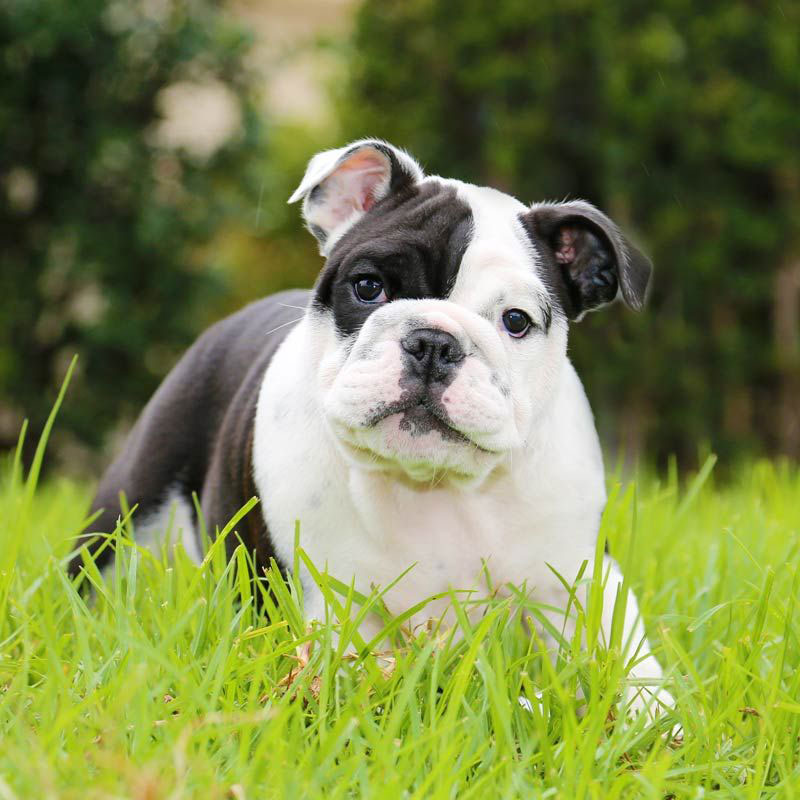
As a cross, appearance is not fixed, but the typical Miniature Bulldog is a small, thickset, low-slung dog usually around 25 to 36 cm tall and roughly 7 to 14 kg, lighter and a little leggier than a full British Bulldog. The head is broad with a short muzzle and a flat face, and the body is compact and muscular with a wide chest. Skin folds and wrinkles, especially around the face, are common. The coat is short, smooth and easy to groom. Colours vary widely and include fawn, brindle, white, fawn-and-white and pied, often with a darker mask. Some dogs inherit a more Pug-like curled tail, others the screw tail of the Bulldog.
Suitability
A Miniature Bulldog suits a relaxed home where someone is around most of the day, including apartments, since exercise needs are modest. They are reasonably first-timer friendly in terms of temperament, but a first-time owner must understand and budget for the health risks that come with a flat-faced dog. They do not tolerate being left alone for long and prefer constant company. The most important point for Australian owners is heat: brachycephalic dogs overheat dangerously fast and are at real risk of fatal heatstroke, so keep them indoors with cooling on hot days, exercise only in the cool of early morning or evening, never leave them in a car, and watch closely for laboured breathing. Keep them lean, as excess weight makes the breathing far worse.
Health
Lifespan is usually around 9 to 12 years, and prospective owners should go in expecting potential health costs. As a flat-faced cross of two brachycephalic breeds, the biggest concern is brachycephalic obstructive airway syndrome, which causes noisy, laboured breathing, exercise intolerance and serious heat sensitivity. Eye problems are common because the shallow sockets leave the eyes exposed, including ulcers and dry eye. Skin-fold dermatitis develops in the facial and body wrinkles if they are not kept clean and dry. They are also prone to dental crowding, spinal issues such as hemivertebrae (linked to screw tails), patellar luxation and hip dysplasia, and many cannot whelp naturally. There is no formal pedigree health scheme, so choose a breeder who prioritises open nostrils and a longer muzzle, screens the parents for breathing, eye, knee and hip problems, and does not breed the most extreme-faced dogs. Be honest with yourself about the welfare trade-offs.
Find your Miniature Bulldog
Browse trusted Miniature Bulldog breeders across Australia and read genuine reviews from real owners, or take the quiz to be sure of the fit.