
Norwich Terrier
Nowichy
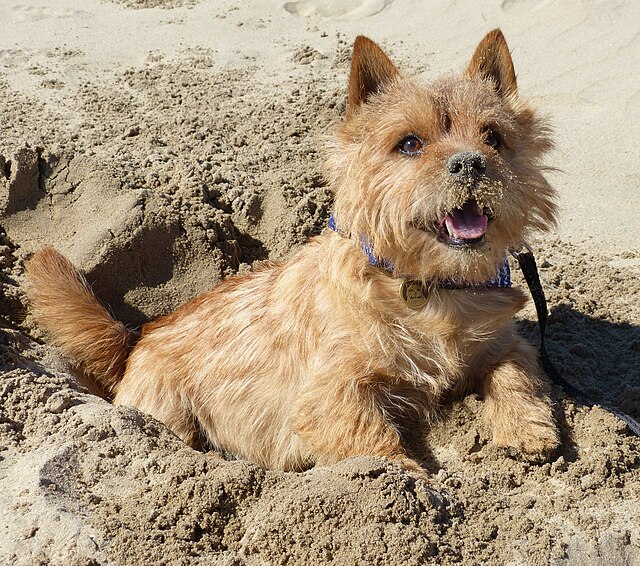
The Norwich Terrier is one of the smallest working terriers, a compact, hardy little dog with a big personality and a genuine terrier engine under the bonnet. Bred to bolt rats and follow foxes underground, it is bold, busy, curious and affectionate, and it generally loves being with its people rather than being a yappy ornament. Energy needs are moderate but real: daily walks plus play and a bit of training keep it satisfied, and a bored Norwich will dig and bark. It suits families, couples and active older owners who want a sturdy small dog that can still walk a decent distance. It is less suited to homes wanting a placid lapdog or one that will reliably ignore the local cat or rabbit. The harsh wiry coat sheds little but needs hand-stripping a couple of times a year to stay in proper condition.
Size
Smallest
Lifespan
12-15 years
Group
Group 2 - Terriers
Height
Male: 23-25 cm (9-10 inches), Female: 23-25 cm (9-10 inches)
Weight
Male: 4.5-5.5 kg (10-12 lbs), Female: 3.5-4.5 kg (8-10 lbs)
Origin
United Kingdom
Compatibility & care
How this breed fits into life with you
Scores are out of 5. Tap the help icon next to any trait to see what it really means.
Personality
How they think and behave
With family
Who they get along with
Care needs
What they ask of you
Origin & history
The Norwich Terrier was developed in East Anglia in eastern England in the late nineteenth and early twentieth centuries, taking its name from the city of Norwich. It was bred as a small, game ratter and fox-bolting terrier, valued by farmers and later popular with students at Cambridge, where small red terriers became something of a fashion. Early dogs varied in ear carriage, with both prick and drop ears appearing in the same litters. For decades the two types were shown together as one breed, but they were formally separated in the mid twentieth century: the prick-eared dogs kept the name Norwich Terrier, and the drop-eared dogs became the Norfolk Terrier. Britain recognised the split in 1964. Both remain relatively uncommon, including in Australia, where the Norwich is kept almost entirely as a companion that still carries its old working spark.
Temperament
For all its working background, the Norwich is a warm, affectionate companion that thrives on being part of the household and dislikes being shut away from its family. It is usually good with children, especially when raised with them, and tends to be more sociable with other dogs than many terriers, though early socialising still pays off. The catch is prey drive: small running animals, including cats it does not know, rabbits and rodents, can trigger the chase instinct, so households with such pets need sensible management. Norwich Terriers are alert and will bark to announce visitors, making decent little watchdogs without being naturally aggressive. They are intelligent and trainable but carry a streak of terrier independence and self-belief, so they do best with patient, consistent, reward-based training and clear boundaries. Their key needs are companionship, daily activity and enough mental engagement to keep that busy brain out of mischief.
Appearance
One of the smallest of the terriers, standing only about 25 to 26 cm at the shoulder and weighing roughly 5 to 5.5 kg, but solid and well-boned rather than fragile. The body is short and sturdy with a slightly foxy head, dark keen eyes and small, neat, erect ears, which distinguish it from the drop-eared Norfolk. The coat is hard, wiry and straight, lying close to the body, with a slightly longer ruff around the neck and shoulders and a soft undercoat beneath. Colours are red, wheaten, black and tan, or grizzle. The overall picture is of a tough, alert little dog that looks every bit the working terrier in miniature.
Suitability
The Norwich adapts well to flats or houses and to town or country, provided it gets daily walks, play and human company. It is a sociable dog that hates long stretches alone and can develop barking or destructive habits if regularly left for hours, so it suits people who are home a fair amount or can take the dog along. First-time owners often do well with the breed because it is small, sturdy and people-oriented, as long as they understand terrier drive and commit to early training. A securely fenced yard is wise given the digging and chasing instincts. The wiry coat copes reasonably with cold, and in the Australian heat the breed is generally fine with common sense: shade, fresh water and walks in the cooler parts of the day rather than the midday sun.
Health
Norwich Terriers generally live around 12 to 15 years and are a fairly robust little breed, but a few issues are well recognised. The most notable is upper airway syndrome, a breed-specific breathing problem that can cause noisy breathing and exercise intolerance, and it is something to ask breeders about directly. Dental disease is common in small breeds, so the mouth needs regular care. Patellar luxation (slipping kneecaps) and hip issues including some dysplasia are seen, and responsible breeders will screen for these. Eye conditions and occasional epilepsy also turn up in the breed. Look for a breeder who is open about airway health in their lines, screens knees and hips, and tests eyes, and treat any seller who dismisses these questions with caution. Because they are small and food-motivated, keeping a Norwich at a sensible weight protects both joints and breathing.
Find your Norwich Terrier
Browse trusted Norwich Terrier breeders across Australia and read genuine reviews from real owners, or take the quiz to be sure of the fit.