
Old English Sheepdog
OES
The Old English Sheepdog is a big, shaggy herding breed with a famously easygoing, clownish nature and a strong attachment to its family. Behind the fluffy coat is a working drover's dog, so it is more active and intelligent than its teddy-bear looks suggest and it needs proper daily exercise and company. These dogs are typically gentle, patient and good-humoured, often keeping a puppyish silliness well into adulthood, and they tend to be wonderful with children. They suit families with space, time and a tolerance for hair, mud and a loud bark. They are a poor choice for apartment dwellers, for people short on grooming time, or for anyone wanting a calm, low-maintenance dog. The huge double coat is the headline commitment: without thorough brushing several times a week it mats badly, and many owners keep it clipped shorter for practicality. They can also be quite vocal.
Size
Large
Lifespan
10-12 years
Group
Group 5 - Working Dogs
Height
Male: 56-61 cm (22-24 inches), Female: 51 cm (20 inches)
Weight
Male: 27-45 kg (60-100 lbs), Female: 20-39 kg (45-85 lbs)
Origin
United Kingdom
Compatibility & care
How this breed fits into life with you
Scores are out of 5. Tap the help icon next to any trait to see what it really means.
Personality
How they think and behave
With family
Who they get along with
Care needs
What they ask of you
Origin & history
The Old English Sheepdog was developed in the west of England, in counties such as Devon, Somerset and the Welsh borders, in the eighteenth and nineteenth centuries. Despite the name it is not especially ancient; it was bred as a drover's dog to move cattle and sheep to market over long distances rather than as a flock-tending shepherd's dog. The traditional docked tail earned it the old nickname "Bobtail", and there is a much-repeated story that working dogs were docked to mark them as drovers' dogs exempt from tax, though how literally to take that is uncertain. The thick coat protected it from the wet British climate. It became a fixture in the show ring from the later nineteenth century and a fashionable companion in the twentieth, helped by film and advertising. In Australia it is kept as a family and show dog, and prospective owners should weigh its size and coat against the local climate.
Temperament
This is a sociable, affectionate and notably gentle breed that wants to be among its people and tends to treat the family as its flock. With children it is usually patient and tolerant, and it generally gets on well with other dogs and household pets, especially when socialised young, though some retain a herding urge to bump or gather moving things. Towards strangers most are friendly or at worst a little reserved rather than aggressive, but they are alert and have a deep, carrying bark that makes them effective watchdogs and a noise consideration for close neighbours. They are intelligent and trainable, with a streak of independent drover's-dog thinking, so they do best with patient, consistent, reward-based training started early, partly to instil manners before they reach their full, considerable size. Their main behavioural needs are company, daily physical and mental exercise, and early socialising; left bored or isolated they can become destructive, noisy and unhappy.
Appearance
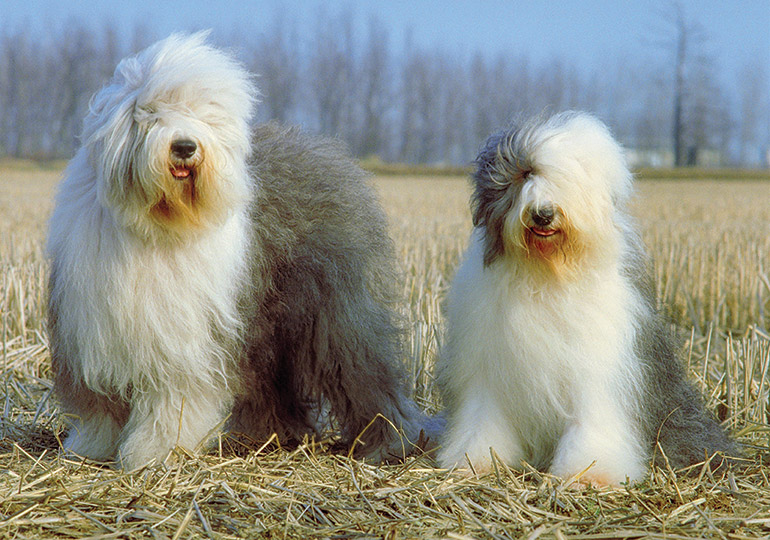
A large, strong, squarely built dog standing from about 56 cm upward at the shoulder, with males typically taller, and weighing roughly 27 to 45 kg, so a substantial animal. The most obvious feature is the profuse shaggy double coat, with a soft waterproof undercoat beneath a long, harsh, shaggy outer coat that covers the whole body and famously falls over the eyes. The coat comes in shades of grey, grizzle or blue, often with white over the head, neck, chest and legs. The body has a characteristic topline that rises slightly towards the rear, the head is large and well coated, and the gait has a distinctive ambling or rolling, bear-like quality. Traditionally the tail was docked, though many dogs are now left with a full tail.
Suitability
Best suited to a house with a decent yard and a family that has genuine time for exercise, training and, above all, grooming. This is not a breed for apartments or for busy people who cannot commit to coat care, since a neglected coat quickly becomes a welfare problem. They are companionable dogs that dislike being left alone for long and can fret or become destructive in isolation, so they suit homes where someone is around much of the day. First-time owners can succeed if they go in clear-eyed about the size, energy, noise and grooming load. The heavy double coat is built for a cool, damp climate, which makes the Australian summer a real consideration: provide shade and plenty of water, exercise in the cooler hours, keep the coat clean and free of mats (a shorter clip helps in hot regions), and watch closely for overheating.
Health
Old English Sheepdogs generally live around 10 to 12 years, shorter than many smaller breeds, partly reflecting their size. Hip dysplasia is well recognised, so breeding dogs should be hip scored, and elbow scoring is sensible too. Inherited eye disease occurs, including progressive retinal atrophy and cataracts, so current eye testing of the parents matters. The breed has a recognised tendency to certain immune-mediated conditions, and like other deep-chested large dogs it carries a risk of bloat (gastric torsion), a true emergency that owners should learn to spot. Hereditary deafness and some cases of hereditary cerebellar ataxia have also been reported. Choose a breeder who hip scores, eye tests and is candid about what is in their lines, and steer clear of anyone selling these big dogs with no screening. The thick coat also makes it easy to miss skin problems and parasites, so regular hands-on grooming is part of keeping them healthy.
Find your Old English Sheepdog
Browse trusted Old English Sheepdog breeders across Australia and read genuine reviews from real owners, or take the quiz to be sure of the fit.