
Pug
Chinese Pug, Dutch Bulldog, Dutch Mastiff, Mini Mastiff, Mops, Carlin
The Pug is a small, compact companion dog from China, bred purely for human company rather than work. It is even-tempered, affectionate and people-oriented, often described as a clown that wants to be the centre of attention while also being happy to nap on the couch. Pugs are sturdy, generally good with children and other animals, and adapt well to apartments. They have low exercise needs but are prone to obesity, so portions and gentle daily walks matter. The flat (brachycephalic) face is the breed's defining feature and its biggest welfare issue: many Pugs have some degree of breathing difficulty and overheat easily. The short coat sheds more than its length suggests and needs weekly brushing, plus regular cleaning of the facial wrinkles to prevent infection. A Pug suits someone wanting a low-activity indoor companion, not anyone after a jogging or hiking partner.
Size
Smallest
Lifespan
12-15 years
Group
Group 1 - Toys
Height
Male: 30-36 cm (12-14 inches), Female: 25-30 cm (10-12 inches)
Weight
Male: 6-8 kg (14-18 lbs), Female: 6-8 kg (14-18 lbs)
Origin
China
Compatibility & care
How this breed fits into life with you
Scores are out of 5. Tap the help icon next to any trait to see what it really means.
Personality
How they think and behave
With family
Who they get along with
Care needs
What they ask of you
Origin & history
The Pug originated in ancient China, where flat-faced toy dogs were kept by emperors and bred as lapdogs for the imperial court well over two thousand years ago. They later spread to Tibetan monasteries and then to Europe via Dutch traders in the 16th and 17th centuries, becoming a favourite of European nobility; the breed is famously linked to the House of Orange in the Netherlands and was popular in Britain during the Victorian era, when Queen Victoria kept and bred them. Selective breeding over the last century shortened the muzzle considerably compared with older examples. The Pug was developed solely as a companion animal, with no herding, hunting or guarding role, and that singular focus on temperament is reflected in its strong attachment to people. It is recognised by the ANKC in the Toy Group and remains a common, popular companion breed across Australia.
Temperament
Pugs are sociable, affectionate and even-tempered, bred over centuries to live closely with people. They are typically gentle and patient with children, friendly with strangers, and get on well with other dogs and household pets, showing little aggression or strong prey drive. They are alert and will bark at the door but are too friendly to be guard dogs. Pugs are intelligent and food-motivated, which makes reward-based training effective, though they can be a little stubborn and slow with house-training; short, fun sessions work best. They form intense bonds with their owners and dislike being left alone for long stretches, which can lead to separation-related behaviours. Their main behavioural need is simply company and inclusion in family life, along with managed activity to prevent boredom and weight gain.
Appearance
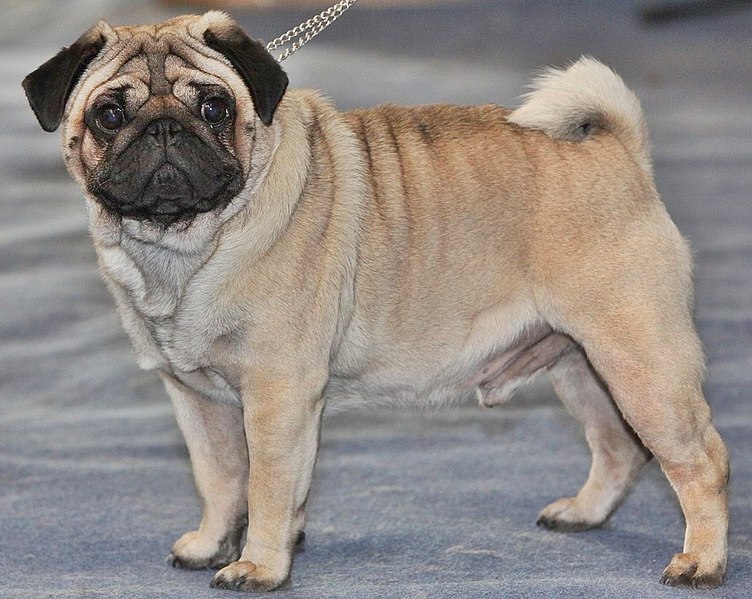
The Pug is a small, square, thickset dog, typically 25 to 33 cm at the shoulder and weighing around 6 to 8 kg. It has a rounded head, a short blunt muzzle, deep facial wrinkles, large dark expressive eyes and small folded ears (rose or button). The tail is set high and curls tightly over the hip, ideally in a double curl. The coat is short, smooth and fine. Standard colours are fawn (with a black mask and ears), apricot, silver-fawn and solid black, usually with a dark trace of hair along the spine. The overall impression is of a compact, cobby dog with a distinctive, expressive face.
Suitability
The Pug suits apartments, small homes and households of almost any activity level, from retirees to families with children, and is one of the more forgiving breeds for first-time owners thanks to its easygoing nature and modest exercise needs. It does not tolerate being left alone all day and is happiest as a constant companion. The most important consideration in Australia is heat: as a flat-faced breed the Pug overheats dangerously and must be kept indoors with air-conditioning or fans on hot days, exercised only in the cool of early morning or evening, and never left in a warm car or yard without shade and water. It is also a poor choice for anyone wanting an athletic or outdoor working dog.
Health
Pugs typically live around 12 to 15 years. The breed's most significant issue is Brachycephalic Obstructive Airway Syndrome (BOAS), caused by the shortened skull, which can cause snoring, snorting, exercise intolerance and serious overheating; some dogs need surgery to widen the airway. The prominent eyes are vulnerable to corneal ulcers, dry eye and pigmentary keratitis, and the breed is predisposed to Pug Dog Encephalitis (a serious inherited brain inflammation), hip dysplasia, luxating patella, and skin-fold dermatitis. Obesity worsens nearly all of these. Buy from breeders who select for more open nostrils and better breathing, screen breeding dogs for BOAS where assessment is available, hip-score their stock, and DNA-test for Pug Dog Encephalitis risk and for primary glaucoma/PRA where applicable. Ask to see the parents breathing normally at rest.
Find your Pug
Browse trusted Pug breeders across Australia and read genuine reviews from real owners, or take the quiz to be sure of the fit.