
Pekingese
Peking Lion Dog, Lion Dog, Chinese Spaniel, Pelchie Dog, Peking Palasthund, Peke
The Pekingese is a small, heavy-boned toy dog with a flat face, a flowing coat and a personality far bigger than its frame. Bred for centuries as a companion to Chinese royalty, it tends to be dignified, opinionated and devoted to one or two people rather than indiscriminately friendly. This is not a bouncy lapdog. Pekingese are calm indoors, content with a couple of short walks a day, and quite happy to ignore commands they consider beneath them, so patient owners do best with them. They suit quiet adults, retirees and people who want a characterful companion that does not need a big yard. They do not suit anyone after an off-lead running mate, a dog that tolerates rough toddlers, or a low-maintenance coat. That long double coat needs brushing several times a week to stay free of mats, and the facial folds need wiping clean to prevent infection.
Size
Smallest
Lifespan
13-15 years
Group
Group 1 - Toys
Height
Male: 15-23 cm (6-9 inches), Female: 15-23 cm (6-9 inches)
Weight
Male: 3-6 kg (7-14 lbs), Female: 3-6 kg (7-14 lbs)
Origin
China
Compatibility & care
How this breed fits into life with you
Scores are out of 5. Tap the help icon next to any trait to see what it really means.
Personality
How they think and behave
With family
Who they get along with
Care needs
What they ask of you
Origin & history
The Pekingese comes from imperial China and is one of the oldest companion breeds in existence, kept by the court for well over a thousand years. These were palace dogs in the truest sense, owned by emperors and high-ranking nobility, and commoners were forbidden from keeping them. Their flat, lion-like face was prized because the lion held strong symbolic meaning in Chinese Buddhism. The breed reached the West after British and French forces looted the Summer Palace in Beijing in 1860, and several dogs were taken back to Britain, one reportedly given to Queen Victoria. From that small foundation the breed spread through British and American show circles in the late nineteenth century. The name comes from Peking, the old Western spelling of Beijing. Modern Pekingese remain almost purely companion dogs, still carrying the unhurried, self-assured manner that came from generations of palace life.
Temperament
Pekingese are loyal, strong-willed and a touch regal. They bond closely with their household and can be genuinely affectionate at home, but they are independent thinkers and will not fawn over people the way many toy breeds do. With strangers they tend to be reserved or coolly indifferent. They are usually fine with other dogs and cats they have grown up alongside, though some are bossy with unfamiliar dogs regardless of size. They make alert little watchdogs and will bark to announce visitors. Children need to be old enough to handle them gently, as the breed dislikes being grabbed and the prominent eyes are vulnerable. Training works best with patience, short sessions and food rewards, since heavy-handed correction simply makes them dig in. They cope with being left for moderate periods but are happiest with company.
Appearance
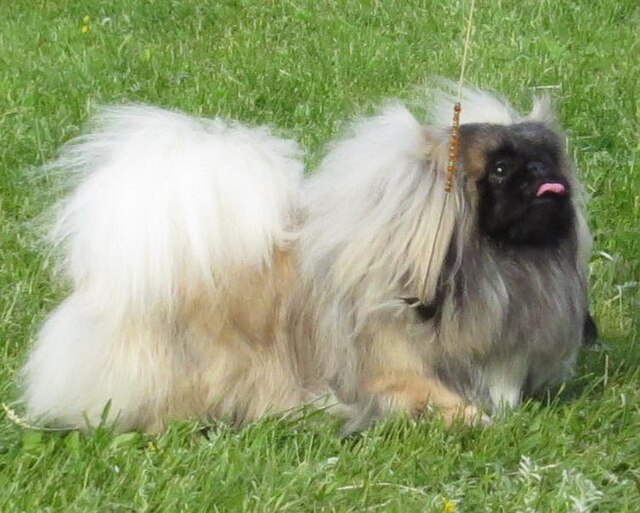
A small toy dog, usually 15 to 23 cm at the shoulder and ideally under about 5 kg, though many pet Pekingese sit a little heavier. The build is surprisingly solid and low-slung, broad at the front and lighter behind, which produces the characteristic rolling walk. The face is flat with a broad, wrinkled muzzle, large dark round eyes and a black nose. A long, coarse-textured double coat forms a thick mane around the neck and shoulders and heavy feathering on the legs, ears and tail. Colours are wide-ranging and include red, fawn, cream, black, black-and-tan and particolours, often with a darker mask.
Suitability
Best suited to apartments, units or houses where calm company matters more than space. Pekingese fit relaxed owners, including retirees and people who work from home, and can work for sensible first-time owners willing to manage the coat and the flat-faced health issues. They tolerate being left alone for moderate stretches better than many toy breeds, though they still prefer not to be solitary all day. The big caution in Australia is heat. Their flat face and heavy coat make them genuinely vulnerable in summer, so they need air-conditioning or a cool room on hot days, walks only in the cool of morning or evening, and constant access to water and shade.
Health
Pekingese typically live around 12 to 14 years. The main concern is their brachycephalic build: the flat face means many struggle to breathe efficiently and overheat dangerously in warm weather, and some need surgery to open the airway. The large, shallow-set eyes are easily injured and prone to ulcers, dry eye and other surface problems. The breed also carries a raised risk of intervertebral disc disease given the long back, plus skin-fold infections and dental crowding. Buy from a breeder who prioritises open nostrils and a longer muzzle, screens eyes, and is honest about how their dogs cope with heat and exercise. Ask to see the parents breathing and moving normally. A reputable breeder will discuss airway health frankly rather than treating snorting and snuffling as just part of the breed.
Find your Pekingese
Browse trusted Pekingese breeders across Australia and read genuine reviews from real owners, or take the quiz to be sure of the fit.