
Parson Russell Terrier
Jack Russell Terrier, Parson, Parson Jack Russell Terrier
The Parson Russell Terrier is a small, leggy working terrier bred to run with foxhounds and go to ground after fox, and it is every bit as bold, driven and energetic as that job demands. This is a dog with serious stamina, a sharp mind and a powerful prey drive, not a low-key lapdog, and it needs far more exercise and mental work than its size suggests. A Parson that is properly exercised and trained is brilliant company: athletic, funny, affectionate and game for anything. Bored or under-exercised, it digs, barks, escapes and finds its own (usually unwelcome) entertainment. It suits active, experienced owners who enjoy training and outdoor activity, and households without small prey pets. It is a poor fit for sedentary homes, full-time absentee owners or anyone wanting a placid pet. The mostly white coat comes in smooth, broken and rough types and needs only modest grooming, with the rough and broken coats benefiting from occasional hand-stripping.
Size
Medium
Lifespan
13-15 years
Group
Group 2 - Terriers
Height
Male: 33-36 cm (13-14 inches), Female: 31-34 cm (12-13.5 inches)
Weight
Male: 6-8 kg (14-18 lbs), Female: 5.9-7.3 kg (13-16 lbs)
Origin
United Kingdom
Compatibility & care
How this breed fits into life with you
Scores are out of 5. Tap the help icon next to any trait to see what it really means.
Personality
How they think and behave
With family
Who they get along with
Care needs
What they ask of you
Origin & history
The Parson Russell Terrier was developed in the south of England in the nineteenth century and is named for the Reverend John (Jack) Russell, a Devon parson and keen fox hunter who bred working terriers to a particular pattern. He wanted a terrier with the legs and stamina to keep up with mounted hunts and the courage and narrow build to bolt foxes from their earths, while having enough white in the coat to be clearly visible and not mistaken for the quarry. His type became the foundation of the various Jack Russell terriers. The taller, squarer, more standardised dog was eventually recognised under the name Parson Russell Terrier to distinguish it from the shorter-legged and more variable Jack Russell types still bred for work. It is now kept worldwide, including in Australia, as a working terrier, an active companion and a strong competitor in agility, flyball and earthdog activities, while keeping its full hunting character.
Temperament
The Parson Russell is bright, bold and intensely energetic, with the confident, sometimes pushy character typical of working terriers. With its own family it is affectionate and loyal, and it generally does well with active older children who can match its energy, though it can be too boisterous and quick to react for very small children. It can be selective with other dogs and may not back down from a challenge, so early socialising and supervision help. The big caveat is prey drive: this is a dog bred to hunt and kill vermin, so rabbits, rodents, and often cats it does not know are at real risk, and homes with small pets are usually a poor match. Towards strangers it is often alert and a little reserved, and it will bark to raise the alarm, making a sharp watchdog. It is intelligent and very trainable but also independent and strong-willed, so it needs firm, fair, consistent, reward-based training and plenty to do, or that clever brain turns to mischief.
Appearance
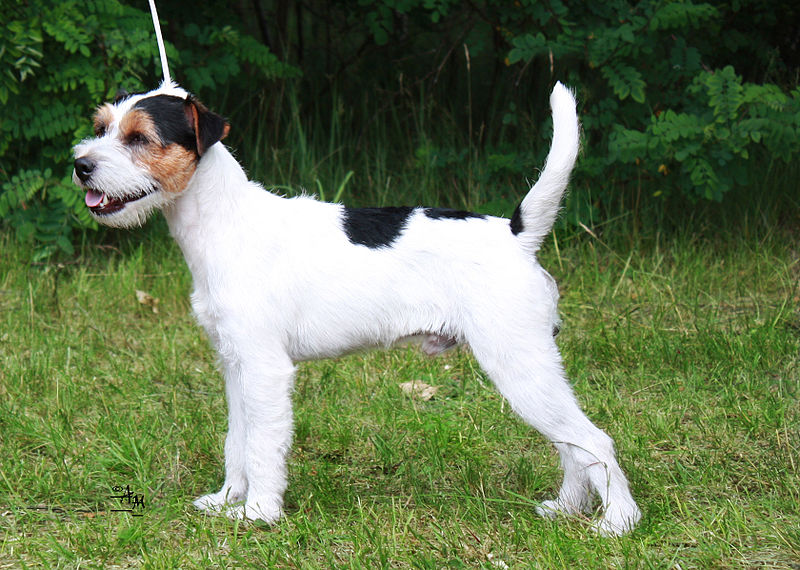
A small but distinctly leggy, squarely built terrier, standing around 33 to 36 cm at the shoulder, with the taller build that separates it from the shorter-legged Jack Russell, and weighing roughly 6 to 8 kg. The body is balanced and athletic, built for speed and endurance, with a flexible, fairly narrow chest that historically let it follow fox underground. The head is wedge-shaped with a strong jaw, dark almond eyes and small V-shaped ears that fold forward. The coat comes in three types, smooth, broken and rough, all harsh, dense and weatherproof. Colour is predominantly white, with markings in tan, black, or a combination, usually confined to the head and the base of the tail. The overall look is keen, workmanlike and ready to go.
Suitability
This terrier is best suited to active owners, whether in town or country, who can give it a great deal of daily exercise plus training, play and problem-solving to occupy its mind. It can live in a flat only if those needs are genuinely met every day, and any yard must be very securely fenced, because Parsons are determined diggers, climbers and escape artists once a scent or a rabbit is involved. They do not cope well with being left alone for long and will bark, dig and chew if bored or isolated, so they suit homes where someone is about and the dog has company and a job. They are better for experienced, energetic owners than for first-timers wanting an easy pet. The weatherproof coat handles a range of conditions, and in the Australian heat ordinary sense applies: shade, fresh water and exercise in the cooler parts of the day, with care not to over-work a keen dog that will run itself into trouble in the heat.
Health
Parson Russell Terriers are typically long-lived and hardy, often reaching around 13 to 15 years. They are generally a sound breed, but several inherited conditions are well documented and DNA tests now exist for some. Hereditary eye disease is the main area: primary lens luxation, where the lens dislocates and can cause painful glaucoma and blindness, is well recognised in the breed and has a DNA test, and progressive retinal atrophy also occurs, so eye testing and DNA results on the parents genuinely matter. Patellar luxation (slipping kneecaps) is seen, as is late-onset ataxia and a related neurological condition called spinocerebellar ataxia, both of which have DNA tests. Deafness occurs occasionally, in line with the largely white coat. A good breeder will eye test, check knees and use the available DNA tests for lens luxation and the ataxias, and will discuss results openly; treat any seller who skips screening on a breed with known eye and neurological risks with real caution.
Find your Parson Russell Terrier
Browse trusted Parson Russell Terrier breeders across Australia and read genuine reviews from real owners, or take the quiz to be sure of the fit.