
Puggle
Beagle-pug
The Puggle is a cross between a Pug and a Beagle, not a pedigree breed in its own right, so it is not recognised by the ANKC. It became popular as a designer cross from the 1990s and 2000s. The idea was to keep the Pug's affectionate, people-loving nature while adding the Beagle's longer muzzle and sturdier build, and many Puggles are friendly, playful and sociable family dogs. The catch is that crossbred puppies vary a lot: some get a usefully longer nose and breathe well, while others inherit a flatter Pug-type face and the breathing and heat problems that come with it. Expect a curious, food-driven dog with a Beagle nose that loves to follow scents, plus a tendency to be vocal. Grooming is easy, just weekly brushing of the short coat. A Puggle suits an active, sociable household but not anyone wanting a guaranteed look, temperament or health profile.
Size
Small
Lifespan
10-15 years
Group
Not ANKC Recognised
Height
Male: 25-38 cm (10-15 inches), Female: 25-38 cm (10-15 inches)
Weight
Male: 8-14 kg (18-30 lbs), Female: 8-14 kg (18-30 lbs)
Origin
United States
Compatibility & care
How this breed fits into life with you
Scores are out of 5. Tap the help icon next to any trait to see what it really means.
Personality
How they think and behave
With family
Who they get along with
Care needs
What they ask of you
Origin & history
The Puggle is a modern designer cross developed mainly in the United States, with the name and the deliberate Pug to Beagle pairing becoming popular through the 1990s and especially the 2000s. It was one of the first wave of intentionally marketed crossbreeds, sold on the promise of a small, family-friendly companion with a bit more leg, nose and substance than a Pug. Both parent breeds have long, well-documented histories: the Pug is an ancient Chinese companion breed, while the Beagle is a British scent hound bred to hunt hare and rabbit in packs. A Puggle is a first-cross of these two and does not breed true, so litters and even individual pups within a litter can differ widely. It is not a recognised pedigree breed with the ANKC or other major registries, and there is no breed standard, so buyers should judge the actual parents rather than rely on a breed label.
Temperament
Most Puggles are affectionate, outgoing and sociable, inheriting the Pug's love of human company and the Beagle's cheerful, busy nature. They are usually good with children and tend to get on with other dogs and pets, which fits their pack-hound heritage. They are friendly rather than protective, so they make poor guard dogs but will often bark or bay to announce visitors, and the Beagle voice can be loud. The scent-hound side means many are nose-led, easily distracted on walks and inclined to wander off after an interesting smell, so a secure yard and lead walks matter. They are intelligent and food-motivated, which helps training, but the Beagle stubbornness and selective hearing can make recall a challenge, so reward-based, consistent training pays off. The main need is company, activity and mental engagement, as a bored Puggle can become noisy and destructive.
Appearance
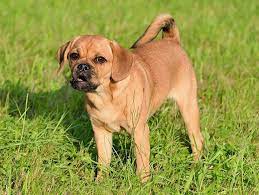
There is no fixed standard, so appearance varies, but most Puggles are small to medium dogs of around 18 to 38 cm at the shoulder and roughly 7 to 14 kg, depending on the parents and whether a standard or smaller Beagle was used. The typical look is a compact, solid body with a Pug-influenced head softened by a longer Beagle muzzle, droopy Beagle ears, a curled or partly curled tail, and a short, smooth, easy-care coat. Common colours follow the parent breeds and include fawn, tan, black, and combinations, often with a darker mask. The amount of muzzle is the feature that matters most for the dog's wellbeing, since it largely decides how well the individual breathes.
Suitability
A Puggle suits an active, sociable household, including families with children, that wants a friendly small-to-medium companion and can cope with a vocal, scent-driven dog. It does best with a securely fenced yard given the Beagle wandering instinct, though it can live in a smaller home if properly exercised. It can work for first-time owners who are ready for consistent training and the breathing uncertainty that comes with any Pug cross. Like most companion dogs it dislikes long stretches alone and may bark or chew if isolated. In the Australian climate, heat tolerance is the key unknown: a longer-nosed Puggle copes reasonably, but any flatter-faced individual must be treated as heat-sensitive, kept cool and exercised only in the cooler parts of the day.
Health
As a Pug to Beagle cross, a Puggle's health depends heavily on which traits it inherits, and lifespans commonly fall around 10 to 15 years. The biggest concern is the brachycephalic (flat-faced) inheritance from the Pug side: dogs that get a shortened muzzle can suffer Brachycephalic Obstructive Airway Syndrome, with noisy breathing, exercise intolerance and dangerous overheating, while longer-nosed Puggles fare much better. Both parent breeds contribute risk of eye problems (including corneal ulcers and progressive retinal atrophy), patellar luxation and hip dysplasia, and the Beagle side adds a tendency to ear infections, epilepsy and easy weight gain. There is no breed health scheme for crossbreds, so the sensible approach is to insist the breeder has health-tested both parents (hip scoring, eye testing, and relevant DNA tests for the Beagle) and to choose pups from a longer-muzzled, open-nostrilled Pug parent. Ask to see both parents and watch them breathe at rest.
Find your Puggle
Browse trusted Puggle breeders across Australia and read genuine reviews from real owners, or take the quiz to be sure of the fit.