
Rottweiler
Rottie, Rott
The Rottweiler is a large, powerful working breed from Germany, originally used to drive cattle and later taken up as a police, military and guard dog. It is confident, calm and deeply loyal, usually forming a strong bond with its family while staying watchful and reserved with strangers. A well-bred, well-socialised Rottweiler is steady and self-assured rather than nervous or sharp, but its size, strength and protective instincts mean it needs an owner who can provide firm, consistent leadership and thorough socialisation from puppyhood. This is a demanding dog that wants daily exercise plus mental work, and it does best with a job to focus on. The short double coat is easy to look after with a weekly brush, though Rottweilers shed more than people expect. It suits experienced, committed owners and is a poor choice for anyone who is time-poor or wanting a low-maintenance pet.
Size
Large to Giant
Lifespan
8-11 years
Group
Group 6 - Utility
Height
Male: 61-69 cm (24-27 inches), Female: 56-63 cm (22-25 inches)
Weight
Male: 43-61 kg (95-135 lbs), Female: 36-45 kg (80-100 lbs)
Origin
Germany
Compatibility & care
How this breed fits into life with you
Scores are out of 5. Tap the help icon next to any trait to see what it really means.
Personality
How they think and behave
With family
Who they get along with
Care needs
What they ask of you
Origin & history
The Rottweiler takes its name from the town of Rottweil in south-western Germany. Its ancestors are thought to descend from drover dogs left behind by Roman legions that moved cattle across the Alps. In Rottweil, a cattle-trading hub, these dogs were developed to drive and guard herds to market and to pull butchers' carts, which earned the old name Rottweiler Metzgerhund, or butcher's dog. When droving declined in the 19th century the breed nearly disappeared, but it was revived in the early 1900s and redirected into police, military and protection work, roles it still performs internationally. The first German Rottweiler club formed in 1907, and the modern standard puts a sound working temperament front and centre. Recognised by the ANKC in the Utility Group, the Rottweiler is well established in Australia as a guardian, sport and family dog.
Temperament
The Rottweiler is calm, confident and devoted to its people, with a strong protective and territorial streak that makes early, ongoing socialisation essential. With its own family it is typically affectionate and steady, and when properly raised it can be gentle and reliable with children, though its sheer size means time with small children should always be supervised. It is naturally aloof rather than friendly toward strangers and makes an effective deterrent and watchdog. Toward other dogs, particularly same-sex dogs, some individuals can be pushy, so neutral introductions and sensible management help. Rottweilers are clever, biddable and keen to work with their owner, responding very well to firm, fair, reward-based training, while harsh handling tends to backfire. Their core needs are confident leadership, structure, daily physical exercise and meaningful mental work such as obedience, tracking or protection sport to channel their drive.
Appearance
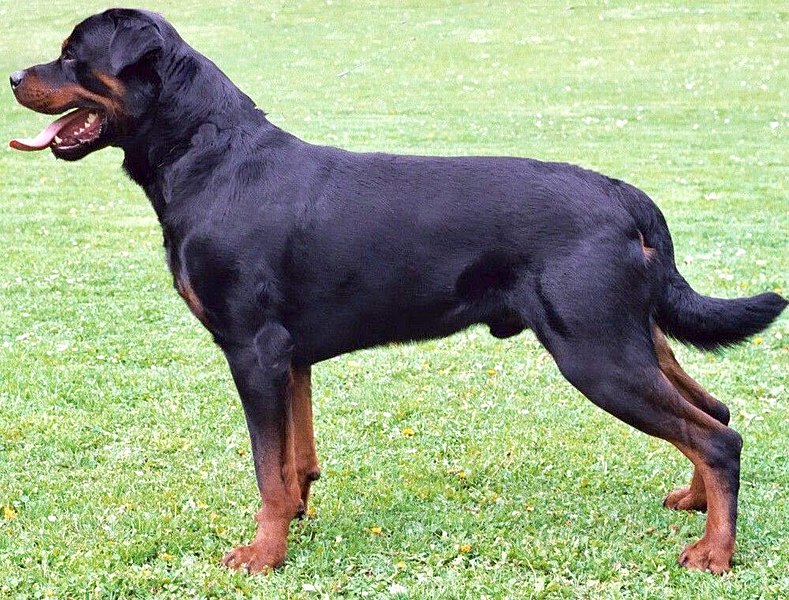
The Rottweiler is a large, robust, muscular dog. Males typically stand about 61 to 69 cm at the shoulder and females about 56 to 63 cm, with weight roughly 35 to 60 kg depending on sex and build. It is slightly longer than tall, with a broad head, heavy muscling and a balanced, powerful outline. The coat is a short, dense, flat double coat. Colour is always black with clearly defined rust to mahogany markings over the eyes, on the cheeks and muzzle, on the chest and legs, and under the tail. The natural tail is increasingly seen, since docking is restricted or banned across much of Australia. The whole impression is one of substance and strength without coarseness.
Suitability
The Rottweiler needs a house with a securely fenced yard and an experienced, confident owner who can commit time to training, socialisation and daily exercise. It is not suited to apartment living, to first-time dog owners, or to people who are out for long hours, since boredom and under-exercise can tip into destructive or over-protective behaviour. It bonds closely with its family and would much rather be with them than left alone outside. The short coat copes reasonably with the Australian climate, but the black coat soaks up heat, so provide shade and water and walk during the cooler parts of the day in summer. Prospective owners should also check local council and insurance rules, as the breed is sometimes subject to extra requirements.
Health
Rottweilers generally live around 8 to 10 years, shorter than many breeds partly because of a real predisposition to cancer, including osteosarcoma (bone cancer) and lymphoma. They are also prone to hip and elbow dysplasia, and to several heart conditions, particularly subaortic stenosis, a narrowing below the aortic valve. As a deep-chested breed they are at risk of gastric dilatation-volvulus (bloat), a sudden, life-threatening emergency. Cruciate ligament rupture and entropion also turn up. Choose a breeder who hip and elbow scores their breeding dogs, has cardiac screening done for subaortic stenosis (ideally by a cardiologist), and tests eyes, and ask honestly about the longevity and causes of death in their lines given the cancer risk. Keeping a Rottweiler lean and feeding to slow rapid puppy growth helps protect the developing joints.
Find your Rottweiler
Browse trusted Rottweiler breeders across Australia and read genuine reviews from real owners, or take the quiz to be sure of the fit.