
Russian Toy
Russian Toy Terrier, Russian Terrier, Moscow Toy Terrier
The Russian Toy is a tiny, fine-boned companion dog from Russia, one of the smallest breeds in the world. It comes in two coat types, smooth and long, and carries itself with a bright, alert, almost terrier-like energy despite weighing only a couple of kilos. These are devoted little dogs that attach closely to their owner and like to be involved in everything, often picking one favourite person. They are lively and playful indoors and need far less formal exercise than a bigger dog, which makes them well suited to small homes. They can be wary and yappy with strangers, so early socialisation matters. Owners need to remember just how fragile the breed is, as a jump from the couch or a knock from a larger dog can cause real injury. Grooming is minimal for both coats.
Size
Smallest
Lifespan
11-13 years
Group
Group 1 - Toys
Height
Male: 20-26 cm (8-10 inches), Female: 18-24 cm (7-9 inches)
Weight
Male: 1.8-2.7 kg (4-6 lbs), Female: 1.8-2.7 kg (4-6 lbs)
Origin
Russia
Compatibility & care
How this breed fits into life with you
Scores are out of 5. Tap the help icon next to any trait to see what it really means.
Personality
How they think and behave
With family
Who they get along with
Care needs
What they ask of you
Origin & history
The Russian Toy descends from the English Toy Terriers that were fashionable among the Russian aristocracy in the 18th and 19th centuries. After the 1917 revolution the type nearly vanished, as small companion dogs fell out of favour and breeding stock dwindled. From the 1950s, Soviet breeders working largely in isolation rebuilt the breed from the few dogs that remained, which is why it developed along its own lines rather than tracking the English toy terrier. The long-haired variety appeared in the late 1950s from two smooth-coated parents and was deliberately fixed as a distinct coat type. The breed was barely known outside Russia and neighbouring countries until recent decades, and it remains uncommon in Australia. It is recognised internationally by the FCI in the Toy Group.
Temperament
For such a small dog the Russian Toy has a big, bold personality. It is affectionate and intensely loyal, often bonding most strongly with one person and wanting to be on a lap or at their heels. It is brighter and more trainable than many toy breeds and enjoys learning tricks and simple obedience, responding best to gentle, reward-based handling rather than any harshness. With strangers it tends to be reserved and will bark to announce visitors, which makes it an alert little watchdog but also means barking needs managing early. It can live happily with other dogs and with cats it has grown up alongside, though it should not be left unsupervised with large or boisterous dogs that could hurt it by accident. Its main behavioural needs are gentle handling, early socialisation to build confidence, and clear, kind boundaries so a small dog does not become a tyrant.
Appearance
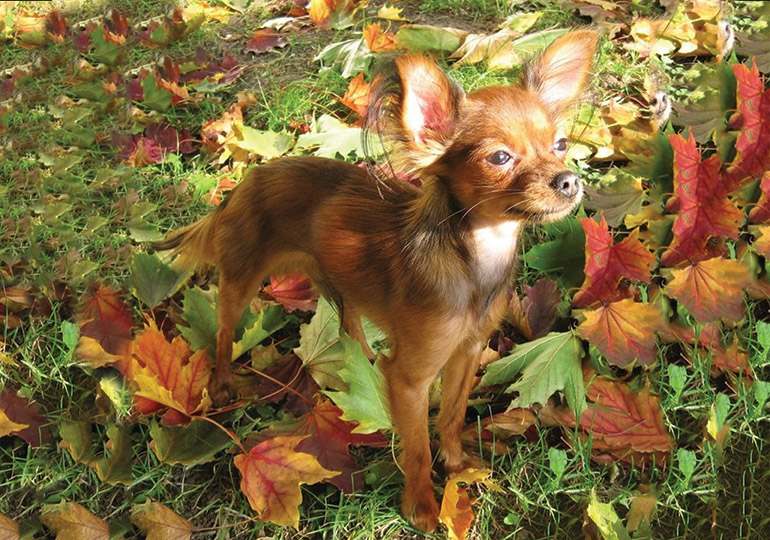
The Russian Toy is one of the smallest dog breeds, standing about 20 to 28 cm at the shoulder and usually weighing no more than 3 kg. It is elegant and fine-boned, with long slim legs, a small wedge-shaped head, large round dark eyes and big, erect, pointed ears. There are two coat varieties. The smooth coat is short, close and glossy, while the long coat carries distinctive feathering, with the ears in particular fringed in long hair so they look almost like wings. Accepted colours include black and tan, brown and tan, blue and tan, and various shades of solid red and sable. The overall look is delicate, leggy and lively.
Suitability
The Russian Toy is close to an ideal apartment dog, happy in a small space and content with short walks and indoor play. It suits a wide range of owners, including first-timers and older people, as long as everyone understands how breakable it is and supervises around small children and big dogs. It bonds very closely with its people and does not cope well with long hours alone, so it is best for households where someone is around for much of the day. On the Australian climate, the smooth-coated dogs in particular feel the cold and shiver easily, so a coat in a southern winter is sensible, while in summer both varieties need shade and water and protection from heat, as small dogs overheat quickly. Its size and devotion make it a true indoor companion rather than a backyard dog.
Health
Russian Toys generally live a long time for a dog, commonly around 12 to 15 years. As a toy breed they are prone to patellar luxation, where the kneecap slips out of place, and the very fine leg bones mean fractures from falls or rough handling are a genuine risk. Dental disease is common, since small mouths crowd the teeth, so daily tooth care and check-ups matter. Some lines carry progressive retinal atrophy, an inherited eye disease that there is a DNA test for in related toy breeds, along with the odd case of hydrocephalus, retained puppy teeth and patent ductus arteriosus, a heart defect. Look for a breeder who has breeding dogs' knees and hearts checked, does eye testing or DNA testing where available, and raises confident, well-handled puppies. Keeping the dog at a sensible weight protects those delicate joints.
Find your Russian Toy
Browse trusted Russian Toy breeders across Australia and read genuine reviews from real owners, or take the quiz to be sure of the fit.