
St. Bernard
St. Hubert Hound, Chien St. Hubert, Sleuth Hound
The St. Bernard is one of the giant breeds, a calm, affectionate dog famous for its bulk and its soft nature. Despite the size it is generally placid and patient indoors, happy to lie about near its family and gentle with children when raised with them. It is not a high-energy dog; a couple of moderate walks a day and room to move suit it well, and over-exercising a growing pup can damage developing joints. It suits a household with space, a reasonable budget for food and vet care, and tolerance for drool and shedding. It does not suit apartment living, hot climates, or anyone houseproud. Grooming is straightforward but constant: regular brushing for both the rough and smooth coats, and a cloth handy for the slobber.
Size
Large to Giant
Lifespan
8-10 years
Group
Group 6 - Utility
Height
Male: 61-70 cm (25.5-27.5 inches), Female: 56-65 cm (22-25.5 inches)
Weight
Male: 64-82 kg (140-180 lbs), Female: 54-64 kg (120-140 lbs)
Origin
Italy Switzerland
Compatibility & care
How this breed fits into life with you
Scores are out of 5. Tap the help icon next to any trait to see what it really means.
Personality
How they think and behave
With family
Who they get along with
Care needs
What they ask of you
Origin & history
The St. Bernard developed in the Western Alps on the border of Switzerland and Italy, taking its name from the Great St. Bernard Hospice, a refuge on a treacherous mountain pass. From around the 17th and 18th centuries the monks kept large dogs as watchdogs and companions, and the dogs proved valuable for finding travellers lost in snow and helping clear a path through drifts. Their reputation for mountain rescue grew over generations, and the famous dog Barry became a lasting symbol of the type. After heavy snow losses in the mid-19th century the surviving dogs were crossed with Newfoundlands, which is where the long-coated variety comes from. The breed was formally established in Switzerland in the 1880s. In Australia it is kept as a companion and show dog, with its size and heat sensitivity the main practical considerations.
Temperament
St. Bernards are steady, friendly and strongly attached to their families, and most are wonderful with children, although their sheer mass means small kids can be knocked over by accident rather than malice. They are typically welcoming or politely indifferent to strangers, with enough natural presence to act as a deterrent without being a sharp guard dog. With other dogs and household pets they are usually easygoing. They are intelligent but can be a touch stubborn, so training needs to be patient, kind and started early while the pup is still liftable, since an unruly adult is very hard to manage. They are sensitive and respond badly to harsh corrections. Above all they want to be with their people and do not cope well shut away from the family.
Appearance
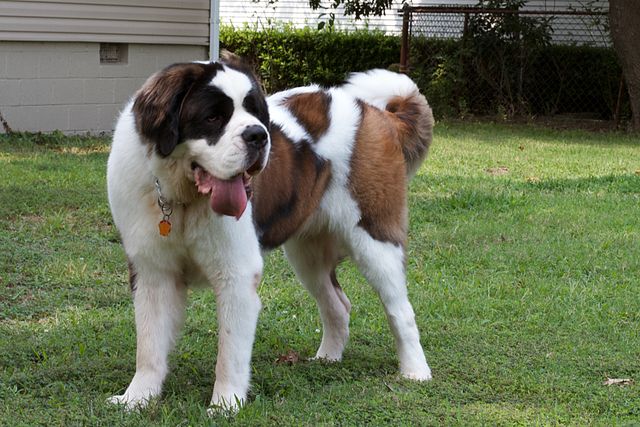
A massive, powerful dog. Males stand from about 70 cm at the shoulder and females from about 65 cm, with weight commonly ranging from roughly 60 to 90 kg and sometimes more. The head is large and broad with a wrinkled brow, dark friendly eyes and high-set drop ears. There are two coat types, a dense smooth coat and a longer rough coat, both with a thick undercoat. The classic colouring is white with red, mahogany or brindle markings, usually including a white blaze, white chest and white feet, often with a darker mask over the face and ears.
Suitability
This is a dog for a house with space, ideally with a yard, and an owner prepared for the costs and the cleaning that come with a giant breed. They are calm enough indoors to suit fairly relaxed owners, but they need company and do not like being left alone for long stretches. First-time owners can manage one if they do their homework on giant-breed care, joint health and early training. The Australian climate is the biggest watch-point: a thick double coat plus great size means real heat sensitivity, so provide constant shade and water, keep them indoors with cooling on hot days, exercise only in the cool, and never leave them in a warm car or unshaded yard.
Health
As a giant breed the St. Bernard is not long-lived, with a typical lifespan of around 8 to 10 years. Well-documented predispositions include hip and elbow dysplasia, bloat (gastric dilatation and volvulus, a true emergency in deep-chested dogs), dilated cardiomyopathy and other heart conditions, the eyelid faults entropion and ectropion, and a raised risk of bone cancer. Buy only from a breeder who hip and elbow scores their dogs, has hearts checked by a cardiologist and eyes examined, and is open about longevity in their lines. Keep these dogs lean, especially while growing, to protect the joints, and learn the signs of bloat. Their size means heat is poorly tolerated, so the warmer Australian months call for careful management.
Find your St. Bernard
Browse trusted St. Bernard breeders across Australia and read genuine reviews from real owners, or take the quiz to be sure of the fit.