
Scottish Terrier
Scottie, Aberdeenie
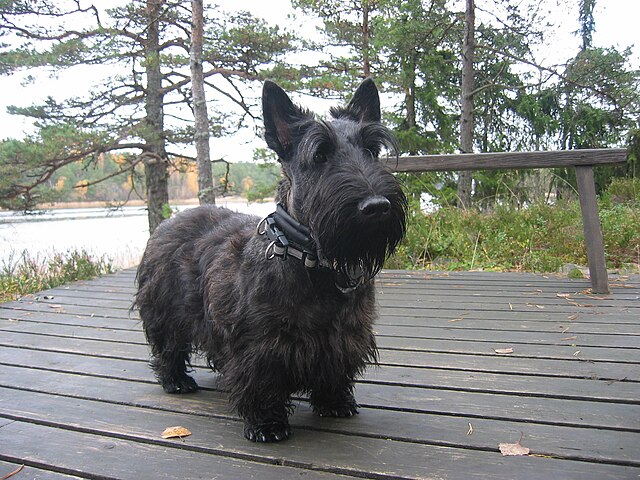
The Scottish Terrier, or Scottie, is a small, low-slung, sturdy terrier from Scotland with a wiry coat, a notable beard and a famously independent mind. These are dignified, determined little dogs, bold well out of proportion to their size and deeply loyal to their own people. They tend to bond closely to one or two family members and are often reserved, even aloof, with everyone else. They have real terrier drive and will dig, chase and stand their ground. Exercise needs are moderate, a couple of good walks and some play, but the stubborn streak makes patient, consistent training essential. They suit owners who appreciate a strong-willed dog with character and are a poor match for anyone wanting an eager-to-please pushover or a dog that ignores small animals. The harsh coat needs regular brushing and clipping or hand-stripping.
Size
Small
Lifespan
11-13 years
Group
Group 2 - Terriers
Height
Male: 25-28 cm (10-11 inches), Female: 23-26 cm (9-10 inches)
Weight
Male: 8.6-10 kg (19-22 lbs), Female: 8.2-9.5 kg (18-21 lbs)
Origin
United Kingdom
Compatibility & care
How this breed fits into life with you
Scores are out of 5. Tap the help icon next to any trait to see what it really means.
Personality
How they think and behave
With family
Who they get along with
Care needs
What they ask of you
Origin & history
The Scottish Terrier comes from the Highlands and islands of Scotland, where small, hardy earth dogs were kept for generations to hunt foxes, badgers and vermin among the rocks and farms. Several of the Scottish terrier types share this rough background and were not clearly separated until the nineteenth century, when breeders began defining the Scottie as its own type and showing it. The short legs and powerful front let the dog dig and go to ground after quarry, and the harsh weatherproof coat suited the climate. The breed became fashionable well beyond Scotland in the early twentieth century and is firmly fixed in popular culture, from the black Scottie of the Monopoly board to several in the White House. In Australia it is a recognised and steadily popular companion and show breed rather than a working dog.
Temperament
Scotties are confident, self-contained and often genuinely stubborn, with the dignity of a much bigger dog. They are devoted to their family but tend to choose a favourite person and are typically polite rather than effusive with strangers, sometimes downright standoffish. They are not generally a children-swarming breed and do best with older kids who respect that they like their own space. The prey drive is strong, so cats and small pets can be a problem unless the dog is raised with them, and they are not always tolerant of strange dogs. They are intelligent but train on their own terms, responding to patient, reward-based work and shutting down under heavy-handed methods. They make alert watchdogs and can be barky and prone to digging if bored. Early socialisation softens the natural reserve and gives you a steady, characterful companion.
Appearance
A small, compact, surprisingly heavy dog standing about 25 to 28 cm at the shoulder and weighing roughly 8 to 10 kg, built long and low with short, strong legs. The head looks long for the dog, finished with a profuse beard and eyebrows, and the small, pointed ears stand erect. The double coat has a hard, wiry outer layer and a soft dense undercoat, with longer furnishings on the lower body and legs that give the breed its skirted outline. Colours are black, wheaten, or brindle in various shades, with black being the one most people picture. The tail is short and carried up, and the whole dog has a solid, purposeful look.
Suitability
Scottish Terriers adapt well to flats or houses as long as they get daily walks and some enrichment, and a secure yard suits their digging and chasing instincts. They suit owners who actively like an independent, opinionated dog rather than a biddable one, which makes them a better fit for someone with a bit of dog experience than for a first-timer hoping for an easy ride. They tolerate moderate time alone better than many companion breeds but still want their people about. The barking is worth training early for the sake of the neighbours. The harsh double coat copes with Australian conditions reasonably, though their low build puts them close to hot pavement, so walk them in the cooler parts of summer days and always provide shade and water.
Health
Scottish Terriers generally live around 11 to 14 years. The breed has a few well-documented concerns. Von Willebrand disease, an inherited bleeding disorder, occurs and can be DNA tested. They have a notably raised risk of certain cancers, particularly transitional cell carcinoma of the bladder, which is more common in Scotties than in most breeds. A breed-specific condition called Scottie cramp, a usually harmless movement disorder triggered by excitement, is also recognised, along with patellar luxation, craniomandibular osteopathy in pups and some skin allergies. Choose a breeder who DNA tests for von Willebrand disease, checks patellas and is open about the cancer history and longevity in their lines. Watching for blood in the urine and getting it investigated promptly is sensible given the bladder cancer risk.
Find your Scottish Terrier
Browse trusted Scottish Terrier breeders across Australia and read genuine reviews from real owners, or take the quiz to be sure of the fit.