
Saluki
Gazelle Hound, Persian Greyhound
The Saluki is a tall, slender sighthound from the Middle East, one of the most ancient breeds and built entirely for speed and endurance over open country. It is quiet, graceful and dignified at home, often aloof and cat-like in its independence, and deeply attached to its own people while being reserved with strangers. Salukis are gentle and sensitive, and they do not respond to heavy-handed training. The defining trait, and the thing every owner must respect, is an extreme prey drive paired with blistering speed, which means they will chase moving things and must be kept on lead or in securely fenced areas. They need regular chances to gallop. The smooth coat is low-maintenance, while the feathered variety needs a little brushing of the ears, legs and tail. The Saluki suits calm, patient owners who can offer safe space to run and accept a hound that does not live to obey.
Size
Large
Lifespan
12-14 years
Group
Group 4 - Hounds
Height
Male: 58-71 cm (23-28 inches), Female: 58-71 cm (23-28 inches)
Weight
Male: 20-29 kg (45-65 lbs), Female: 16-23 kg (35-50 lbs)
Origin
Middle East
Compatibility & care
How this breed fits into life with you
Scores are out of 5. Tap the help icon next to any trait to see what it really means.
Personality
How they think and behave
With family
Who they get along with
Care needs
What they ask of you
Origin & history
The Saluki is one of the oldest known breeds, with sighthounds of this type depicted in the art of the ancient Middle East and kept across a vast region, from the deserts of Arabia through Persia and into Central Asia. Nomadic tribes used the Saluki to course game such as gazelle and hare, often working with falcons and hunting on horseback, and the dogs were valued enough to be treated as treasured members of the household rather than mere working stock. Because tribes ranged so widely, regional types developed in coat, size and colour. The breed reached Britain seriously in the early 20th century, brought back by travellers from the Middle East, and the British club formed in 1923. The Saluki is recognised by the ANKC in the Hound Group and has a small, dedicated following in Australia, including in lure coursing.
Temperament
Salukis are gentle, sensitive and reserved, with a quiet dignity that many owners describe as cat-like. They bond closely with their family but show it in an understated way, and they are typically polite but distant with strangers rather than openly friendly. They can be good with children when raised with them, though they are not boisterous, rough-and-tumble dogs and prefer calm company. With other dogs, and especially other sighthounds, they are usually sociable, but small fast-moving animals trigger an overwhelming urge to chase, so living safely with cats or small pets is not guaranteed and depends heavily on the individual and early raising. They are intelligent but independent, bred to make their own decisions at a flat gallop far from the handler, so recall is unreliable and training needs endless patience, gentleness and rewards. Their key needs are safe space to run, soft handling, comfortable resting places, and respect for a hound that simply is not built for blind obedience.
Appearance
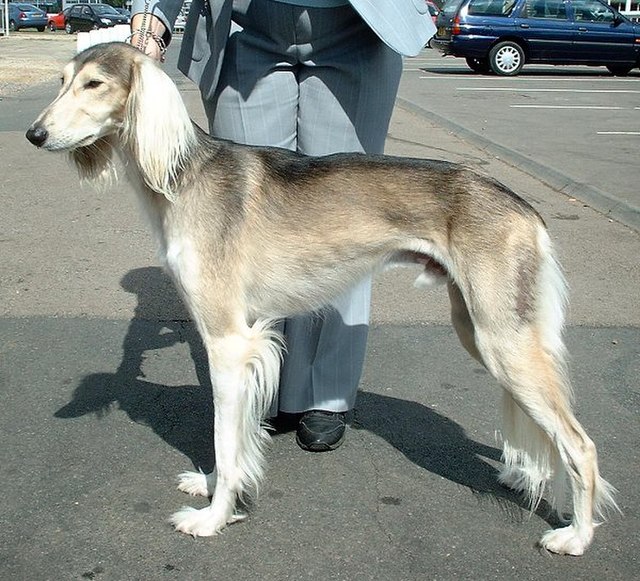
The Saluki is a graceful, finely built sighthound, standing about 58 to 71 cm at the shoulder, with bitches usually noticeably smaller, and weighing roughly 18 to 27 kg. The body is long-legged and athletic, with a deep narrow chest, a tucked-up waist and a long, narrow head carried on an arched neck, giving an impression of elegance and speed even when standing still. There are two coat types, the smooth and the feathered, the latter carrying soft feathering on the ears, the backs of the legs and the underside of the tail. Colours are very varied and include white, cream, fawn, golden, red, grizzle and tan, black and tan, and tricolour. The overall picture is one of refinement, balance and effortless athleticism.
Suitability
The Saluki suits a calm, patient owner who can provide a house with a high, secure fence and regular chances to run flat out in safe enclosed spaces, since off-lead freedom in open areas is rarely safe given the prey drive. It is not a natural first dog because of that independence and the need to manage chasing, though a thoughtful first-time owner who does their homework can succeed. Despite their athleticism Salukis are quiet and clean indoors and enjoy lounging on soft furniture, so they fit a relaxed home as long as their exercise needs are met. They form strong attachments and can struggle if left alone for very long periods. On the Australian climate they handle warmth well, in keeping with their desert origins, and love a sunny spot, but they have so little body fat that they feel the cold badly and appreciate a coat and a warm, padded bed in a southern winter.
Health
Salukis are generally long-lived for a large dog, often reaching 12 to 14 years. As a deep-chested breed they are at risk of gastric dilatation-volvulus (bloat), a sudden, life-threatening emergency. The breed is predisposed to heart disease, including cardiomyopathy and valve problems, so cardiac screening of breeding dogs is worthwhile. Some inherited eye conditions occur, and certain cancers, including haemangiosarcoma, are seen in the breed. Owners should also know that, like other sighthounds, Salukis have very little body fat and a known sensitivity to some anaesthetics and drugs, so they need a vet who understands the type. Choose a breeder who does cardiac testing and eye testing on their dogs and can discuss longevity and causes of death in their lines. Feeding smaller meals and avoiding hard exercise straight after eating helps reduce the bloat risk in this lean, deep-chested hound.
Find your Saluki
Browse trusted Saluki breeders across Australia and read genuine reviews from real owners, or take the quiz to be sure of the fit.