
Tibetan Spaniel
Tibbie, Simkhyi
The Tibetan Spaniel is a small, bright, affectionate companion with a big personality and an independent streak that traces back to its monastery origins. Despite the name it is not a spaniel and was never a gundog. Tibbies are people-focused, charming and quietly comical, happiest perched somewhere high where they can survey the room. They bond closely with their family and can be reserved or selectively aloof with strangers. Exercise needs are modest, a couple of short walks and some play indoors suit them, which makes them adaptable to smaller homes. They are not pushovers to train, having a cat-like willingness to ignore you when it suits them, so patience and positive methods work best. The coat is a silky, moderate double coat that needs a brush a couple of times a week rather than clipping. A standout trait is their alertness. They were bred partly to sit on monastery walls and bark a warning, so they make surprisingly good little watchdogs.
Size
Smallest
Lifespan
12-15 years
Group
Group 1 - Toys
Height
Male: 25 cm (10 inches), Female: 25 cm (10 inches)
Weight
Male: 4-7 kg (9-15 lbs), Female: 4-7 kg (9-15 lbs)
Origin
Tibet
Compatibility & care
How this breed fits into life with you
Scores are out of 5. Tap the help icon next to any trait to see what it really means.
Personality
How they think and behave
With family
Who they get along with
Care needs
What they ask of you
Origin & history
The Tibetan Spaniel developed in Tibet over many centuries as a companion and small watchdog in monasteries and noble households. Monks kept these little dogs as company and as alert dogs that would sit up high and bark to warn the larger guardian dogs of approaching strangers. They were also turners of prayer wheels in some accounts and were considered to bring good fortune. They were given as gifts rather than sold, which spread them between monasteries and to other regions, and there was likely some exchange of type with other small Tibetan and Asian breeds over time. The breed reached Britain in the late nineteenth and early twentieth centuries and was developed seriously in the West from the 1940s onward. In Australia it remains a fairly uncommon companion breed, kept by enthusiasts who value its character and easy size.
Temperament
Tibbies are confident, friendly and devoted to their own people, often attaching especially strongly to one person while still enjoying the whole family. They are usually good with sensible children and tend to get on well with other dogs and with cats, especially when raised together, though their watchful nature means they will announce visitors loudly. With strangers they are typically polite but reserved, taking their time to warm up rather than rushing to greet. They are intelligent and learn quickly, but the monastery independence is real and they respond far better to reward-based, low-pressure training than to drilling or corrections. The watchdog instinct is well developed for such a small dog. Key behavioural needs are companionship and inclusion. Tibetan Spaniels do not thrive when isolated, and a bored or lonely one can become a nuisance barker.
Appearance
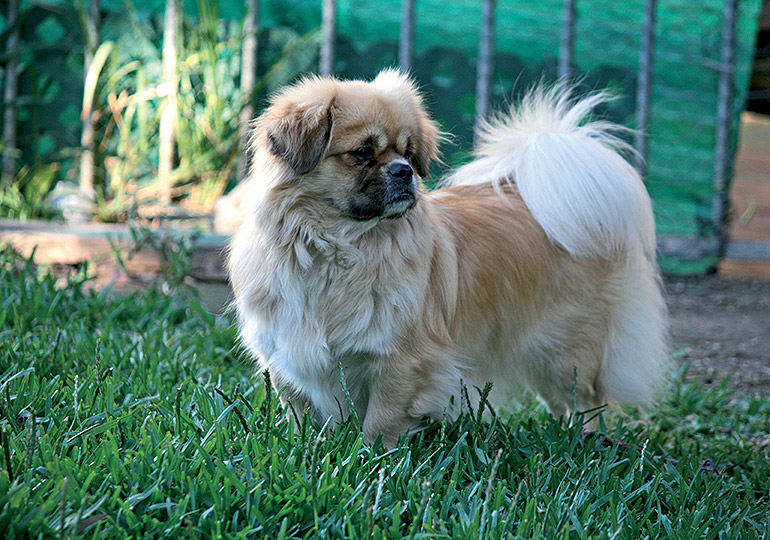
A small but not fragile dog, standing roughly 24 to 26 cm at the shoulder and weighing about 4 to 7 kg. The body is slightly longer than tall, neat and well balanced, with a domed head, a short blunt muzzle, and dark expressive eyes set fairly wide that give the breed its open, friendly look. A slight underbite is normal for the breed. The coat is silky and of moderate length, lying flatter on the body with a noticeable mane or shawl around the neck (heavier in males), feathering on the ears, legs and tail, and a plumed tail carried over the back. Colours are wide open and include gold, red, cream, fawn, black, black and tan, and various particolours and sable shadings.
Suitability
This is one of the more adaptable companion breeds. A Tibetan Spaniel suits apartments and houses equally, and works well for both relaxed owners and moderately active ones, since its exercise needs are easily met. It can be a sensible first dog for someone who appreciates a bit of independence and does not expect instant obedience. They prefer not to be left alone for long stretches and are best in a home where someone is around much of the day, or where a second pet provides company. The coat copes reasonably with Australian conditions, but the shortened muzzle means they should not be over-exercised in the heat of the day during summer, and they need shade and water like any dog. Overall a friendly, low-fuss companion for a wide range of households.
Health
Tibetan Spaniels are a generally robust little breed with a typical lifespan of around 13 to 15 years. The best-documented inherited concern is progressive retinal atrophy (PRA), a gradual degeneration of the retina leading to blindness, and DNA testing is available for at least one form, so ask whether breeding parents are tested or clear. Other eye issues such as cataracts and cherry eye are seen. Patellar luxation (slipping kneecaps) occurs, as in many small breeds, and can be checked by a vet. Because the muzzle is shortened, some individuals can have minor brachycephalic-related issues, though far less severely than the flat-faced toy breeds. A responsible breeder should be doing eye testing on their dogs (ideally annual eye examinations plus the PRA DNA test) and be happy to discuss patella status. Routine dental care helps, as small mouths are prone to tartar.
Find your Tibetan Spaniel
Browse trusted Tibetan Spaniel breeders across Australia and read genuine reviews from real owners, or take the quiz to be sure of the fit.