
Tibetan Mastiff
Dok-khyi, Tsang-khyi
The Tibetan Mastiff is a giant livestock-guardian breed built for cold mountains and serious work, and that heritage shapes everything about it. These are independent, territorial dogs that think for themselves, bond hard to their own family, and treat strangers with deep suspicion. Exercise needs are surprisingly moderate (a guardian conserves energy and patrols rather than running for hours), but the dog needs space, a secure high fence, and a job that amounts to watching over its patch. They are not for first-time owners. A poorly socialised or under-managed Tibetan Mastiff is a genuine liability given the size and the guarding drive. The coat is a heavy double coat that blows out once a year in a dramatic moult, and during that period you will be brushing constantly. Many are nocturnal barkers by instinct, which can be a real problem in suburban Australia. Best for confident, experienced owners on rural or large blocks.
Size
Giant
Lifespan
10-14 years
Group
Group 6 - Utility
Height
Male: 61-71 cm (24-28 inches), Female: 61-71 cm (24-28 inches)
Weight
Male: 45-73 kg (100-160 lbs), Female: 41-54 kg (90-120 lbs)
Origin
China
Compatibility & care
How this breed fits into life with you
Scores are out of 5. Tap the help icon next to any trait to see what it really means.
Personality
How they think and behave
With family
Who they get along with
Care needs
What they ask of you
Origin & history
The breed comes from the high Himalaya and the Tibetan plateau, where for centuries it guarded flocks, monasteries and villages against wolves, leopards and snow leopards in brutal cold. It is one of the older guardian types, kept by nomadic herders and by monastery communities, and it carried real prestige in Tibetan culture. Dogs of this kind reached the West in the nineteenth century, with documented imports to Britain including animals associated with Queen Victoria, and Western breeding programmes grew slowly through the twentieth century. The modern show Tibetan Mastiff has been bred heavier and more profusely coated than the leaner working dogs still found on the plateau. In Australia the breed is uncommon and sits firmly in the working and guardian niche rather than the family-pet mainstream, so finding a well-bred, health-tested litter takes patience and research.
Temperament
This is an aloof, self-possessed dog rather than a biddable one. With its own family a Tibetan Mastiff is affectionate, steady and often gentle, and it is generally good with the children of its household, though its sheer size means small children should always be supervised. Towards strangers it is naturally wary and will assess visitors carefully, and towards strange dogs, particularly same-sex ones, it can be confrontational. The guarding instinct is strong and largely cannot be trained out, only managed through early, thorough socialisation. Trainability is real but filtered through a strongly independent mind. These dogs will weigh up whether a command is worth following, so harsh methods backfire and consistency matters more than repetition. The watchdog tendency is intense, including night barking. Owners must provide secure containment, clear leadership, and an understanding that this is a working guardian first and a pet second.
Appearance
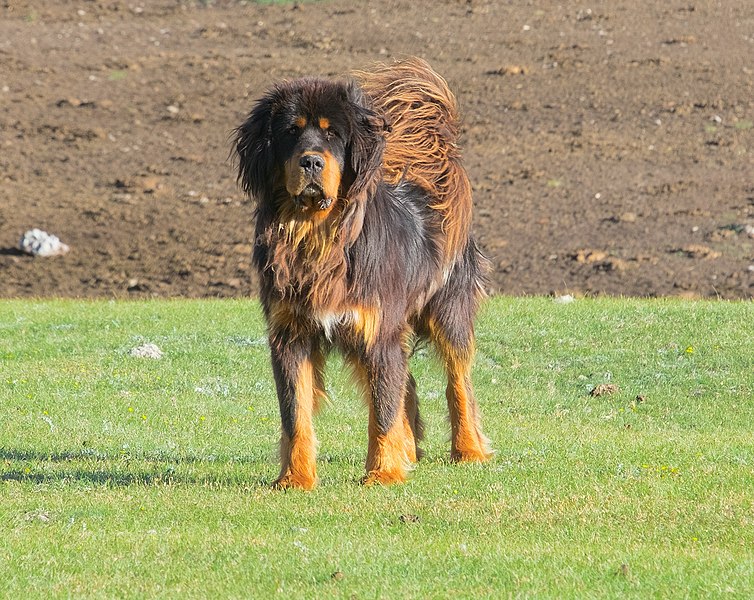
A giant, powerfully built dog. Males commonly stand around 66 to 76 cm and can weigh anywhere from roughly 45 to 70 kg or more, with females noticeably smaller. The build is heavy-boned and slightly longer than tall, carrying a broad head, a deep muzzle, and often a pronounced mane of longer hair around the neck and shoulders that gives a lion-like look in males. The coat is a thick, weather-resistant double coat, fairly coarse on top with a dense undercoat. Common colours include black, black and tan, various shades of gold or red, blue-grey, and sometimes brown, frequently with tan points above the eyes and on the legs. The tail is well-feathered and carried curled over the back.
Suitability
This breed needs a house with a large, securely fenced yard, ideally rural or semi-rural, and an owner who has handled big, strong-willed dogs before. It is a poor match for apartments, for first-time owners, and for anyone who cannot tolerate barking or who has close neighbours. Tibetan Mastiffs can be left alone for moderate periods if they have space and a settled routine, but they are guardians who want to be near their territory and family. The heavy double coat means they feel the heat badly, so in most of mainland Australia they need shade, constant fresh water, and the hottest part of summer spent indoors with cooling. They suit cooler, elevated or southern regions far better than the tropical north.
Health
Typical lifespan is around 10 to 14 years, which is good for a giant breed. The main orthopaedic concerns are hip and elbow dysplasia, so insist on parents with hip and elbow scores from a recognised scheme. The breed has a specific inherited condition called canine inherited demyelinative neuropathy (CIDN), a neurological disease of young puppies, and a DNA test exists for it, so ask whether the breeding lines have been tested or are clear. Eye conditions including entropion (in-rolling eyelids) occur, so eye examination of breeding stock is worth asking about. Hypothyroidism is reported in the breed. As with any deep-chested giant dog, owners should be aware of bloat (gastric torsion) and feed accordingly. Buy only from a breeder who can show hip and elbow scoring and is open about CIDN status and eye testing.
Find your Tibetan Mastiff
Browse trusted Tibetan Mastiff breeders across Australia and read genuine reviews from real owners, or take the quiz to be sure of the fit.