
Bull Terrier (Miniature)
Mini Bull, Miniature Bull Terrier
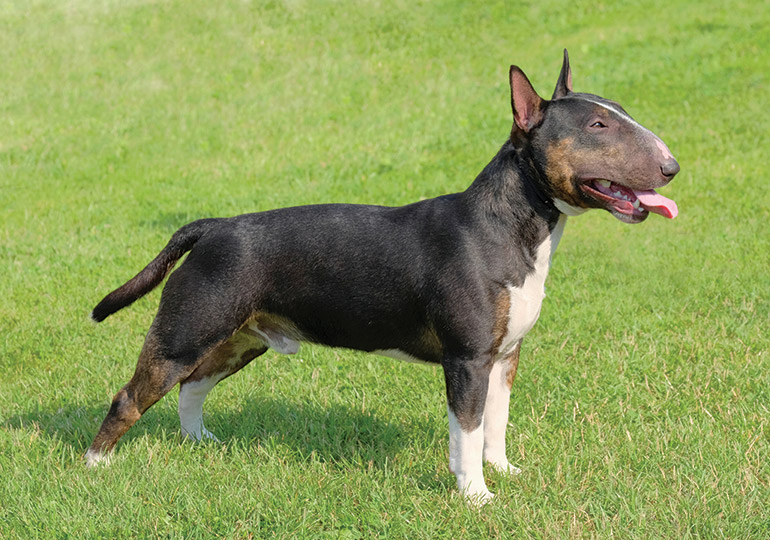
The Miniature Bull Terrier is a compact, muscular dog with the same unmistakable egg-shaped head as the standard Bull Terrier, just in a smaller package. It is playful, comical and full of character, deeply attached to its people and known for a stubborn, clownish streak. Sturdy and surprisingly strong for its size, it is energetic and needs proper daily exercise and games to stay out of mischief. It can be good with children when raised with them, but its boisterous, hard-headed nature means it suits an owner who will commit to firm, patient training and plenty of socialisation. It is not a soft, easygoing lapdog. The short coat is very easy to look after. This is a breed for someone who enjoys a strong personality and a few laughs, and who has the energy to keep up.
Size
Small
Lifespan
10-14 years
Group
Group 2 - Terriers
Height
Male: 25-36 cm (10-14 inches), Female: 25-36 cm (10-14 inches)
Weight
Male: 11-15 kg (25-33 lbs), Female: 11-15 kg (25-33 lbs)
Origin
England
Compatibility & care
How this breed fits into life with you
Scores are out of 5. Tap the help icon next to any trait to see what it really means.
Personality
How they think and behave
With family
Who they get along with
Care needs
What they ask of you
Origin & history
The Bull Terrier was created in nineteenth-century England by crossing the old Bulldog with terriers, originally for fighting and ratting, and later refined into a companion and show dog, with the distinctive curved head developing over time. From early on there were smaller specimens, and breeders worked to fix a true miniature version that kept the standard's type and temperament at a reduced size. Numbers of the Miniature were uneven for decades, and the variety went through periods of scarcity before being stabilised. The English Kennel Club restored full recognition to the Miniature Bull Terrier in 1939. Today the breed is judged to the same standard as the standard Bull Terrier apart from size, and it is kept in Australia by a relatively small but dedicated group of enthusiasts as a companion and show dog rather than a working one.
Temperament
The Miniature Bull Terrier is energetic, mischievous and very attached to its family, a dog with a real sense of humour and a streak of pure stubbornness. It is affectionate and people-focused, and is generally good with children, especially those it has grown up with, though its robust, bouncy play needs supervision around little ones. It tends to be friendly but can be reserved with strangers and has a protective side. Dog-to-dog issues are not unusual, and many can be scrappy with unfamiliar dogs or same-sex dogs, so early and ongoing socialisation is essential. The terrier heritage means a strong prey drive, so it is not reliable with small pets. It is intelligent but strong-willed and easily bored, so training needs to be firm, consistent, short and fun, and it must have enough exercise and mental work, or it will invent its own destructive entertainment.
Appearance
A small but solid, well-muscled dog, the Miniature Bull Terrier usually stands up to about 35.5cm at the shoulder and weighs roughly 8 to 14kg, looking far heavier and stronger than the height suggests. The breed-defining feature is the long, egg-shaped head with a smooth, downward curving profile (the Roman nose) and small, dark, triangular eyes set close together. The ears are small, neat and carried erect. The body is compact and rounded with a deep chest, and the coat is short, flat and harsh with a slight sheen. Colours include solid white, and coloured dogs in brindle, black, red and fawn, with or without white markings.
Suitability
This breed can live in an apartment or a house as long as it gets solid daily exercise and stimulation, but it really suits an active owner who finds its full-on personality entertaining rather than exhausting. It is best for someone willing to put in early socialisation and consistent training, so it is not the easiest first dog, though a committed beginner who reads up on the breed can do well. It is intensely bonded to its people and does not cope happily with long periods alone, tending towards boredom and mischief, so a home where it has company for much of the day is ideal. In the Australian heat its short coat offers little protection, so it needs shade, water and cooler-hour exercise in summer.
Health
Lifespan is generally around 11 to 14 years. The Miniature Bull Terrier has several well-established inherited conditions, and responsible breeders test for them. Primary lens luxation, a painful eye condition that can cause glaucoma and blindness, is a particular concern, and there is a reliable DNA test, so both parents should be tested. Inherited deafness occurs, and puppies should be BAER hearing tested. The breed is also prone to kidney disease, including hereditary nephritis and other inherited kidney problems, so breeders should screen with urine and blood tests, and to patellar luxation and some heart defects, which means cardiac checks are worthwhile. Skin allergies also turn up. Buy only from a breeder who DNA tests for primary lens luxation, BAER tests litters for deafness, and screens kidneys and hearts.
Find your Bull Terrier (Miniature)
Browse trusted Bull Terrier (Miniature) breeders across Australia and read genuine reviews from real owners, or take the quiz to be sure of the fit.