
Foxhound
Foxy
The Foxhound is a large, athletic scenthound bred to hunt fox in packs over open country, and that pack background shapes everything about it. It is friendly, sociable and easygoing, good-natured with people and other dogs, but it is first and foremost a working hound with enormous stamina and a nose that rules its head. It needs a great deal of exercise, ideally long walks and runs in a securely fenced space, because once it picks up a scent it can switch off and follow it for miles. It suits very active owners with room and time, not flat-dwellers or anyone after an easy, obedient housedog. Recall is a lifelong challenge and a strong fence is essential. The short coat is extremely easy to care for. A standout trait is its sheer good nature and tolerance, though its baying voice and exercise needs are not for everyone.
Size
Large
Lifespan
10-13 years
Group
Group 4 - Hounds
Height
Male: 56-64 cm (22-25 inches), Female: 53-61 cm (21-24 inches)
Weight
Male: 29-32 kg (65-70 lbs), Female: 27-29 kg (60-65 lbs)
Origin
United Kingdom
Compatibility & care
How this breed fits into life with you
Scores are out of 5. Tap the help icon next to any trait to see what it really means.
Personality
How they think and behave
With family
Who they get along with
Care needs
What they ask of you
Origin & history
The Foxhound was developed in England from around the 1600s and 1700s, bred by hunts to pursue fox across country in large, well-matched packs. Breeders drew on older hound stock to fix a dog with the stamina, drive, nose and biddability to work all day in a pack under the direction of huntsmen. The English Foxhound was always a functional pack animal rather than a household pet, kept in kennels and bred to hunt cooperatively, which is why it remains intensely sociable with other dogs and people while keeping a powerful independent hunting instinct. The breed contributed to many other hounds, including the American Foxhound and various harrier and hunting types. It is recognised by the ANKC but is genuinely rare as a companion in Australia, where it is seen far more in working hunt kennels than in suburban homes.
Temperament
Foxhounds are gentle, sociable and remarkably easygoing, bred over centuries to live and work peacefully in large packs, so they are typically excellent with other dogs and tolerant, friendly company for people. Most are good-natured with children, though a big, bouncy hound can be a lot for small kids. They are usually too amiable to make guard dogs, but they will bay, and that deep, carrying voice can be an issue close to neighbours. The flip side of the pack temperament is independence: a Foxhound is governed by its nose and was bred to work away from close human control, so it is not naturally obedient and recall is genuinely hard once a scent takes over. With small fleeing pets the strong prey and chase drive can be a problem. The key behavioural needs are lots of exercise, secure containment, the company of people or other dogs, and patient, realistic training that works with the hound nature rather than against it.
Appearance
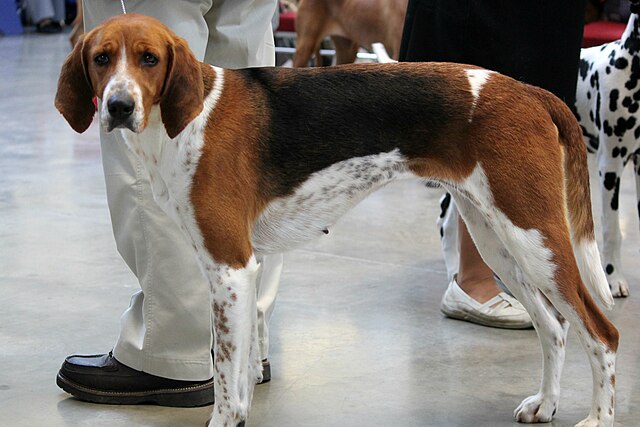
The Foxhound is a large, powerfully built scenthound made for endurance and steady galloping. It typically stands around 58 to 64 cm at the shoulder, with weight commonly in the 29 to 34 kg range, and shows clean, muscular lines with strong bone and a deep chest. The head is moderately broad with a long muzzle, gentle dark eyes and fairly low-set, pendant ears that frame the face. The coat is short, dense and weatherproof, sitting close to the skin. The classic colouring is hound tricolour of black, white and tan, though various hound markings and combinations occur. The tail, known as the stern, is carried up with a slight curve and tapers to a point, often with a paler tip.
Suitability
The Foxhound suits a rural or semi-rural home with plenty of securely fenced space and a very active owner who can provide hours of exercise and does not expect off-lead reliability. It is poorly suited to apartments, small yards or quiet households, and its baying and exercise demands make it a difficult urban dog. It is not a good match for first-time owners, who can find the independence, scent-driven recall and sheer energy overwhelming. As a pack animal it hates being alone and does far better with canine company or constant human presence, so long stretches by itself lead to howling and destruction. The short coat copes reasonably with the Australian climate, but the dog still needs shade, fresh water and exercise saved for the cooler parts of hot days, especially given how hard it will run.
Health
Typical lifespan is around 10 to 13 years, and as a working-bred hound the Foxhound is on the whole a sound, robust dog. The best-established concern is hip dysplasia, which a careful breeder will screen for. As a deep-chested breed it carries a risk of gastric dilatation and volvulus (bloat), a sudden, life-threatening emergency that owners should learn to recognise. Ear infections are common because of the heavy pendant ears, so routine ear checks and cleaning help. Because the breed is overwhelmingly kept and bred for pack hunting rather than as pets, there is less formal companion-focused health screening than for many breeds, so seek out a breeder who hip scores, who keeps their hounds in good condition, and who is honest about what they test. Keeping the dog lean, well exercised and fed in a way that lowers bloat risk supports a long, active life.
Find your Foxhound
Browse trusted Foxhound breeders across Australia and read genuine reviews from real owners, or take the quiz to be sure of the fit.