
Griffon Bruxellois
Smooth Brussels Griffon
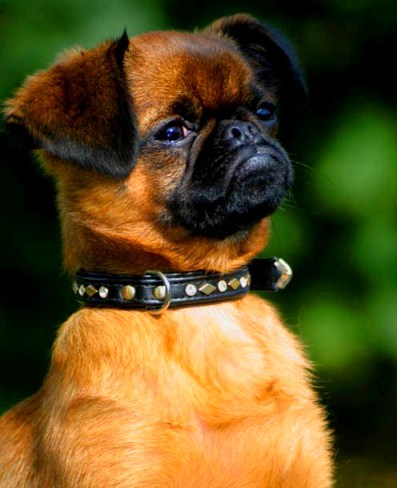
This is the smooth-coated variety of the Griffon Bruxellois, a tiny Belgian toy breed with an almost human, slightly grumpy expression that owners find irresistible. The smooth coat (in Belgium called the Petit Brabancon) is the only difference from the rough variety; the personality is the same big character in a small frame. These are bold, affectionate little dogs that attach themselves intensely to one or two people and want to be involved in everything. They are lively, curious and surprisingly sensitive, reading their owners moods closely. They suit devoted owners, including apartment dwellers and retirees, who will give them constant companionship, and they do not suit a household that is out all day or wants an aloof, independent dog. The smooth coat is very low-maintenance, needing only a quick weekly brush. The standout is sheer personality: a comic, expressive, almost monkey-like little dog.
Size
Small
Lifespan
12-15 years
Group
Group 1 - Toys
Height
Male: 20-25 cm (8-10 inches), Female: 20-25 cm (8-10 inches)
Weight
Male: 2.5-5.5 kg (6-12 lbs), Female: 2.5-5.5 kg (6-12 lbs)
Origin
Belgium
Compatibility & care
How this breed fits into life with you
Scores are out of 5. Tap the help icon next to any trait to see what it really means.
Personality
How they think and behave
With family
Who they get along with
Care needs
What they ask of you
Origin & history
The Griffon Bruxellois was developed in and around Brussels in the 19th century, starting from small rough-coated terrier-type ratters kept in stables to control vermin. Brussels cab drivers favoured them, keeping the little dogs in their horse-drawn carriages where they earned their keep against rats and made good company. To refine the look and temperament, breeders crossed in the Affenpinscher, the Pug and the King Charles Spaniel, and it was the Pug influence in particular that introduced the smooth coat seen in this variety. The breed caught the eye of Belgian royalty, which boosted its fashionable status, and it was exported widely from the early 20th century. The two World Wars hit numbers hard in Europe. It has always been a relatively uncommon breed in Australia, kept by toy-dog enthusiasts rather than seen on every street.
Temperament
For such a small dog the Griffon Bruxellois has an outsized personality: confident, lively, affectionate and often quite demanding of attention. It bonds hard, frequently to one person, and wants to be a constant shadow, on the lap or following from room to room. With strangers it can be self-assured and outgoing or a little wary and reserved, and it makes a surprisingly keen watchdog, quick to bark at the door. Early socialisation matters to stop the wariness tipping into nervousness or yappiness. With other dogs they are generally fine and often think they are far bigger than they are, which can get them into trouble with larger dogs. They are intelligent and learn tricks readily, but they are also sensitive and can be stubborn about toilet training, so patient, gentle, reward-based methods work far better than any heavy-handedness. Their key need is company; this is not a dog that copes with being left alone for long.
Appearance
A small, sturdy toy dog, typically weighing somewhere between about 3.5 kg and 6 kg and standing only around 18 to 25 cm tall, compact and square rather than fragile. The head is the hallmark: large, with a domed skull, a very short upturned muzzle, a prominent chin and big, dark, wide-set eyes that give the breed its distinctive almost human look. This variety carries a short, smooth, glossy coat with no beard or moustache, which is the visible difference from the rough-coated Griffon. Ears are small and set high, sometimes left natural and semi-erect. Recognised colours include red, black, black and tan, and belge (a mix of black and reddish-brown). The expression is alert, bright and full of character.
Suitability
The smooth Griffon Bruxellois is ideally suited to someone who is home a great deal and wants a true companion dog: apartments and small houses are fine, and retirees, singles and quieter families all tend to do well with them, provided children are old enough to handle a small dog gently. They are reasonable for a committed first-time owner, though the sensitivity and stubborn toileting take patience. The one thing they cannot tolerate is being left alone for long stretches, and separation distress is a real risk in a home that is out all day. On climate, the flat face makes heat genuinely dangerous, so in Australian summers they must be kept cool, exercised in the early morning or evening, and never left in a hot car or sunroom, while the short coat also means they appreciate warmth in winter.
Health
Griffons typically live around 12 to 15 years, but the breed carries some clear health concerns to ask a breeder about. The flat face means they are brachycephalic, so they can suffer breathing difficulties, snore, and overheat easily in warm weather. Their prominent eyes are exposed and prone to injury, ulcers and tear-staining. As a small breed they can have slipping kneecaps (patellar luxation) and dental crowding. The most serious concern is neurological: syringomyelia and the related Chiari-like malformation, where a mismatch between skull and brain size causes fluid-filled cavities in the spinal cord and can be very painful, occurs in the breed. Difficult whelping is common because of the large heads, and many litters are delivered by caesarean. Choose a breeder who screens breathing and eyes, checks knees, and is open about syringomyelia and birthing history rather than one chasing an ever-flatter face.
Find your Griffon Bruxellois
Browse trusted Griffon Bruxellois breeders across Australia and read genuine reviews from real owners, or take the quiz to be sure of the fit.