
Griffon Bruxellois
Brussels Griffon, Griffon Belge
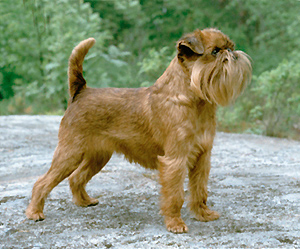
This is the rough-coated variety of the Griffon Bruxellois, the wiry-coated version of the small Belgian toy breed with the famous whiskery, almost human face. Coat aside, it is the same dog as the smooth variety: a bold, affectionate, intensely people-focused little character. These dogs latch onto their owners and want to share every moment, and behind the comic expression sits a sensitive, perceptive temperament that picks up on household mood. They suit devoted owners who are home often, including apartment and unit dwellers, retirees and quieter families, and they do not suit anyone out all day or after a low-maintenance, independent pet. The harsh coat needs more work than the smooth version: regular brushing plus hand-stripping a few times a year to keep its texture, since it sheds little. The standout is the bearded, bright-eyed face packed with personality.
Size
Small
Lifespan
12-15 years
Group
Group 1 - Toys
Height
Male: 18-20 cm (7-8 inches), Female: 18-20 cm (7-8 inches)
Weight
Male: 3.5-4.5 kg (8-10 lbs), Female: 3.5-4.5 kg (8-10 lbs)
Origin
Belgium
Compatibility & care
How this breed fits into life with you
Scores are out of 5. Tap the help icon next to any trait to see what it really means.
Personality
How they think and behave
With family
Who they get along with
Care needs
What they ask of you
Origin & history
The Griffon Bruxellois grew up in 19th-century Brussels from small rough-coated ratting terriers kept in stables and homes. Cab drivers in the city took to them, carrying the little dogs in their horse-drawn cabs as ratters and companions. Breeders then refined the type by crossing in the Affenpinscher, which strengthened the harsh wiry coat and the cheeky expression of this rough variety, along with some Pug and King Charles Spaniel. Royal favour in Belgium made the breed fashionable, and it spread abroad in the early 20th century. Numbers were badly knocked back in Europe by the two World Wars and the breed has never been numerous since. In Australia it remains an uncommon choice, the preserve of toy-dog enthusiasts and a few dedicated breeders rather than a mainstream pet.
Temperament
The rough Griffon Bruxellois is a big personality in a tiny body: confident, devoted, lively and frankly a bit of an attention-seeker. It forms a deep attachment, often to one favourite person, and likes to be a constant companion on the lap or at the heel. Towards strangers it ranges from boldly outgoing to cautious and reserved, and it is a sharp little watchdog that will announce visitors loudly. Good early socialisation keeps the caution from becoming nervousness or excessive barking. With other dogs they are usually sociable and tend to have no idea how small they are, which can lead them to challenge dogs many times their size. They are clever and enjoy learning tricks, but they are sensitive souls and can be slow and stubborn about toilet training, so gentle, consistent, reward-based handling is essential. Most of all they need company and become unhappy if left alone for long.
Appearance
A small but solid toy dog, generally weighing about 3.5 kg to 6 kg and standing only around 18 to 25 cm at the shoulder, compact and square in outline. The breed is defined by its head: a domed skull, a very short upturned nose, a jutting chin and large, dark, expressive eyes set wide apart. This variety wears a harsh, wiry double coat with a pronounced beard and eyebrows that frame the face and give it the characteristic griffon look, quite different from the slick smooth variety. Ears are small, set high and may be natural and semi-erect. Recognised colours include red, black, black and tan, and belge (a blend of black and reddish-brown). The whole effect is alert, characterful and slightly comical.
Suitability
The rough Griffon Bruxellois fits best with an owner who is around most of the day and wants a genuine companion dog. Apartments and small homes suit it well, and singles, retirees and calmer families all tend to do well, as long as any children are old enough to respect a small, sensitive dog. A committed first-time owner can manage one, accepting that the toileting and sensitivity require patience. What it cannot handle is long hours alone, and separation distress is a real risk in a household that is out all day. On climate, the brachycephalic face makes heat dangerous, so Australian summers call for cool indoor space, walks limited to the cooler parts of the day, and never leaving the dog in a hot car or closed room; in winter the dog will also appreciate warmth despite the wiry coat.
Health
Rough Griffons share the same health profile as the smooth variety and usually live around 12 to 15 years. The flat, brachycephalic face can bring breathing problems, snoring and a real intolerance of heat. The large, prominent eyes are vulnerable to injury, ulcers and weeping. Being a toy breed, they are prone to luxating patellas (slipping kneecaps) and to crowded teeth that need dental attention. The most serious issue is neurological: syringomyelia with Chiari-like malformation, in which the skull is too small for the brain and fluid-filled pockets form in the spinal cord, causing pain, is recognised in the breed. Whelping is often difficult because of the puppies large heads, so caesarean births are common. Seek a breeder who screens for breathing and eye health, checks knees, is honest about syringomyelia in their lines, and is not breeding for an extreme, ever-flatter muzzle.
Find your Griffon Bruxellois
Browse trusted Griffon Bruxellois breeders across Australia and read genuine reviews from real owners, or take the quiz to be sure of the fit.