
Ibizan Hound
Podenco Ibicenco, Ca Eivissenc
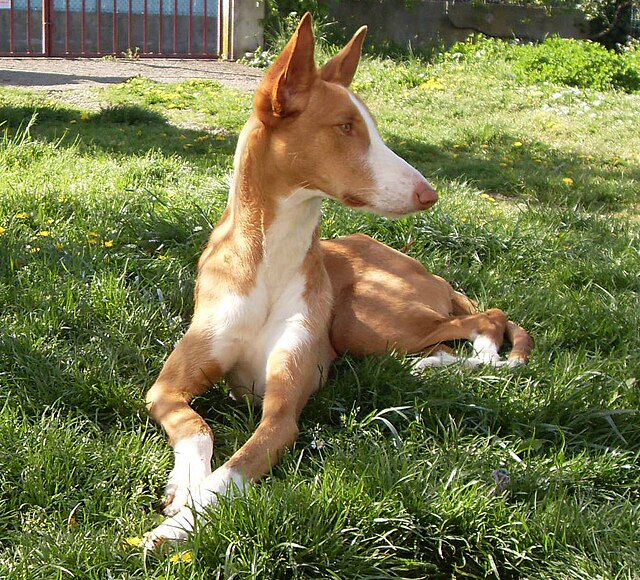
The Ibizan Hound is a tall, lean sighthound from the Balearic Islands, all big upright ears and elegant lines. Built to hunt rabbits over rough ground, it is fast, agile and a famous jumper, capable of clearing surprisingly high fences from a standstill. The temperament is independent and a little aloof, affectionate at home but reserved with strangers and very much its own dog. It needs daily galloping room in a securely fenced area, as the prey drive is strong and a moving cat or small dog can trigger a chase. It suits active owners who appreciate a quieter, sensitive hound and have the fencing to contain one. The short coat (there is also a rough-coated variety) needs almost no grooming beyond an occasional brush. This is a thinking dog rather than an eager-to-please one.
Size
Medium to Large
Lifespan
12-14 years
Group
Group 4 - Hounds
Height
Male: 60-70 cm (23.5-27.5 inches), Female: 57-66 cm (22.5-26 inches)
Weight
Male: 25-29 kg (55-65 lbs), Female: 20-25 kg (45-55 lbs)
Origin
Spain (Balearic Islands)
Compatibility & care
How this breed fits into life with you
Scores are out of 5. Tap the help icon next to any trait to see what it really means.
Personality
How they think and behave
With family
Who they get along with
Care needs
What they ask of you
Origin & history
The Ibizan Hound comes from the Balearic Islands off the Spanish coast, above all Ibiza and Formentera, where it was bred for centuries to hunt rabbits across hot, rocky, broken country. It hunts using a blend of sight, scent and remarkable hearing, often in packs, and the hard island conditions shaped a tough, frugal, athletic dog. There is a long-standing popular story linking the breed to the hunting hounds of ancient Egypt, but there is no firm evidence for that, and the breed is more accurately understood as a regional Mediterranean rabbit hound refined over a long time in relative isolation. It reached the United States and Britain in the 20th century and gained formal recognition there. In Australia it is recognised by the ANKC but remains an uncommon breed.
Temperament
The Ibizan Hound is intelligent, sensitive and independent, affectionate and playful with its own family but typically reserved, even slightly shy, with strangers, so early and ongoing socialisation matters. Raised with children it is usually gentle and good-natured, though its sensitivity means it does best in a calm household rather than a chaotic one. It generally lives happily with other dogs, particularly other sighthounds, but the powerful prey drive makes it a real risk around cats, rabbits and small pets unless very carefully raised with them. It will bark to announce visitors and is alert, but it is not a guard dog. Training requires patience and a light, rewarding touch, this is a hound that thinks for itself and will simply switch off under heavy-handed or repetitive drilling. A reliable recall is hard to guarantee once prey is sighted, which shapes how it must be exercised.
Appearance
This is a tall, slim, finely built sighthound. Males generally stand about 66 to 72 cm at the shoulder and females around 60 to 67 cm, with weight roughly in the 20 to 25 kg range, giving a lean, racy outline. The most striking feature is the ears, large, upright and very mobile, set high on a long, narrow head with amber eyes. The coat comes in two types, smooth (short and close) and wire (rough and harsh, sometimes with a moustache), and grooming is minimal for both. Colour is white, red (from light tan to deep chestnut), or any combination of the two, and the nose, eye rims and lips are flesh-coloured rather than black. The build is all about light, springy speed.
Suitability
This breed needs a house with a tall, secure fence, as it is an exceptional jumper and climber that will clear an ordinary fence with ease, and it must not be let off lead anywhere unsafe given the chase instinct. It suits active owners who can provide daily free running in a contained space and who appreciate a quieter, more aloof, sensitive hound rather than a constantly demonstrative dog. It can manage moderate time alone if well exercised and is reasonably clean and quiet indoors. It is not the most obvious first dog, mainly because of the fencing, recall and prey-drive challenges. The short coat and lean frame suit warm weather reasonably well, but in the Australian summer it still needs shade, water and exercise in the cooler hours, and it feels the cold in winter, often appreciating a coat.
Health
Ibizan Hounds are generally a healthy, long-lived breed, often reaching around 12 to 14 years. They have relatively few breed-specific inherited diseases compared with many pedigrees. Eye conditions such as cataracts and retinal disease are reported, so eye testing of breeding dogs is worthwhile, and seizures or epilepsy turn up in some lines. As a deep-chested breed there is some risk of bloat (gastric torsion), so feed measured meals and avoid hard exercise right after eating. Like all sighthounds they tend to be lean and sensitive to certain anaesthetics, which is worth flagging to your vet before any procedure. Choose a breeder who is open about the health and longevity of their lines and who eye-tests their stock. Protecting the thin skin and keeping the dog at its natural lean weight both help.
Find your Ibizan Hound
Browse trusted Ibizan Hound breeders across Australia and read genuine reviews from real owners, or take the quiz to be sure of the fit.