
King Charles Spaniel
English Toy Spaniel
The King Charles Spaniel, known in some countries as the English Toy Spaniel, is a small flat-faced toy breed from England. It is worth stressing that this is the older, smaller, more domed-headed breed, not the longer-nosed Cavalier King Charles Spaniel, which is a separate and far more common dog. King Charles Spaniels are gentle, affectionate lap dogs that live for their people and settle happily into a quiet, indoor life. They are typically sweet-natured with family, reserved with strangers and generally good with children and other pets. Exercise needs are modest, met with short walks and play, which makes them well suited to apartments and to older or less active owners. The silky coat needs brushing a few times a week and a tidy-up around the feet and ears. As a brachycephalic breed they have real health considerations, covered below, and they do not tolerate heat well.
Size
Small
Lifespan
10-12 years
Group
Group 1 - Toys
Height
Male: 23-28 cm (9-11 inches), Female: 23-28 cm (9-11 inches)
Weight
Male: 5-8 kg (12-18 lbs), Female: 5-8 kg (12-18 lbs)
Origin
United Kingdom
Compatibility & care
How this breed fits into life with you
Scores are out of 5. Tap the help icon next to any trait to see what it really means.
Personality
How they think and behave
With family
Who they get along with
Care needs
What they ask of you
Origin & history
The King Charles Spaniel descends from the small toy spaniels that were fashionable among English nobility from the sixteenth and seventeenth centuries. The breed takes its name from King Charles II, who was famously devoted to his little spaniels and was said to be rarely seen without them. These dogs appear again and again in portraits of the period, kept purely as companions and lap-warmers rather than for any work. Over the eighteenth and nineteenth centuries the type changed, and crossing with flat-faced Asian breeds is generally credited with giving the modern dog its shorter, more upturned muzzle and rounded head. By the twentieth century this shorter-faced toy was the established King Charles Spaniel. In the 1920s an effort to recreate the older, longer-nosed type led to the separate Cavalier King Charles Spaniel, which has since become far more popular. The original King Charles Spaniel is now an uncommon breed, including in Australia.
Temperament
The King Charles Spaniel is a gentle, affectionate companion that wants little more than to be close to its people. It forms a strong attachment to its family and is happiest curled on a lap or following someone quietly around the house. With children it is usually patient and sweet, although its small size and delicate build mean it suits calmer, older children or supervised play with little ones. It generally gets on well with other dogs and with cats and household pets, having very little hunting instinct. With strangers it tends to be shy and reserved rather than outgoing, and it can be sensitive to a loud or chaotic household. These dogs are intelligent and willing but soft, so they respond to gentle, reward-based training and shrink from harsh handling. The main behavioural need is company: bred for centuries as a lap dog, the breed dislikes being left alone and can become unhappy if regularly isolated.
Appearance
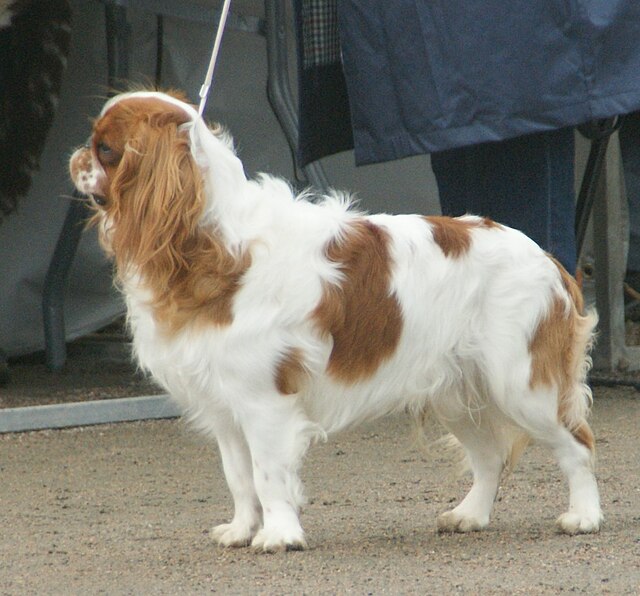
A small, cobby toy dog standing around 25 to 28cm at the shoulder and weighing roughly 3.5 to 6.5kg. The build is compact and square with a short body and short legs. The head is the breed's defining feature: domed, with a short, well-cushioned, distinctly upturned muzzle and large, dark, wide-set eyes that give a soft expression. The long ears are set low and heavily feathered. The coat is long, silky and slightly wavy with feathering on the ears, legs, body and tail. Four colours are recognised: Blenheim (chestnut and white), tricolour (black, white and tan), black and tan, and ruby (a solid rich red).
Suitability
This breed is an excellent fit for apartment living and for quieter, less active homes, including older owners and first-time owners who want an easy, affectionate companion. Exercise needs are light, so short daily walks and indoor play are enough, but they thrive on human company and do not cope well with being left alone for long days. They are not built for vigorous outdoor activity. The brachycephalic face makes heat a serious concern in the Australian climate: these dogs overheat easily and should be kept cool, walked early or late in summer, and never left in a warm car or exercised in the heat of the day. Combined with the breed's heart and neurological risks, that means an owner committed to careful, attentive care and a good relationship with their vet.
Health
This is a brachycephalic toy breed, and prospective owners need to go in with eyes open, as it carries several well-documented health risks and a typical lifespan of around 10 to 12 years. The most serious is mitral valve disease, a degenerative heart condition that is very common in the breed and can appear in middle age, so breeding stock should have regular cardiac checks by a cardiologist. The breed is also affected by syringomyelia, a painful condition where a malformation of the skull affects the spinal cord. As a flat-faced dog it can suffer breathing difficulty, especially in heat, and dental crowding and eye problems, including the eyes being prone to injury, are common. Patellar luxation occurs too. A responsible breeder should provide evidence of cardiac testing on the parents, breed away from extreme flat faces, and be honest about the heart and neurological conditions in their lines.
Find your King Charles Spaniel
Browse trusted King Charles Spaniel breeders across Australia and read genuine reviews from real owners, or take the quiz to be sure of the fit.