
Portuguese Podengo
Podengo Português
The Portuguese Podengo is an ancient hunting hound from Portugal that comes in three sizes and two coat types, giving it real range as a working dog and companion. These are lively, clever, independent dogs with a strong prey drive and a playful streak that stays with them for life. They are affectionate and fun with their own people but think for themselves, which makes training an exercise in patience rather than blind obedience. Energy needs run from moderate in the small variety to high in the larger ones, so daily exercise and secure fencing are a must. They suit active owners who appreciate a thinking dog and do not expect a pushover, and they are less ideal for first-timers wanting easy obedience or for homes with small pets. Grooming is simple for both the smooth and wire coats, needing only occasional brushing.
Size
Small, Medium, Large
Lifespan
12-14 years
Group
Group 4 - Hounds
Height
Small: 20-30 cm (8-12 inches), Medium: 40-55 cm (16-22 inches), Large: 55-70 cm (22-28 inches)
Weight
Pequeno: Male 4-6 kg (9-13 lbs), Female 4-6 kg (9-13 lbs) Medio: Male 16-23 kg (35-50 lbs), Female 16-23 kg (35-50 lbs) Grande: Male 20-30 kg (44-66 lbs), Female 20-30 kg (44-66 lbs)
Origin
Portugal
Compatibility & care
How this breed fits into life with you
Scores are out of 5. Tap the help icon next to any trait to see what it really means.
Personality
How they think and behave
With family
Who they get along with
Care needs
What they ask of you
Origin & history
The Portuguese Podengo is one of the Iberian Peninsula's old hunting breeds, of a primitive type whose ancestors are usually linked to dogs brought to the region by ancient seafaring traders. It developed in Portugal as a versatile hunter, working by sight, scent and hearing, and over time settled into three sizes for different quarry and terrain. The small Podengo Pequeno traditionally hunts rabbits in packs and works them out of burrows and stone walls, while the medium and large varieties take on larger game across open country. Each size occurs in two coats, a smooth and a wire-haired type. The breed remains a common and valued working dog throughout rural Portugal, but is still uncommon in Australia, where it is kept by a small number of enthusiasts rather than seen widely.
Temperament
Podengos are bright, alert and self-directed, with the typical primitive-hound mix of affection and independence. They bond genuinely with their family and stay playful and engaged well into adulthood, but they are not biddable in the way a working gundog is; they decide whether your request is worth their while. They are usually good with children they have grown up with, though the smaller varieties can be quick to startle. Most are reserved or aloof with strangers and make alert, vocal watchdogs that miss very little. The strong prey drive means cats and small pets are risky unless the dog is raised with them, and even then small fleeing animals outside can be too tempting. They generally enjoy other dogs, reflecting a pack-hunting past. Training works best when it is short, motivating and reward-based; harsh or repetitive drilling simply switches them off.
Appearance
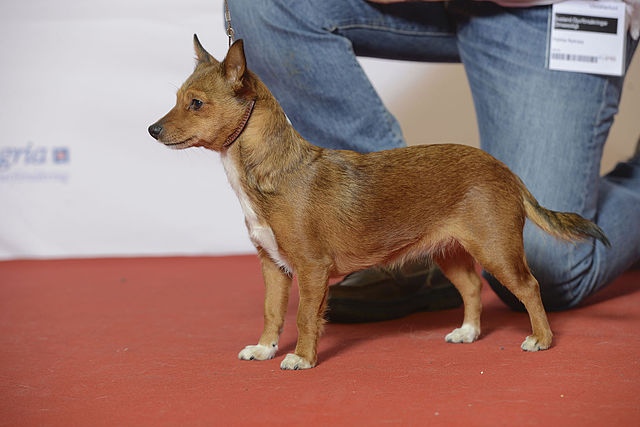
A primitive-type hound built on athletic, rectangular lines, with a wedge-shaped head, erect triangular ears and a watchful, foxy expression. Three distinct sizes are recognised. The small (Pequeno) stands roughly 20 to 30 cm and weighs around 4 to 6 kg; the medium (Medio) around 40 to 54 cm and 16 to 20 kg; and the large (Grande) around 55 to 70 cm and up to 30 kg. Each size comes in two coat types, a short smooth coat and a harsher wire coat that gives a bearded, scruffy look. Common colours are yellow and fawn in various shades, often with white markings, and sometimes black with white. The overall impression is of a lean, alert, agile dog with nothing exaggerated about it.
Suitability
Best suited to active owners and families who want an engaged, characterful dog and do not mind a streak of independence. The small variety can manage in a smaller home or even an apartment with enough exercise, while the medium and large varieties really want a house with a secure, well-fenced yard, since all sizes are agile escape artists when a scent or small animal beckons. They are not the easiest choice for a first-time owner expecting quick obedience, and they need company and stimulation rather than long hours alone. Both coat types are low-maintenance. The breed handles the Australian climate well on the whole, but as with any dog provide shade, fresh water and exercise during the cooler parts of the day through summer.
Health
The Portuguese Podengo is one of the more robust, naturally bred breeds, with few exaggerated features and a reputation for soundness, and it commonly lives 12 to 15 years. Being a primitive working type with a relatively limited population outside Portugal, it has no long list of well-documented breed conditions, and much of the sensible advice is general. As with most breeds, hips are worth screening, and patellar luxation is worth a check in the small variety where it can occur. Eye testing is reasonable due diligence in any hound. The erect ears get good airflow, which helps, but should still be checked routinely. Overall this is a hardy dog, but you should still buy from a breeder who keeps their dogs fit, health checks where it is sensible to do so, and is honest about anything seen in their lines.
Find your Portuguese Podengo
Browse trusted Portuguese Podengo breeders across Australia and read genuine reviews from real owners, or take the quiz to be sure of the fit.