
Pyrenean Mastiff
Mastín del Pirineo
The Pyrenean Mastiff is a giant Spanish livestock guardian, a calm, steady dog bred to live with flocks and see off wolves and bears in the mountains. With its family it is gentle, affectionate and notably level-headed, and it is generally patient and reliable with children. This is a watchful, independent guardian rather than an obedient all-rounder: it thinks for itself, can be reserved with strangers and will bark, often deeply and at night, to warn off intruders. Exercise needs are moderate for its size, daily walks and space to move rather than hard running, but it needs early socialisation and calm, consistent handling from puppyhood because it grows enormous. The thick double coat needs regular brushing, more during the heavy seasonal moults. A Pyrenean Mastiff suits an experienced owner with plenty of space. It does not suit apartments, novices or anyone wanting an off-lead, highly biddable dog.
Size
Giant
Lifespan
10-13 years
Group
Group 6 - Utility
Height
Male: 77-80 cm (30-31.5 inches), Female: 72-75 cm (28-29.5 inches)
Weight
Male: 68-91 kg (150-200 lbs), Female: 54-73 kg (120-160 lbs)
Origin
Spain
Compatibility & care
How this breed fits into life with you
Scores are out of 5. Tap the help icon next to any trait to see what it really means.
Personality
How they think and behave
With family
Who they get along with
Care needs
What they ask of you
Origin & history
The Pyrenean Mastiff comes from the Spanish side of the Pyrenees in Aragon, where it worked for centuries as a livestock guardian, the Mastin del Pirineo. Its job was to live out with the flocks on the seasonal migrations and protect sheep from wolves and bears, often wearing a spiked iron collar (the carlanca) to guard its throat in a fight. It is a giant, heavy-coated mastiff built for stamina and presence rather than speed. The breed declined sharply in the twentieth century as large predators were reduced and transhumance faded, and by the mid-century it was close to disappearing. From the 1970s Spanish breed enthusiasts rebuilt it from the remaining mountain dogs, and it has slowly gained recognition since. In Australia it is very rare. Anyone seeking one should expect to deal with specialist breeders or importing, and should research its guardian temperament carefully before committing.
Temperament
This is a classic livestock-guardian temperament: calm, confident and deeply attached to its family, with a strong protective instinct that switches on when something is genuinely wrong. Day to day it is gentle, affectionate and remarkably tolerant, and it is usually very good and patient with children of its own household, though its sheer size means it must be supervised around small kids. It is naturally reserved and watchful with strangers and territorial about its home, and it tends to bark to warn off perceived threats, frequently at night. It is generally sociable with other dogs and with stock it is raised among, but the guarding drive can extend to defending its family's other animals. It is intelligent but independent, bred to make its own decisions, so it is never as obedient as a working gundog and needs patient, reward-based training and firm, fair boundaries. Early, broad socialisation is essential to produce a stable, discerning guardian.
Appearance
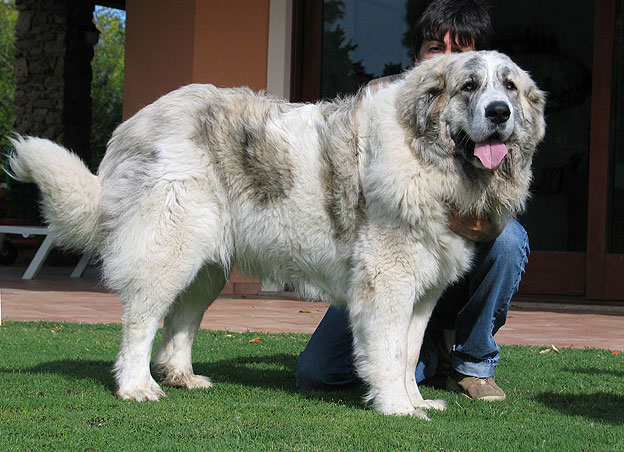
A giant, powerfully built dog. Males stand from around 77 cm at the shoulder and the breed commonly weighs in the region of 55 to 80 kg or more, with females clearly smaller than males. The build is heavy-boned and muscular but not as exaggerated or loose-skinned as some giant mastiffs. The coat is thick, medium-long and weather-resistant, with a dense undercoat. The base colour is white, usually with a well-defined mask and patches over the body in grey, black, tan, brindle, golden or similar, and ideally darker ears. The head is large with a slight stop, the expression calm and intelligent, and the tail is bushy and carried with an upward curl when the dog is alert.
Suitability
The Pyrenean Mastiff suits an experienced owner with a large property and secure fencing who understands and wants a livestock-guardian breed, whether as a working guardian or a calm rural family dog. It is not an apartment dog and not a sensible choice for first-time owners, given its size, independence, protective drive and tendency to bark. It is fairly tolerant of being left for moderate periods, as guardians are used to working alone, but it still wants to be near its family and territory rather than isolated. Heat is a real issue in the Australian climate: the dense double coat is built for cold mountains, so the dog needs shade, constant water, and exercise only in the cool of the day, and it should never be worked or left out in the heat.
Health
Pyrenean Mastiffs typically live around 10 to 12 years, which is fairly normal for a giant breed. As with most very large dogs, the joints are the main concern: hip dysplasia and elbow dysplasia are the key conditions, and breeding stock should be formally scored for both. Bloat (gastric dilatation-volvulus), a sudden, life-threatening twisting of the stomach, is a serious risk in deep-chested giants and owners should learn the warning signs and feeding precautions. The breed can also suffer eyelid faults such as entropion and ectropion (lids rolling in or out), which irritate the eye and may need surgery. Like all giants it is slow to mature and its growing joints should not be over-exercised as a pup. Buy from breeders who hip-score and elbow-score their dogs, check eyes, are open about longevity and bloat in their lines, and rear pups with sensible growth and exercise.
Find your Pyrenean Mastiff
Browse trusted Pyrenean Mastiff breeders across Australia and read genuine reviews from real owners, or take the quiz to be sure of the fit.