
Russian Black Terrier
Black Terrier, Chornyi Terrier, Tchiorny Terrier
The Russian Black Terrier is a large, powerful working breed created in the Soviet Union as a military guard dog, and despite the name it is not really a terrier but a robust, hardy guardian. It is confident, courageous and intensely loyal, calm and steady when well bred and well raised, but naturally protective and reserved with strangers. Big, strong and strong-willed, it needs an owner who can provide firm, fair leadership, structure and thorough socialisation from an early age. This is a working dog that wants daily exercise plus serious mental engagement and ideally a job, whether training, sport or protection work. The thick, coarse double coat is high-maintenance, needing regular brushing and clipping or hand-stripping to stay in order. The Russian Black Terrier suits experienced, committed owners with space and time, and is a poor choice for first-timers or anyone wanting an easy, low-effort dog.
Size
Large
Lifespan
10-14 years
Group
Group 6 - Utility
Height
Male: 68-76 cm (27-30 inches), Female: 66-74 cm (26-29 inches)
Weight
Male: 45-68 kg (100-150 lbs), Female: 36-54 kg (80-120 lbs)
Origin
Russia
Compatibility & care
How this breed fits into life with you
Scores are out of 5. Tap the help icon next to any trait to see what it really means.
Personality
How they think and behave
With family
Who they get along with
Care needs
What they ask of you
Origin & history
The Russian Black Terrier was developed at the state-run Red Star kennel near Moscow from the late 1940s, after the Second World War, to provide the Soviet military and security services with a large, hardy, biddable guard dog that could work in harsh climates. Breeders crossed a range of working breeds, with the Giant Schnauzer central to the project, alongside the Airedale Terrier, Rottweiler, Newfoundland and others, then selected hard for soundness, weatherproof coat, trainability and a confident guarding temperament. The result was first shown publicly in the 1950s and recognised as a distinct breed, and from the 1970s it spread beyond the Soviet Union as a companion and guardian. It is recognised by the ANKC in the Utility Group. Still a fairly uncommon breed in Australia, it is kept by enthusiasts who want a powerful, protective family dog and are prepared for its size and coat care.
Temperament
The Russian Black Terrier is calm, confident and deeply devoted to its family, with the strong protective and territorial instincts it was bred for, which makes early and ongoing socialisation essential. With its own people it is typically affectionate, steady and even-tempered, and when properly raised it can be reliable and gentle with the children of its household, though its size means supervision around small children is wise. It is naturally aloof and watchful with strangers and is a serious, effective guardian and deterrent. It can be assertive with unfamiliar dogs, particularly of the same sex, so good management and neutral introductions help. It is highly intelligent, biddable and keen to work with its handler, learning quickly and responding very well to firm, fair, reward-based training, while harsh methods damage trust. Its central needs are confident leadership, structure, daily exercise and genuine mental work to satisfy a clever, powerful working mind.
Appearance
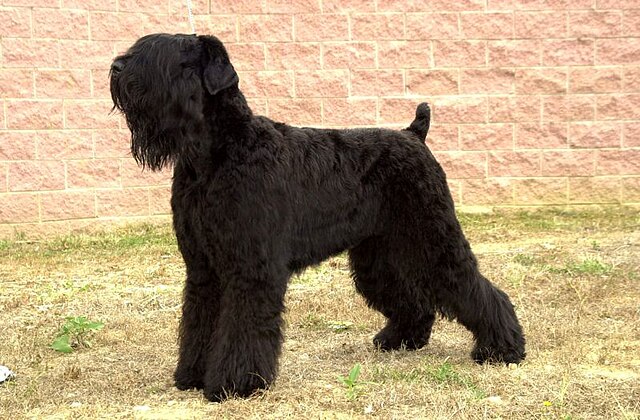
The Russian Black Terrier is a large, substantial, muscular dog, with males standing about 72 to 76 cm at the shoulder and females about 68 to 72 cm, and weight commonly around 36 to 60 kg depending on sex and build. It has a powerful head with a strong muzzle, accentuated by a beard and eyebrows, and a deep, broad, well-muscled body that conveys strength and endurance. The coat is a defining feature, a dense, coarse, slightly wavy double coat usually around 5 to 15 cm long, with a soft undercoat, designed to protect the dog in severe weather. Colour is black, or black with a scattering of grey hairs. Overall the breed looks imposing, athletic and weatherproof.
Suitability
This breed needs a house with a securely fenced yard and an experienced, confident owner who can commit real time to training, socialisation, exercise and coat care. It is not suited to apartment living, to first-time dog owners, or to people away for long hours, since a bored, under-stimulated guardian of this size can become difficult and over-protective. It bonds very closely with its family and wants to be with them, indoors and involved, rather than left alone outside. The thick double coat means the Russian Black Terrier feels the heat in the Australian climate, so it needs shade, fresh water and exercise during the cooler parts of the day in summer, and the coat must be kept well groomed and clipped to help it cope. Prospective owners should also be ready for the grooming costs and consider local council requirements for a large guarding breed.
Health
Russian Black Terriers generally live around 10 to 12 years. As a large, fast-growing breed they are predisposed to hip and elbow dysplasia, so hip and elbow scoring of breeding dogs is important. The eye condition seen most in the breed is hereditary, and includes progressive retinal atrophy as well as hyperuricosuria in some lines, both of which have DNA tests available, so ask which screening a breeder uses. Some lines carry heart disease, and as a deep-chested dog there is a risk of gastric dilatation-volvulus (bloat), a sudden emergency needing immediate veterinary care. Juvenile laryngeal paralysis and polyneuropathy has been reported in the breed, with research into DNA testing ongoing. Choose a breeder who hip and elbow scores, eye tests, and can discuss DNA testing and the longevity of their lines. Feeding to slow rapid puppy growth and keeping the adult lean helps protect those large joints.
Find your Russian Black Terrier
Browse trusted Russian Black Terrier breeders across Australia and read genuine reviews from real owners, or take the quiz to be sure of the fit.