
Sussex Spaniel
NULL
The Sussex Spaniel is a low-set, solidly built gundog with an unhurried, good-humoured manner. It is one of the calmer spaniels, affectionate and steady at home, and it tends to attach closely to its family rather than being everyone's friend. It enjoys a sniffy walk and some pottering outdoors but is not a frantic dog, and many have a stubborn, comical streak. It suits owners who want a gentle, fairly relaxed companion with sporting roots and do not mind a dog that can be slow to do things on its own terms. It does not suit someone wanting a quick, biddable performer or a jogging partner. The coat needs regular brushing and the long ears need routine cleaning to stay healthy.
Size
Medium
Lifespan
10-12 years
Group
Group 3 - Gundogs
Height
Male: 33-38 cm (13-15 inches), Female: 30-35 cm (12-14 inches)
Weight
Male: 16-20 kg (35-45 lbs), Female: 14-18 kg (30-40 lbs)
Origin
United Kingdom
Compatibility & care
How this breed fits into life with you
Scores are out of 5. Tap the help icon next to any trait to see what it really means.
Personality
How they think and behave
With family
Who they get along with
Care needs
What they ask of you
Origin & history
The Sussex Spaniel takes its name from the county of Sussex in southern England, where it was developed from the late 18th century. It was bred to flush and retrieve game for hunters working on foot through dense, heavy cover, and its low, sturdy build and steady pace suited that close work. Unusually for a spaniel it was prized for giving tongue, barking on scent so the gun could follow it in thick undergrowth. It was one of the original breeds recognised by the English Kennel Club in 1873. The breed has always been scarce and came close to disappearing more than once, most critically during the Second World War, after which it was rebuilt from a very small number of dogs. It remains rare worldwide, including in Australia, and is mostly kept by dedicated enthusiasts.
Temperament
At home the Sussex Spaniel is affectionate, mellow and devoted, generally excellent with children and content to be part of family life. It is often reserved or quietly polite with strangers rather than effusive, and it will usually give a bark at the door, which makes it a mild watchdog without being a guard. With other dogs and household pets it is normally sociable and easygoing, helped by its sporting background. It is intelligent but independent and famously stubborn, so training calls for patience, consistency and plenty of motivation; harsh methods get you nowhere with this breed. Some individuals are quite vocal. It is a sensitive, companionable dog that wants to be near its people and can sulk or fret if it feels left out.
Appearance
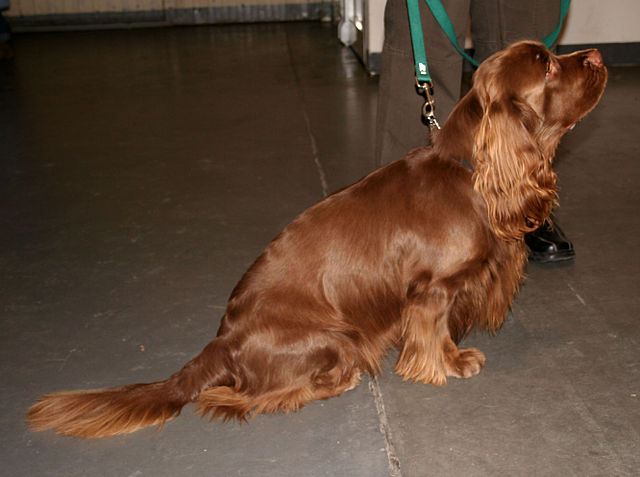
A long, low and substantial spaniel, more heavily boned than it first appears. Height is roughly 38 to 41 cm at the shoulder with weight usually around 18 to 23 kg, so it is short but quite weighty. The body is longer than it is tall, with a deep chest and a rolling gait. The hallmark is the coat colour, a rich golden liver found in no other breed, with an abundant, flat or slightly wavy coat and good feathering on the legs, ears and tail. The head is broad with a frowning but kindly expression, hazel eyes and long, low-set lobular ears.
Suitability
The Sussex Spaniel fits a range of homes, from a house with a yard to a roomy unit, as long as it gets daily walks and company. It suits fairly relaxed owners who appreciate a steady, affectionate dog and are not in a hurry, and its gentle nature makes it reasonable for considered first-time owners. It is a real family dog and does not enjoy long stretches alone, so a household that is out all day is a poor fit. The full, fairly heavy coat means it feels the heat, so in the Australian summer keep exercise to the cooler hours, provide shade and water, watch for overheating, and check the ears regularly since humidity encourages infection.
Health
Typical lifespan is around 11 to 13 years. As a long-backed, heavy-eared breed it has some predictable issues: intervertebral disc problems linked to the long spine, ear infections (otitis externa) because of the heavy hanging ears, and hip dysplasia. Eye conditions including cataracts and retinal disease occur, and the breed carries an inherited condition called pyruvate kinase deficiency that has a DNA test. Buy from a breeder who hip scores, has eyes examined, and uses the available DNA test where relevant, and who can talk honestly about the small gene pool. Keep the dog lean and discourage repeated jumping to protect the back, and get into a routine of checking and cleaning the ears, since the heavy flap traps moisture and debris.
Find your Sussex Spaniel
Browse trusted Sussex Spaniel breeders across Australia and read genuine reviews from real owners, or take the quiz to be sure of the fit.