
Tenterfield Terrier
Miniature Fox Terrier (Tenterfield)
The Tenterfield Terrier is a small, smart, energetic Australian terrier, closely related to the Miniature Fox Terrier and developed as a working ratter on farms. It is confident, lively and affectionate, devoted to its family and far tougher than its size suggests. Like most terriers it is busy, bold and quick-witted, with real prey drive and a fondness for digging and barking if it gets bored. It suits an active owner or family who will give it daily exercise, play and training, and who appreciates a plucky, characterful little dog. It is not the right choice for someone wanting a placid lapdog, or a home that cannot handle terrier energy and noise. The short, smooth coat is very low-maintenance, needing only an occasional brush.
Size
Small
Lifespan
12-14 years
Group
Group 2 - Terriers
Height
Male: 20-30 cm (8-12 inches), Female: 20-30 cm (8-12 inches)
Weight
Male: 4.5-7 kg (10-15 lbs), Female: 3.6-5.4 kg (8-12 lbs)
Origin
Australia
Compatibility & care
How this breed fits into life with you
Scores are out of 5. Tap the help icon next to any trait to see what it really means.
Personality
How they think and behave
With family
Who they get along with
Care needs
What they ask of you
Origin & history
The Tenterfield Terrier is a genuinely Australian breed, descended from small working terriers, including the Miniature Fox Terrier, brought out by British settlers in the 19th century. Compact, fast and fearless, these little dogs earned their keep on farms and stations across the country by killing rats, mice and other vermin, and were valued as handy, no-nonsense workers. The name honours the town of Tenterfield in northern New South Wales and the district associated with the type, and the breed was christened the Tenterfield Terrier in the 1990s when Australian enthusiasts set out to formalise and preserve it under its own name. It is recognised by the Australian National Kennel Council. It remains far better known at home than overseas, kept both as a capable vermin hunter and, increasingly, as a family companion.
Temperament
The Tenterfield Terrier is friendly, outgoing and strongly bonded to its family, and it is generally good with children, suiting active kids who can match its energy and handle it gently. It is alert and makes a sharp watchdog, quick to bark at anything unusual, and it can be a little reserved with strangers at first before warming up. With other dogs it is usually sociable, though terrier boldness means it will not back down if challenged, and care is wise around much larger dogs. Its prey drive is the main thing to manage with other pets: small scurrying animals can trigger a chase, and cats are best introduced early. It is intelligent and trainable and enjoys learning, responding well to upbeat, reward-based methods, but it has an independent terrier streak and will test a soft owner. It needs company and activity, and a bored Tenterfield will bark and dig.
Appearance
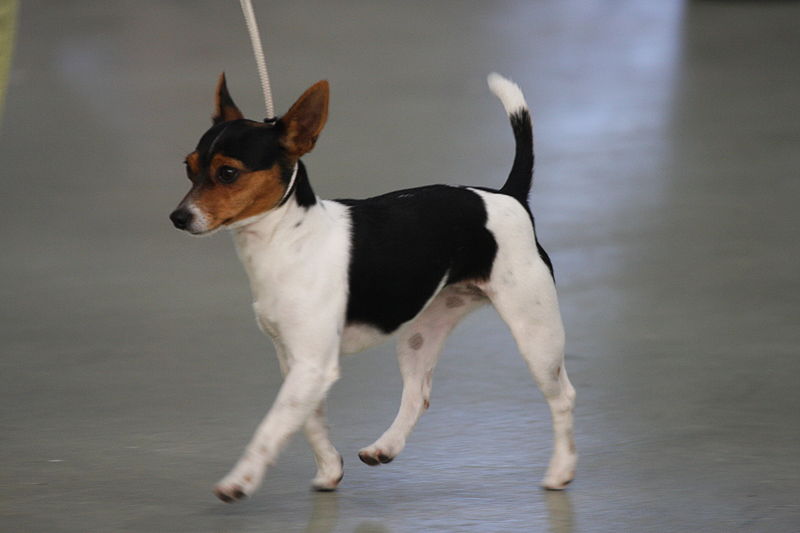
A small, neat, well-balanced terrier built for agility rather than bulk. Height is roughly 25 to 30 cm at the shoulder, with weight usually around 4 to 6 kg. The body is square to slightly long, lean and athletic, with a flat skull, a moderate muzzle and a keen, alert expression. The coat is short, smooth and close, lying flat to the body. The dogs are predominantly white, marked with black, tan, liver or a combination, commonly with coloured patches over the head and ears and a white body. The eyes are oval and dark and the ears are V-shaped, carried pricked or with the tips dropping forward.
Suitability
This breed adapts well to houses or apartments as long as it gets daily exercise, play and mental stimulation, and a secure yard or lead is important given its chase instinct and digging. It suits active owners and families who enjoy a busy, interactive small dog, and it can work for first-time owners who are ready for terrier energy, prey drive and a tendency to bark. It is people-focused and does not like being left alone all day. Being a short-coated dog it handles the Australian climate reasonably, but it still feels extremes, so provide shade and water and avoid the hottest part of the day in summer, and offer warmth and a cosy bed in cold weather since there is little coat for insulation.
Health
Typical lifespan is around 12 to 15 years and the Tenterfield Terrier is generally a sound, hardy little breed. The most relevant predispositions are patellar luxation, where the kneecap slips out of place, and the inherited eye condition primary lens luxation, which can cause pain and blindness and has a DNA test available in the breed. Some lines may also show other eye faults and the occasional joint issue. Buy from a breeder who screens for patellar luxation, has eyes examined, and uses the DNA test for primary lens luxation so they can avoid producing affected pups. Keep the dog at a healthy weight to ease the knees, and as a small active terrier give it sensible exercise and dental care, since small breeds are prone to tartar build-up.
Find your Tenterfield Terrier
Browse trusted Tenterfield Terrier breeders across Australia and read genuine reviews from real owners, or take the quiz to be sure of the fit.