
Tornjak
Bosnian-Herzegovinian and Croatian Shepherd Dog, Croatian Mountain Dog
The Tornjak is a large livestock-guardian dog from the mountains of Bosnia and Herzegovina and Croatia, bred to live with flocks and see off wolves and bears. It is calm, steady and self-reliant, with the deep family loyalty and natural wariness of strangers that define good guardian breeds. Unlike some flock-guarding types it has a reputation for being relatively even-tempered and manageable, but it is still a powerful, independent-minded dog that needs experienced, confident handling. Exercise needs are moderate rather than extreme. A Tornjak wants space, a job to do and room to patrol more than it wants formal runs. It suits rural or semi-rural homes and owners who understand guardian breeds, and it is not a good fit for apartments or for first-time owners. The coat is a long, thick double coat, heaviest around the neck and on the hindquarters, that needs regular brushing and sheds heavily once or twice a year. A composed, watchful presence is its defining trait.
Size
Large
Lifespan
9-12 years
Group
Group 6 - Utility
Height
Male: 64-80 cm (25-31 inches), Female: 59-74 cm (23-29 inches)
Weight
Male: 40-60 kg (88-132 lbs), Female: 35-50 kg (77-110 lbs)
Origin
Bosnia and Herzegovina, Croatia
Compatibility & care
How this breed fits into life with you
Scores are out of 5. Tap the help icon next to any trait to see what it really means.
Personality
How they think and behave
With family
Who they get along with
Care needs
What they ask of you
Origin & history
The Tornjak is an old Balkan livestock-guardian breed whose name comes from the local word tor, meaning a sheep pen or enclosure. For centuries it lived alongside shepherds in the mountains of Bosnia and Herzegovina and Croatia, guarding sheep and cattle from wolves and bears and weathering hard mountain winters thanks to its dense coat. The type nearly disappeared in the twentieth century, and from the 1970s onward dedicated breeders in the region worked to locate authentic working dogs and rebuild the breed to a written standard. It is recognised internationally by the FCI as a Bosnian and Herzegovinian and Croatian breed. In Australia the Tornjak is rare and known mainly to livestock-guardian enthusiasts and a small number of dedicated owners, so anyone seeking one will need to research carefully and be prepared to deal with specialist breeders.
Temperament
Tornjaks are calm, confident and devoted to their families, and within the home they are typically gentle and good with children they have been raised alongside. They get on with other household animals, especially the stock or pets they have grown up to protect, which is the whole point of a guardian breed. With strangers they are reserved and watchful, sizing up newcomers before accepting them, and they will act decisively if they judge their family or flock to be threatened. Trainability is reasonable for a guardian breed, helped by the Tornjak's steadier temperament, but it remains an independent thinker that guards on its own initiative rather than waiting for instructions, so early socialisation and consistent, fair leadership are essential. The watchdog instinct is strong and serious. The key behavioural needs are a clear role, secure boundaries, and an owner who respects the breed's guarding nature instead of trying to suppress it.
Appearance
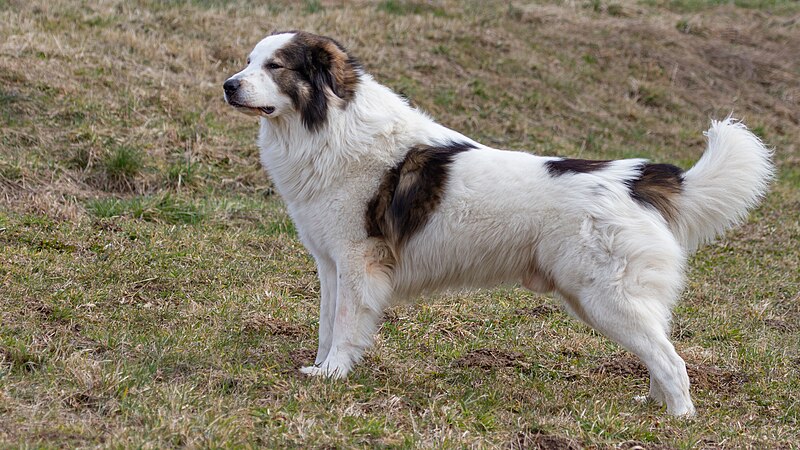
A large, strongly built but not ponderous dog, standing roughly 60 to 70 cm at the shoulder, with males clearly taller and heavier than females and adults commonly weighing around 35 to 50 kg. The frame is squarish and well proportioned, powerful without being bulky, which gives the breed an agile, sound-moving gait for its size. The coat is long, thick and weatherproof, with a profuse undercoat and a longer outer coat that forms a pronounced mane around the neck and feathering on the legs and tail. The most common colouring is a base of white broken by patches of another colour such as black, tan, red or grey, and a wide range of markings is accepted. The tail is bushy and carried high when the dog is alert.
Suitability
This breed belongs on a property with room to move and a securely fenced area, ideally with livestock or at least a genuine guarding role, and it needs an owner who has kept large, independent dogs before. It is unsuited to apartment life, to first-time owners, and to homes with close neighbours who would object to a big barking guardian. Tornjaks tolerate being outdoors and alone better than many companion breeds because they are bred to work independently, but they still need to feel part of their family and territory. The thick double coat is built for cold mountains, so in Australian conditions they need ample shade, constant water and relief from extreme summer heat, and they are far better suited to cooler and southern regions than to the hot, humid north.
Health
The Tornjak is generally a hardy, naturally bred working dog with a typical lifespan of around 11 to 14 years, good for a dog of its size. Because it has not been heavily over-bred, it does not carry a long list of breed-specific conditions, but it shares the concerns common to all large and giant breeds. Hip and elbow dysplasia are the main ones, so look for breeding dogs with hip and elbow scores from a recognised scheme. As with any big, deep-chested dog, owners should be aware of the risk of bloat (gastric torsion) and manage feeding and exercise accordingly. Routine eye examination of breeding stock is sensible, and general joint health matters during the long growth period of a large pup. Given the breed's rarity, choose a breeder who health-tests hips and elbows and is open about the health and longevity of their lines rather than relying on the breed's robust reputation alone.
Find your Tornjak
Browse trusted Tornjak breeders across Australia and read genuine reviews from real owners, or take the quiz to be sure of the fit.